Charleston to Austin
Austin → CharlestonFTL freight transportation service between Charleston and Austin. Reliable logistics solutions for your business.
Route Description
Everything you need to know about the corridor Charleston - Austin
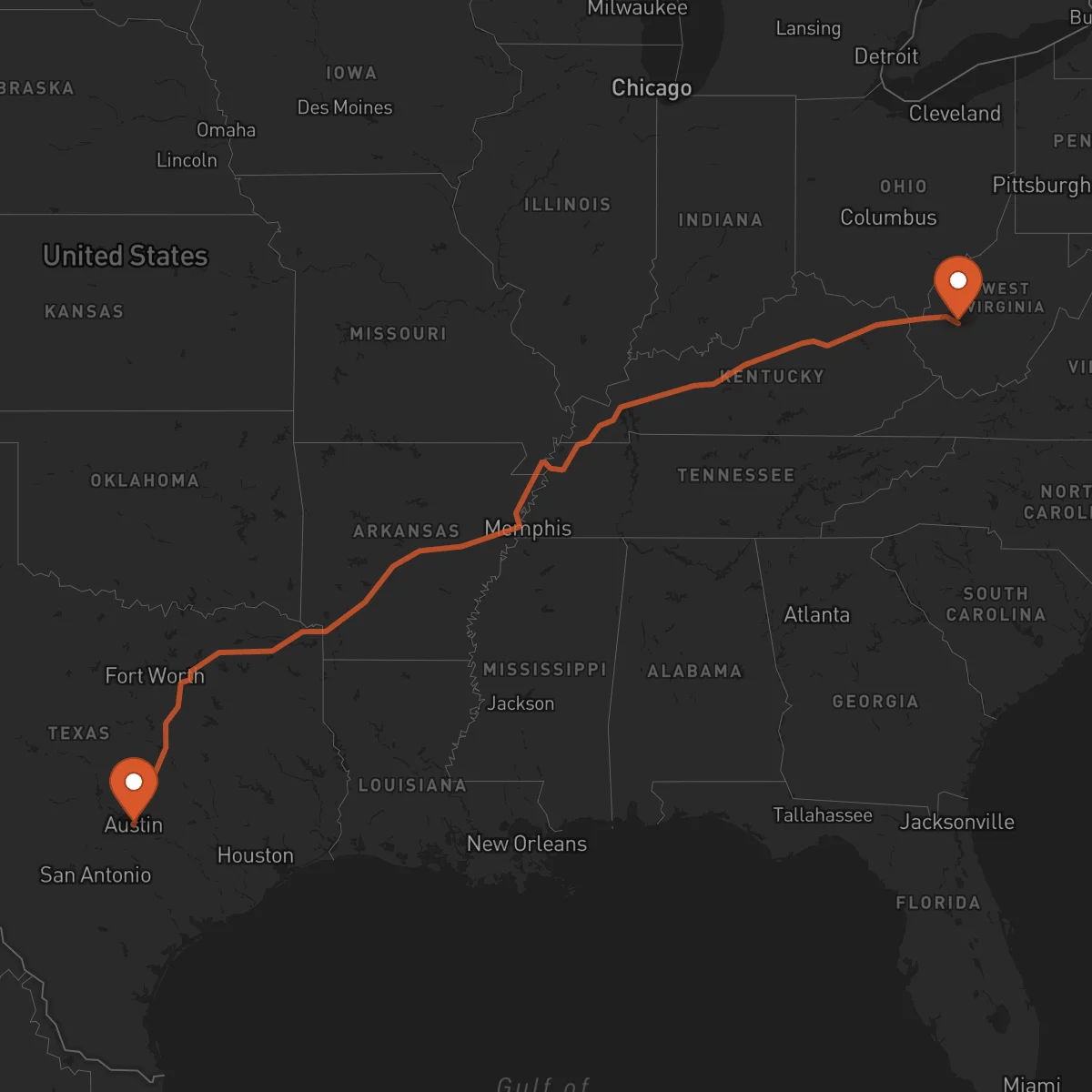
The logistics corridor connecting Charleston, West Virginia to Austin, Texas represents a vital transportation link spanning approximately 1,727 kilometers across the heart of the United States. This east-west route traverses diverse geographical regions and connects two distinct economic centers, facilitating the movement of goods between the Appalachian region and the dynamic Texas capital. The corridor serves as a critical supply chain artery for industries requiring reliable full truckload (FTL) transportation services.
The economic significance of this corridor is underscored by the complementary industrial landscapes of both endpoints. Charleston anchors a region with strong manufacturing, energy, and chemical processing sectors, while Austin has emerged as a technology and innovation hub with growing demands for industrial supplies and equipment. This creates a balanced flow of goods moving in both directions, from raw materials and industrial products outbound from West Virginia to technology components, specialized equipment, and consumer goods inbound to Texas.
Transportation infrastructure along this corridor relies primarily on major interstate highways including I-64, I-70, I-35, and I-40, providing multiple routing options for freight carriers. The route passes through key logistics hubs in cities such as Nashville, St. Louis, and Dallas, offering opportunities for strategic distribution and efficient cross-docking operations. Control Terrestre leverages this infrastructure to provide dedicated FTL services, ensuring that cargo moves efficiently without the delays associated with consolidated freight operations.
Control Terrestre facilitates seamless operations on this corridor through our network of certified transportation providers. Our expertise in full truckload services means that shipments move directly from origin to destination without intermediate handling, reducing transit times and minimizing the risk of damage or loss. We coordinate with our providers to optimize routing, manage capacity, and ensure compliance with all regulatory requirements across multiple state jurisdictions, providing our clients with reliable door-to-door transportation solutions.
Services for this Route
Available services for the corridor Charleston - Austin
 Origin
Charleston
Charleston, West Virginia serves as a strategic logistics hub in the Appalachian region, offering access to a network of highways including I-64 and I-77 that connect to major eastern markets. The city's location along the Kanawha River historically established it as a transportation center, and this legacy continues with modern freight infrastructure supporting efficient cargo movement. Charleston benefits from proximity to industrial centers in Ohio, Pennsylvania, and Virginia, making it an ideal origin point for regional distribution operations.
The local economy is anchored by energy production, chemical manufacturing, and healthcare sectors, with West Virginia's natural resources driving significant freight activity. The Charleston area hosts several industrial parks and warehousing facilities that support just-in-time inventory management for manufacturers. Transportation infrastructure includes the Yeager Airport for air freight connections and the Port of Huntington-Tristate for barge transportation, providing multimodal options that complement our ground transportation services.
 Destination
Austin
Austin, Texas has established itself as a strategic logistics destination in the southern United States, with its location providing access to major transportation corridors including I-35, which runs north-south through the heart of Texas. The city's rapid growth has been accompanied by significant investments in transportation infrastructure, including expansions to major highways and the development of logistics parks on the city's periphery. Austin's central Texas location offers excellent connectivity to both coastal ports and inland markets.
The Austin metropolitan area has evolved into a technology and manufacturing powerhouse, with companies in semiconductor production, computer hardware, and advanced manufacturing creating substantial freight demand. The presence of major tech companies has also spurred growth in supporting industries including specialized equipment manufacturing and logistics services. Austin-Bergstrom International Airport provides air cargo capabilities, while the city's expanding network of warehousing and distribution centers supports the sophisticated supply chain needs of its diverse industrial base.










