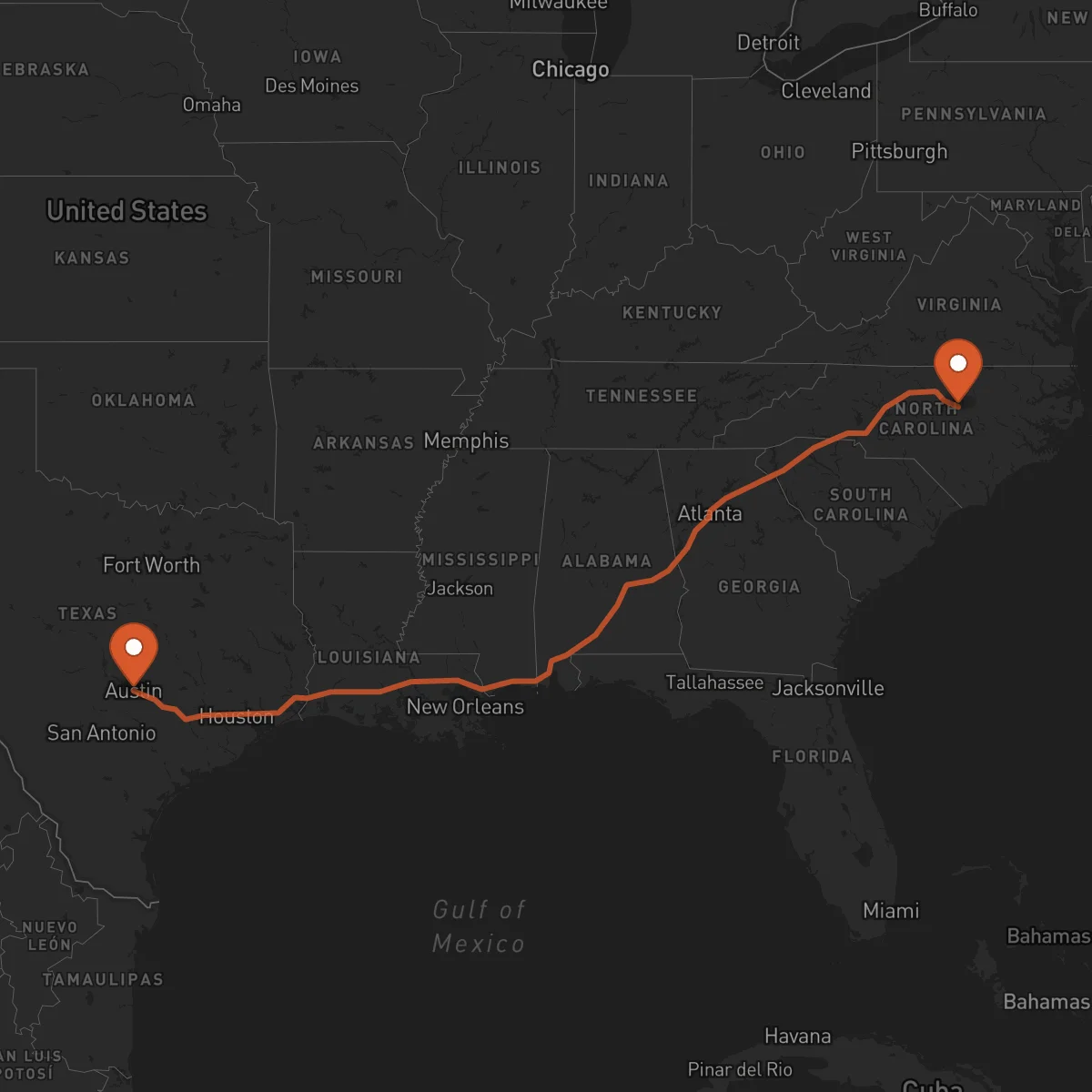
Austin to Raleigh
Raleigh → AustinFTL freight transportation service between Austin and Raleigh. Reliable logistics solutions for your business.
Route Description
Everything you need to know about the corridor Austin - Raleigh
The Austin-Raleigh corridor represents a vital freight transportation link connecting the thriving technology and innovation hub of Texas with the emerging research and manufacturing center of North Carolina. This 1880 km domestic route traverses diverse terrain and crosses multiple state lines, facilitating the movement of goods between two dynamic economic regions of the United States.
The corridor passes through key industrial areas including Dallas-Fort Worth, Little Rock, Memphis, and Nashville, providing access to major distribution networks and manufacturing centers. This strategic positioning allows for efficient freight movement between the Southwest and Southeast regions, supporting the growing demand for cross-country logistics solutions.
Major industries utilizing this corridor include technology and electronics from Austin's Silicon Hills, automotive manufacturing from both regions, pharmaceuticals and biotechnology from the Research Triangle area, and agricultural products from Texas farms. The route also serves the construction materials, consumer goods, and industrial equipment sectors, making it a versatile freight artery.
The primary transportation infrastructure consists of Interstate 35 from Austin to Dallas, I-30 to Little Rock, I-40 through Memphis and Nashville, and finally I-40 to Raleigh. This interstate network provides reliable, high-capacity freight movement with multiple alternate routes for flexibility. Control Terrestre leverages this infrastructure through our network of certified carriers, offering dedicated FTL services that ensure your cargo moves efficiently and securely between these strategic locations.
Services for this Route
Available services for the corridor Austin - Raleigh
 Origin
Austin
Austin, Texas serves as a strategic logistics hub in the heart of the Southwest, combining technology innovation with robust transportation infrastructure. Located in Central Texas, Austin benefits from its position at the intersection of major freight corridors connecting the Mexican border to the northern United States. The city's economic landscape is dominated by technology companies, semiconductor manufacturing, and a growing creative sector, creating substantial freight demand for both imports and exports.
The transportation infrastructure in Austin includes multiple interstate highways (I-35, I-45, I-10), a major international airport, and rail connections through Union Pacific. The Port of Houston, located approximately 200 km away, provides ocean freight access for international shipments. Austin's logistics ecosystem is further strengthened by its proximity to major distribution centers and manufacturing facilities throughout Texas, making it an ideal origin point for freight moving to eastern and southeastern destinations.
 Destination
Raleigh
Raleigh, North Carolina occupies a strategic position in the Southeast as part of the Research Triangle, a region renowned for its concentration of universities, research institutions, and technology companies. The city's location provides excellent access to major East Coast markets within a day's drive, including Washington D.C., Atlanta, and Charlotte. Raleigh's economy is characterized by research and development, biotechnology, information technology, and a growing manufacturing sector, particularly in pharmaceuticals and advanced materials.
The transportation infrastructure supporting Raleigh includes Interstate 40, which connects the city to major freight routes across the country, and Interstate 440 for local distribution. Raleigh-Durham International Airport provides air cargo services, while rail connections through Norfolk Southern and CSX support intermodal transportation. The Port of Wilmington, approximately 200 km away, offers ocean freight capabilities for international trade. This comprehensive infrastructure network makes Raleigh an efficient destination for freight arriving from western and southwestern regions of the United States.










