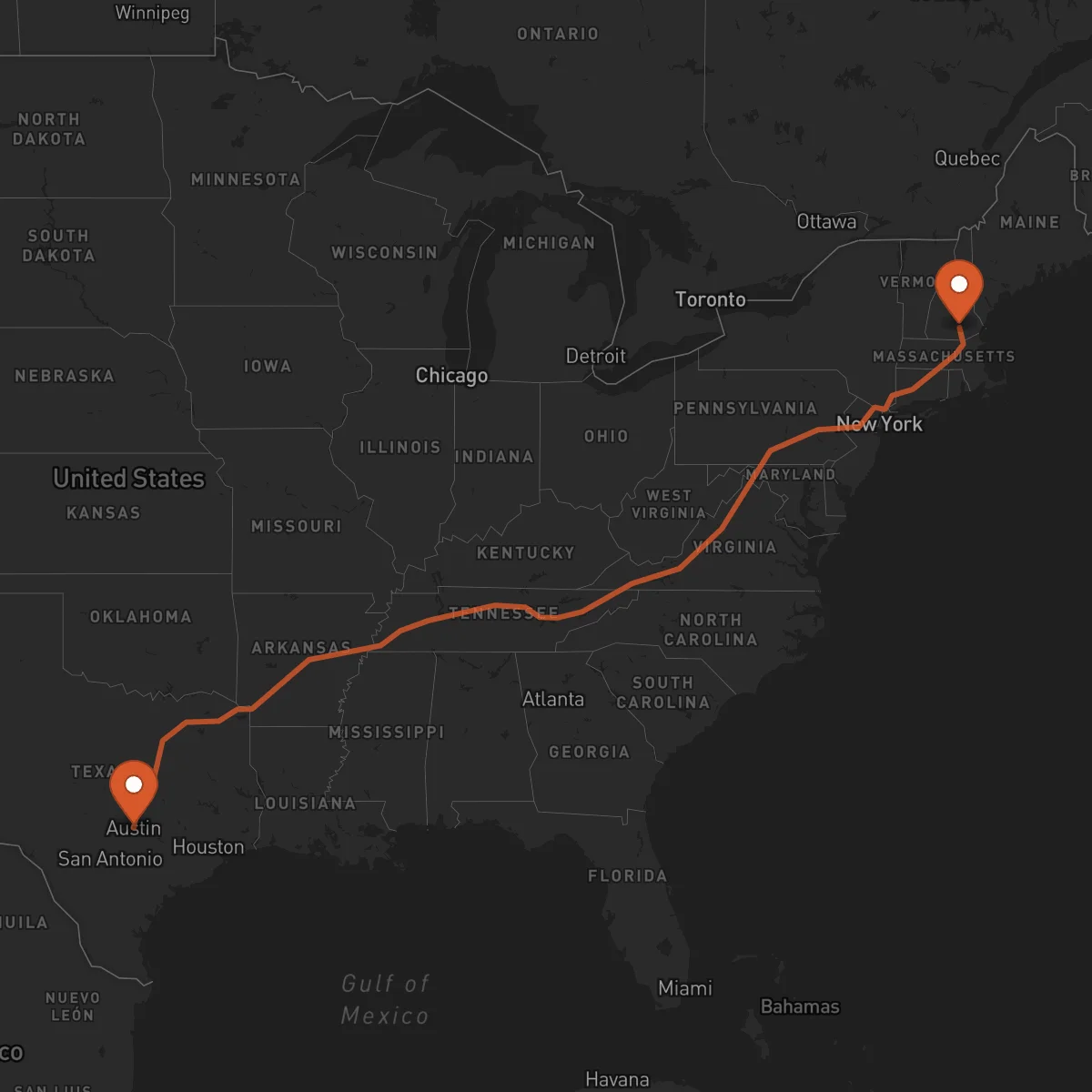
Austin to Manchester
Manchester → AustinFTL freight transportation service between Austin and Manchester. Reliable logistics solutions for your business.
Route Description
Everything you need to know about the corridor Austin - Manchester
The Austin to Manchester corridor represents a vital freight transportation route connecting the dynamic economic center of Texas with the industrial hub of New England. This 2,722 km domestic corridor traverses diverse terrain and crosses multiple state lines, requiring expert logistics coordination to ensure efficient cargo movement. The route connects the technology-driven economy of Central Texas with the manufacturing and distribution centers of the Northeast, facilitating critical supply chain operations between these two distinct economic regions.
The corridor passes through major metropolitan areas including Dallas, St. Louis, Indianapolis, and Boston, utilizing key interstate highways such as I-35, I-70, I-76, and I-93. This strategic pathway enables seamless transportation of goods between the Southern United States and New England, supporting industries ranging from technology and automotive to healthcare and consumer goods. The route's infrastructure includes modern highways, truck stops, and logistics facilities strategically positioned to support heavy freight traffic.
Control Terrestre specializes in managing this complex corridor with our dedicated FTL (Full Truckload) services. Our experienced network of carriers and strategic partnerships ensure reliable transportation of your cargo, whether you need standard dry van services or specialized equipment for temperature-sensitive or oversized freight. We understand the unique challenges of this route, including varying weather conditions, regulatory requirements across state lines, and the need for precise scheduling to meet delivery deadlines.
Services for this Route
Available services for the corridor Austin - Manchester
 Origin
Austin
Austin serves as a strategic logistics hub in Central Texas, positioned at the intersection of major transportation networks. The city's location along I-35 provides direct access to both Mexico and the northern United States, making it an ideal origin point for freight distribution. Austin's growing infrastructure includes Austin-Bergstrom International Airport, multiple rail connections, and extensive highway systems that facilitate efficient cargo movement. The city's central location within Texas allows for quick distribution to major markets throughout the state and beyond.
The Austin metropolitan area is home to a diverse economic landscape dominated by technology, healthcare, and manufacturing sectors. The region hosts numerous tech companies, research institutions, and automotive manufacturers, creating consistent demand for freight transportation services. Austin's economic growth has been driven by its skilled workforce, business-friendly environment, and strategic location, making it a crucial origin point for various types of cargo including electronics, medical equipment, automotive parts, and industrial machinery.
 Destination
Manchester
Manchester, New Hampshire, serves as a strategic logistics gateway to New England, offering excellent access to major Northeast markets including Boston, New York, and Montreal. The city's location along I-93 provides direct connections to the region's extensive transportation network, while Manchester-Boston Regional Airport supports air cargo operations. Manchester's infrastructure includes modern warehousing facilities, distribution centers, and intermodal yards that facilitate efficient freight handling and distribution throughout the Northeast corridor.
The Manchester area has evolved into a significant economic center with strong manufacturing, healthcare, and technology sectors. The region's industrial base includes advanced manufacturing, biomedical research, and financial services, creating diverse freight transportation needs. Manchester's proximity to Boston and other major New England cities makes it an ideal distribution point for companies serving the Northeast market, while its lower operational costs compared to larger metropolitan areas attract businesses seeking efficient logistics solutions.










