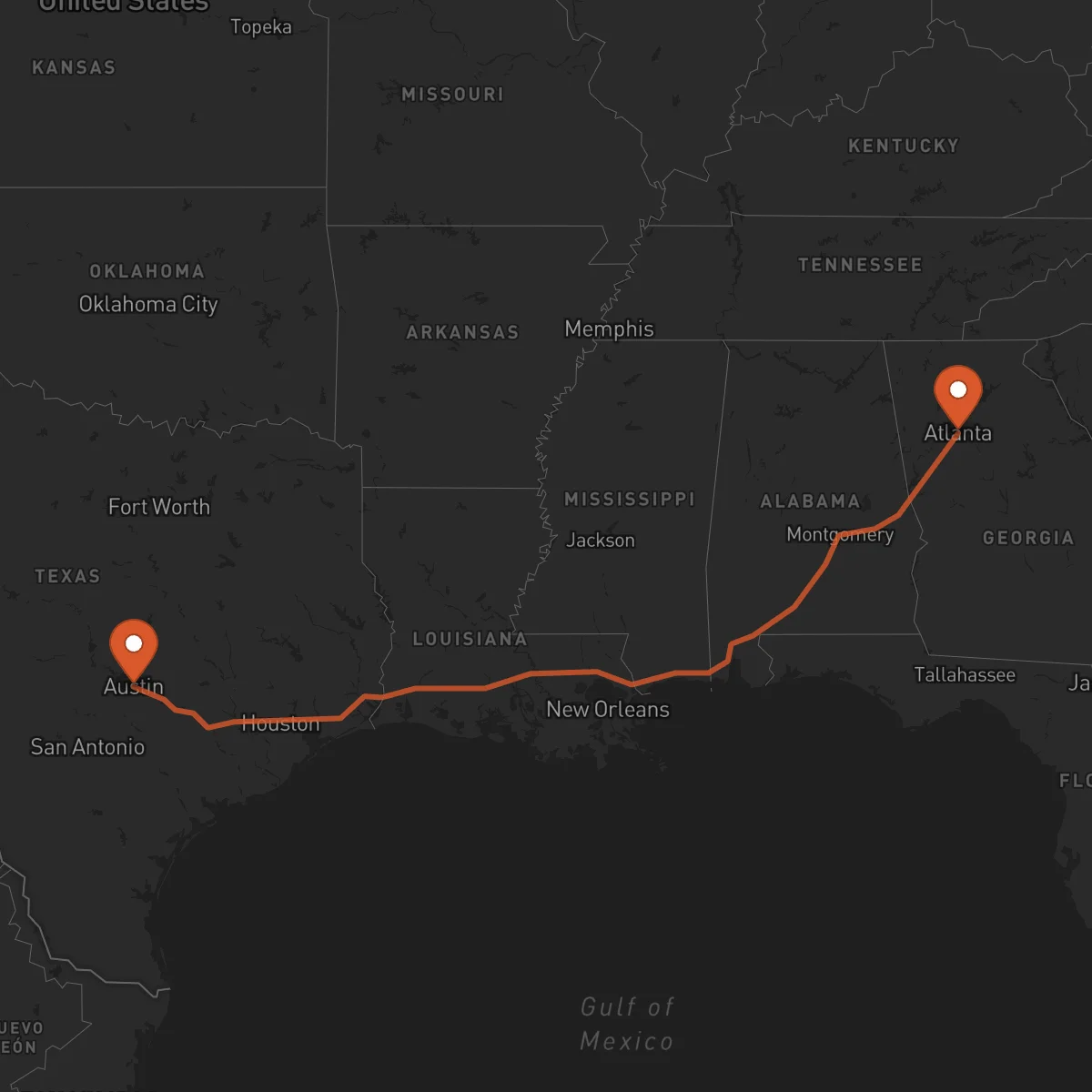
Austin to Atlanta
Atlanta → AustinFTL freight transportation service between Austin and Atlanta. Reliable logistics solutions for your business.
Route Description
Everything you need to know about the corridor Austin - Atlanta
The Austin-Atlanta corridor represents one of the most strategic freight routes in the southeastern United States, connecting Texas's booming technology hub with Georgia's major commercial center. This 1316-kilometer route traverses diverse landscapes and economic regions, facilitating the movement of goods between two of America's fastest-growing metropolitan areas. The corridor serves as a vital link in the supply chain for numerous industries, enabling businesses to efficiently transport goods across state lines.
The economic significance of this route cannot be overstated. Austin has emerged as a major technology and innovation center, while Atlanta serves as a crucial logistics hub for the Southeast. The corridor supports the movement of high-value technology products, automotive components, consumer goods, and industrial equipment. Major highways including I-20 and I-85 form the backbone of this transportation route, providing reliable and efficient passage for freight carriers.
Control Terrestre specializes in providing dedicated full truckload (FTL) services along this corridor, ensuring your cargo receives exclusive use of the trailer throughout its journey. Our strategic alliance with certified transportation providers allows us to offer consistent, reliable service with real-time tracking capabilities. We understand the time-sensitive nature of shipments between these dynamic markets and have optimized our operations to meet the demanding schedules of businesses operating in both Austin and Atlanta.
Services for this Route
Available services for the corridor Austin - Atlanta
 Origin
Austin
Austin, Texas, has established itself as a major logistics and economic powerhouse in the southwestern United States. The city's strategic location in Central Texas provides excellent connectivity to major markets throughout the region, with proximity to Interstates 35, 10, and 20 facilitating efficient freight movement. Austin's booming technology sector, often referred to as 'Silicon Hills,' drives significant freight demand, particularly for high-value electronics and specialized equipment. The city's diverse economy also encompasses healthcare, education, government services, and manufacturing, creating a robust and varied freight market that requires reliable transportation solutions.
 Destination
Atlanta
Atlanta, Georgia, stands as one of the most important logistics hubs in the southeastern United States, offering unparalleled connectivity and infrastructure. The city's Hartsfield-Jackson International Airport, one of the world's busiest, complements its extensive ground transportation network, including major interstates I-20, I-75, and I-85. Atlanta's strategic location allows for efficient distribution throughout the Southeast, with access to over 80% of the U.S. population within a two-hour flight radius. The metropolitan area's diverse economy spans logistics, professional services, media operations, and information technology, generating substantial freight demand across multiple sectors and creating a dynamic market for full truckload transportation services.










