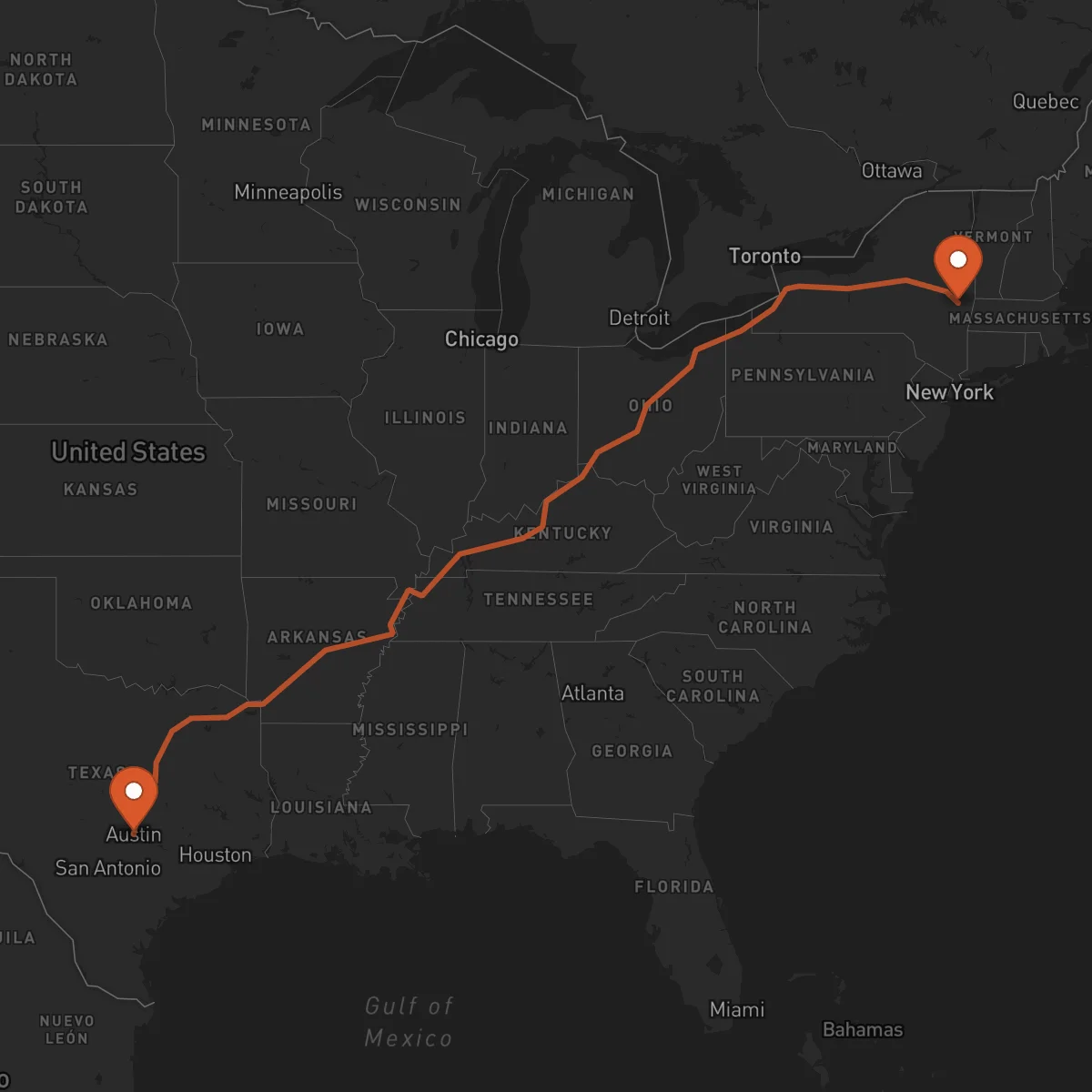
Austin to Albany
Albany → AustinFTL freight transportation service between Austin and Albany. Reliable logistics solutions for your business.
Route Description
Everything you need to know about the corridor Austin - Albany
The Austin to Albany corridor represents a vital domestic transportation link connecting the heart of Texas with New York's capital region. This 2,535-kilometer route traverses diverse landscapes and crosses multiple states, serving as a crucial artery for freight movement between the South and Northeast. The corridor's strategic importance lies in its ability to bridge major economic centers, facilitating the flow of goods from the growing tech and manufacturing hubs of Texas to the established industrial and commercial markets of the Northeast.
This route connects two dynamic economic regions. Austin, known as a technology and innovation powerhouse, generates significant freight volume from its electronics, aerospace, and advanced manufacturing sectors. Albany serves as a distribution gateway to the Northeastern United States, with strong presence in government services, education, and healthcare industries. The corridor supports industries including technology hardware, automotive parts, industrial equipment, and consumer goods, with many companies relying on reliable transportation to maintain their supply chains.
The primary transportation infrastructure along this corridor includes major interstate highways such as I-35, I-40, I-81, and I-87. These well-maintained routes provide efficient north-south and east-west connectivity, with multiple alternate paths to accommodate varying freight volumes and delivery requirements. Control Terrestre leverages this robust infrastructure to provide seamless FTL transportation services, ensuring your cargo moves efficiently from origin to destination with minimal handling and maximum security.
Services for this Route
Available services for the corridor Austin - Albany
 Origin
Austin
Austin serves as a strategic logistics hub in central Texas, benefiting from its location at the intersection of major transportation routes. The city's position along I-35 provides direct access to both Mexico and Canada, while its proximity to major Texas ports and airports enhances its connectivity. Austin's transportation infrastructure includes the Austin-Bergstrom International Airport, extensive highway networks, and growing rail connections, making it an ideal origin point for nationwide freight distribution.
The city's economy is driven by technology, manufacturing, and creative industries. As home to numerous tech companies and startups, Austin generates substantial freight volume in electronics, computer components, and specialized equipment. The region's advanced manufacturing sector produces automotive parts, aerospace components, and industrial machinery. Additionally, Austin's food and beverage industry, including craft breweries and specialty food producers, contributes to the diverse freight mix moving through the region.
 Destination
Albany
Albany's strategic location in upstate New York positions it as a key distribution center for the Northeastern United States. Situated at the confluence of the Hudson River and major interstate highways, Albany provides excellent access to New York City, Boston, and other major Northeastern markets. The city's transportation infrastructure includes the Port of Albany, multiple interstate highways (I-90, I-87), and rail connections, facilitating efficient freight movement throughout the region.
The Albany area's economy encompasses government services, healthcare, education, and advanced manufacturing. As New York's state capital, it generates consistent freight demand in office supplies, technology equipment, and professional services materials. The region's manufacturing sector produces specialized machinery, medical devices, and precision instruments. Albany's role as a distribution hub for the Northeast means it handles significant volumes of consumer goods, retail products, and industrial supplies destined for the broader region.










