Tucson to Little Rock
Little Rock → TucsonFTL freight transportation service between Tucson and Little Rock. Reliable logistics solutions for your business.
Route Description
Everything you need to know about the corridor Tucson - Little Rock
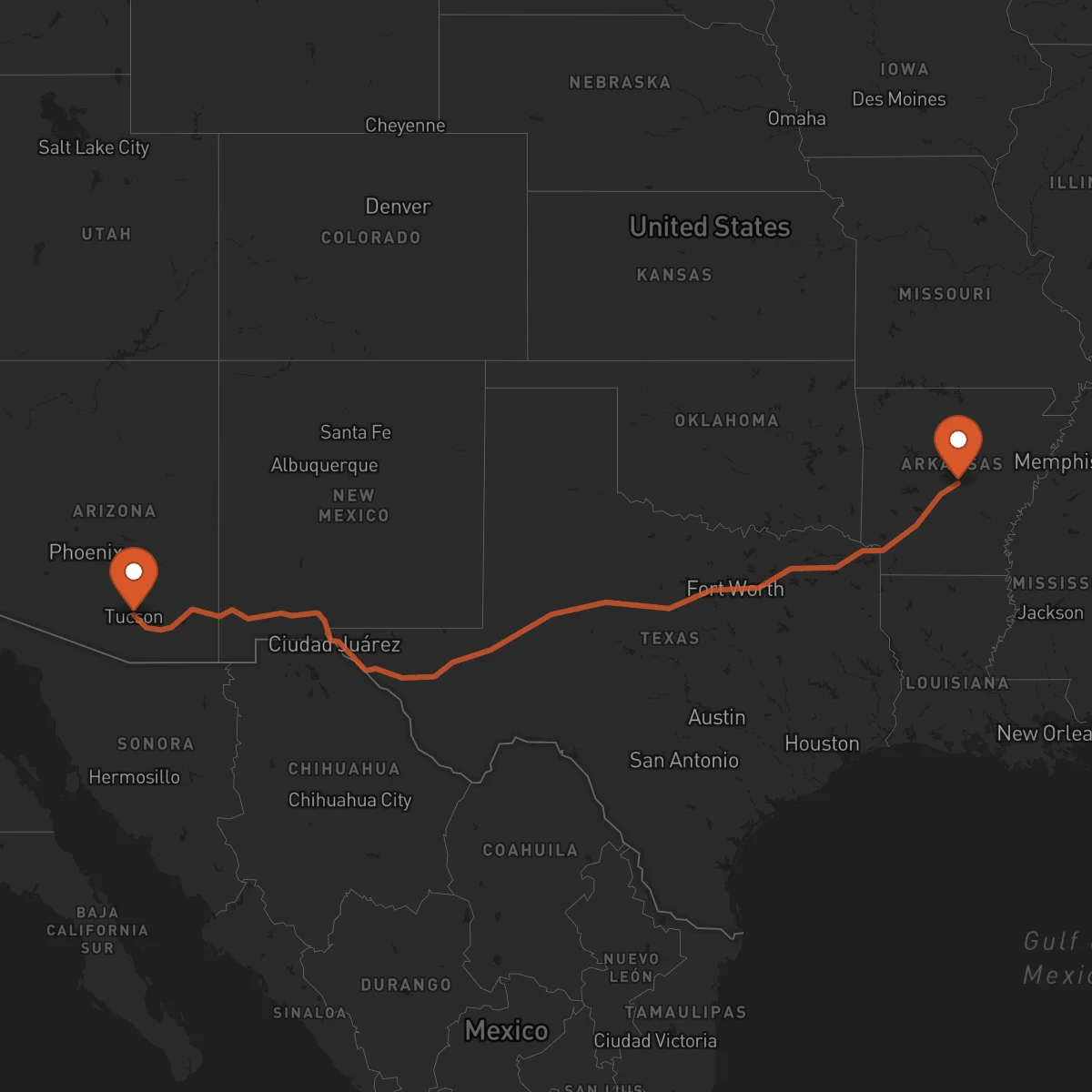
The Tucson to Little Rock corridor connects two important industrial hubs across the American Southwest and South. This 1753 km route traverses multiple states, linking Arizona's border region with Arkansas's central logistics hub. The corridor serves as a vital artery for freight movement between the western United States and the southeastern markets, facilitating the flow of goods across diverse economic regions.
This route passes through key states including Arizona, New Mexico, Texas, Oklahoma, and Arkansas, crossing major economic zones. The corridor's strategic importance stems from its role in connecting manufacturing centers, agricultural regions, and distribution networks across the southern United States. Companies operating along this route benefit from access to both Pacific and Atlantic market connections through interconnected highway systems.
Major industries utilizing this corridor include automotive manufacturing, aerospace components, agricultural products, retail distribution, and industrial equipment. The route particularly serves companies requiring reliable full truckload (FTL) transportation for time-sensitive or high-value cargo moving between the Southwest and Southeast regions.
Control Terrestre facilitates seamless operations along this corridor through our network of certified transportation providers. Our expertise in full truckload services ensures that cargo moves efficiently across the entire route, with dedicated equipment options including dry vans and refrigerated units to meet diverse shipping requirements. We provide end-to-end logistics solutions that optimize transit times and ensure cargo integrity throughout the journey.
Services for this Route
Available services for the corridor Tucson - Little Rock
 Origin
Tucson
Tucson, Arizona serves as a strategic logistics gateway positioned near the U.S.-Mexico border. The city's location provides excellent access to both domestic and international freight movements, with major transportation corridors connecting to California ports and cross-border trade routes. Tucson's transportation infrastructure includes Interstate 10, which runs east-west across the southern United States, and Interstate 19 connecting to Mexico.
The region's economy features strong aerospace and defense industries, with major employers including Raytheon Missiles & Defense and Davis-Monthan Air Force Base. Tucson also supports significant retail distribution centers, agricultural product handling (particularly winter vegetables and citrus), and manufacturing operations. The city's Sky Harbor Airport and Union Pacific rail connections complement its highway network, creating a multimodal logistics environment.
 Destination
Little Rock
Little Rock, Arkansas functions as a central logistics hub in the southeastern United States. The city's geographic position provides strategic access to major markets throughout the South, Midwest, and Eastern United States. Little Rock's transportation infrastructure includes Interstate 30 and Interstate 40, which converge in the city, creating excellent connectivity for freight movement in all directions.
The Little Rock metropolitan area hosts a diverse industrial base including healthcare equipment manufacturing, food processing, retail distribution, and agricultural products. The Port of Little Rock on the Arkansas River provides barge transportation capabilities, while Clinton National Airport offers air cargo services. The region's central location makes it ideal for distribution centers serving multiple states, with companies benefiting from relatively short transit times to major population centers across the southeastern and midwestern United States.










