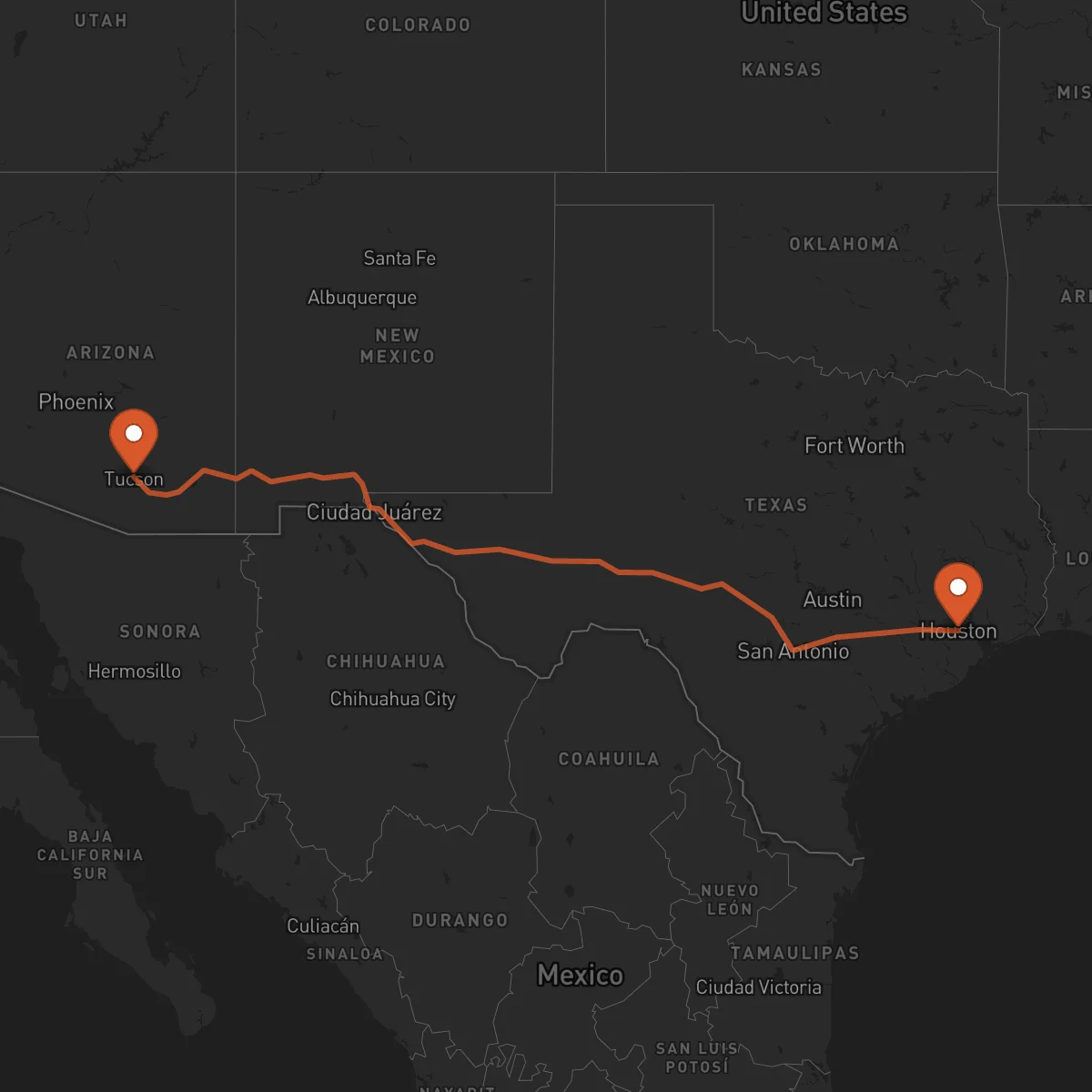
Tucson to Houston
Houston → TucsonFTL freight transportation service between Tucson and Houston. Reliable logistics solutions for your business.
Route Description
Everything you need to know about the corridor Tucson - Houston
The Tucson-Houston corridor represents a vital freight transportation route connecting the southwestern United States with the Gulf Coast. This 1511 km corridor serves as a critical link between Arizona's industrial centers and Texas's major port and petrochemical hub. The route facilitates the movement of diverse cargo types, from manufactured goods and electronics to agricultural products and industrial equipment, supporting the economic integration of both regions.
The corridor traverses some of the most important industrial zones in the southern United States, passing through major cities and transportation hubs. It connects the Sonoran Desert region with the energy capital of the world, facilitating trade and commerce between these economically significant areas. The route benefits from excellent highway infrastructure, primarily utilizing I-10, which provides direct access and efficient transit times for freight carriers.
This corridor is particularly crucial for industries such as aerospace, automotive, electronics, and agriculture in Tucson, while serving Houston's massive petrochemical, energy, and maritime sectors. The route also supports cross-border trade operations, as Tucson serves as a gateway for goods entering from Mexico. Control Terrestre's specialized FTL services ensure reliable, dedicated transportation along this corridor, with our network of certified carriers providing consistent capacity and professional handling of all cargo types.
Our strategic approach to this corridor includes real-time tracking, dedicated customer service, and compliance with all transportation regulations. We understand the unique requirements of each industry served by this route and tailor our services accordingly. Whether you need standard freight transport, refrigerated services for perishable goods, or specialized handling for oversized cargo, Control Terrestre delivers comprehensive solutions that keep your supply chain moving efficiently between Tucson and Houston.
Services for this Route
Available services for the corridor Tucson - Houston
 Origin
Tucson
Tucson, Arizona serves as a strategic logistics hub in the southwestern United States, positioned at the crossroads of major transportation routes. The city's location near the U.S.-Mexico border makes it a crucial gateway for international trade, particularly with the state of Sonora. Tucson's logistics infrastructure includes the Tucson International Airport, multiple rail connections through Union Pacific Railroad, and extensive highway networks including I-10, I-19, and I-8. The city's proximity to major ports of entry facilitates efficient cross-border operations and supports the region's thriving import-export activities.
The local economy is diverse, with strong sectors in aerospace and defense, optics and photonics, healthcare, and technology. Tucson is home to major employers including Raytheon Missiles & Defense, University of Arizona, and Davis-Monthan Air Force Base. The region also has a significant presence in the semiconductor industry and serves as a distribution center for agricultural products from southern Arizona and northern Mexico. These industries generate substantial freight volumes that require reliable transportation solutions to major markets across the United States.
 Destination
Houston
Houston, Texas stands as one of the most important logistics and industrial centers in the United States, strategically positioned near the Gulf of Mexico. The city's location provides access to the Port of Houston, one of the busiest ports in the country, and connects to a vast network of rail lines and highways. Houston's transportation infrastructure includes three major airports, an extensive highway system with I-10, I-45, and I-69, and significant rail freight operations through Union Pacific and BNSF. This comprehensive infrastructure makes Houston a critical node for domestic and international freight movement.
The Houston metropolitan area is renowned as the energy capital of the world, hosting numerous oil and gas companies, refineries, and petrochemical plants. Beyond energy, the region has strong healthcare, aerospace, manufacturing, and technology sectors. Houston is home to the Texas Medical Center, NASA's Johnson Space Center, and major corporations like ExxonMobil, Chevron, and Phillips 66. The city's diverse economy generates massive freight volumes across various industries, requiring sophisticated logistics solutions to manage the complex supply chains that support these sectors.










