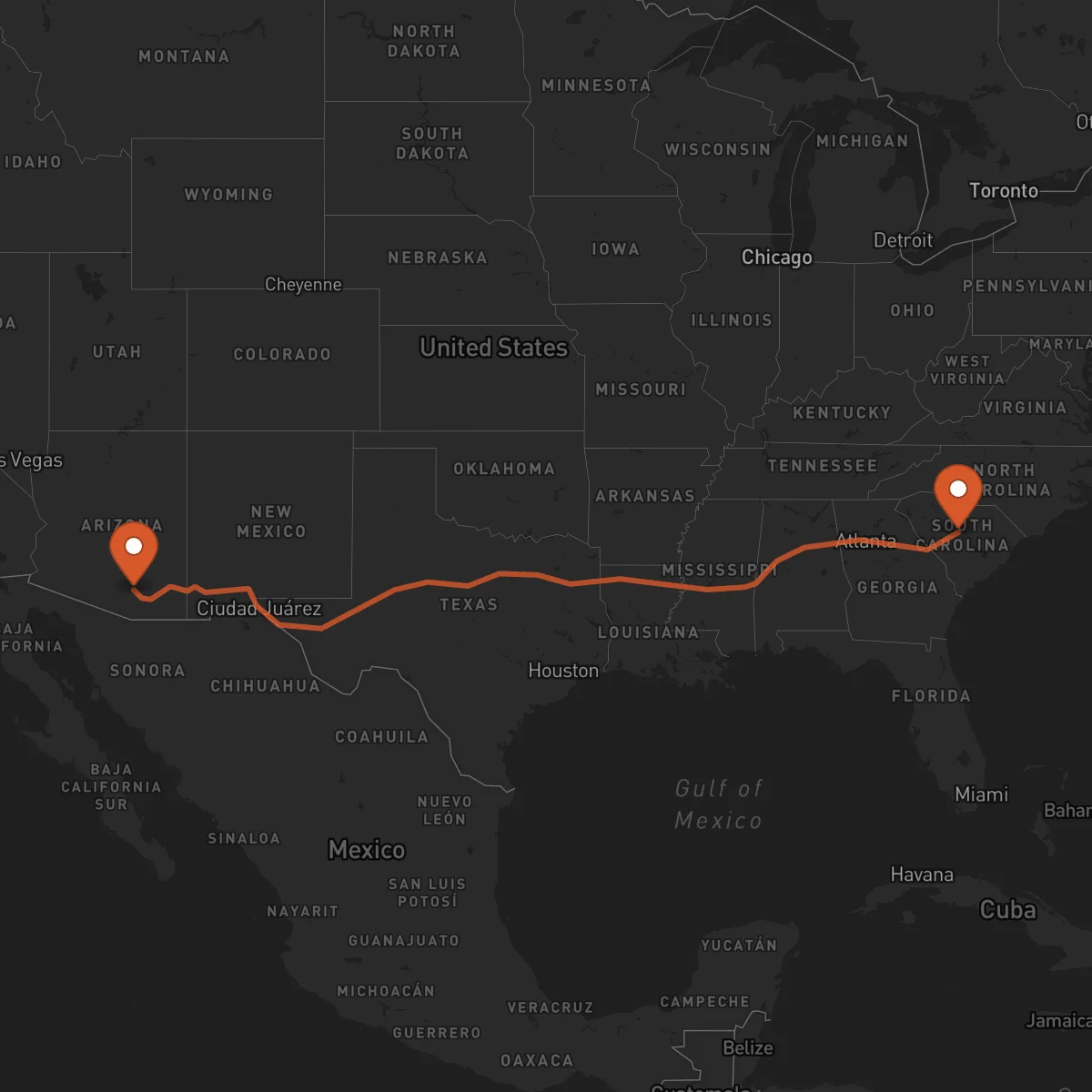
Tucson to Columbia
Columbia → TucsonFTL freight transportation service between Tucson and Columbia. Reliable logistics solutions for your business.
Route Description
Everything you need to know about the corridor Tucson - Columbia
The Tucson to Columbia corridor represents a vital domestic freight transportation route connecting the southwestern United States with the southeastern region. This east-west corridor spans approximately 2,785 kilometers, traversing diverse geographical and economic landscapes that are crucial for national supply chain operations. The route facilitates the movement of goods between Arizona's growing industrial base and South Carolina's manufacturing and distribution hubs, supporting both regional and national commerce.
The corridor's strategic importance is underscored by its connection between two dynamic economic regions. Tucson serves as a gateway to the Southwest, with strong ties to Mexico and the Pacific ports, while Columbia anchors South Carolina's thriving economy, which includes automotive manufacturing, aerospace, and advanced materials industries. This freight lane supports the continuous flow of raw materials, components, and finished goods that power these interconnected economic ecosystems.
Major transportation infrastructure along this corridor includes Interstate 10 (I-10) heading east from Tucson through New Mexico and Texas, connecting with I-20 through Atlanta, and finally I-26 leading into Columbia. These interstate highways provide reliable, high-capacity freight movement with multiple alternate routes to optimize transit times and avoid congestion. The corridor also benefits from numerous logistics hubs and truck stops strategically positioned along the route.
Control Terrestre specializes in providing dedicated full truckload (FTL) services along this corridor, offering companies reliable transportation solutions with our certified carrier network. Our expertise in managing long-haul domestic routes ensures that freight moves efficiently and securely from origin to destination, with real-time tracking and dedicated support throughout the journey.
Services for this Route
Available services for the corridor Tucson - Columbia
 Origin
Tucson
Tucson, Arizona serves as a strategic logistics hub in the southwestern United States, positioned advantageously for both domestic and international freight movements. Located just 100 kilometers from the Mexican border, Tucson provides seamless connectivity to cross-border operations and serves as a critical gateway for trade between the U.S. and Mexico. The city's logistics infrastructure includes multiple interstate highways, including I-10, which runs east-west across the southern United States, and I-19, connecting to the Mexican border at Nogales.
The region's economy is diverse, with strong presence in aerospace and defense, optics and photonics, mining, and agriculture. Tucson benefits from proximity to major distribution centers and warehousing facilities that support both local industries and cross-border trade. The city's Sky Harbor International Airport and nearby ports of entry facilitate multimodal transportation options, while the Union Pacific Railroad provides additional freight rail capacity for bulk shipments and intermodal transport.
 Destination
Columbia
Columbia, South Carolina stands as a strategic logistics center in the southeastern United States, offering excellent connectivity to major markets along the East Coast. Located at the confluence of the Broad and Saluda rivers, Columbia serves as South Carolina's capital and largest metropolitan area, with a well-developed transportation infrastructure that includes major highways, rail connections, and the nearby Port of Charleston for international freight.
The Columbia metropolitan area has experienced significant economic growth, particularly in advanced manufacturing, automotive production, and distribution sectors. The region is home to major employers including Fort Jackson military base, the University of South Carolina, and numerous manufacturing facilities. Columbia's central location in South Carolina provides efficient access to Atlanta, Charlotte, and the coastal ports, making it an ideal distribution point for companies serving the southeastern market. The city's logistics infrastructure includes the Columbia Metropolitan Airport, extensive highway networks (I-20, I-26, I-77), and rail connections through CSX and Norfolk Southern railroads.










