Columbia to Tucson
Tucson → ColumbiaFTL freight transportation service between Columbia and Tucson. Reliable logistics solutions for your business.
Route Description
Everything you need to know about the corridor Columbia - Tucson
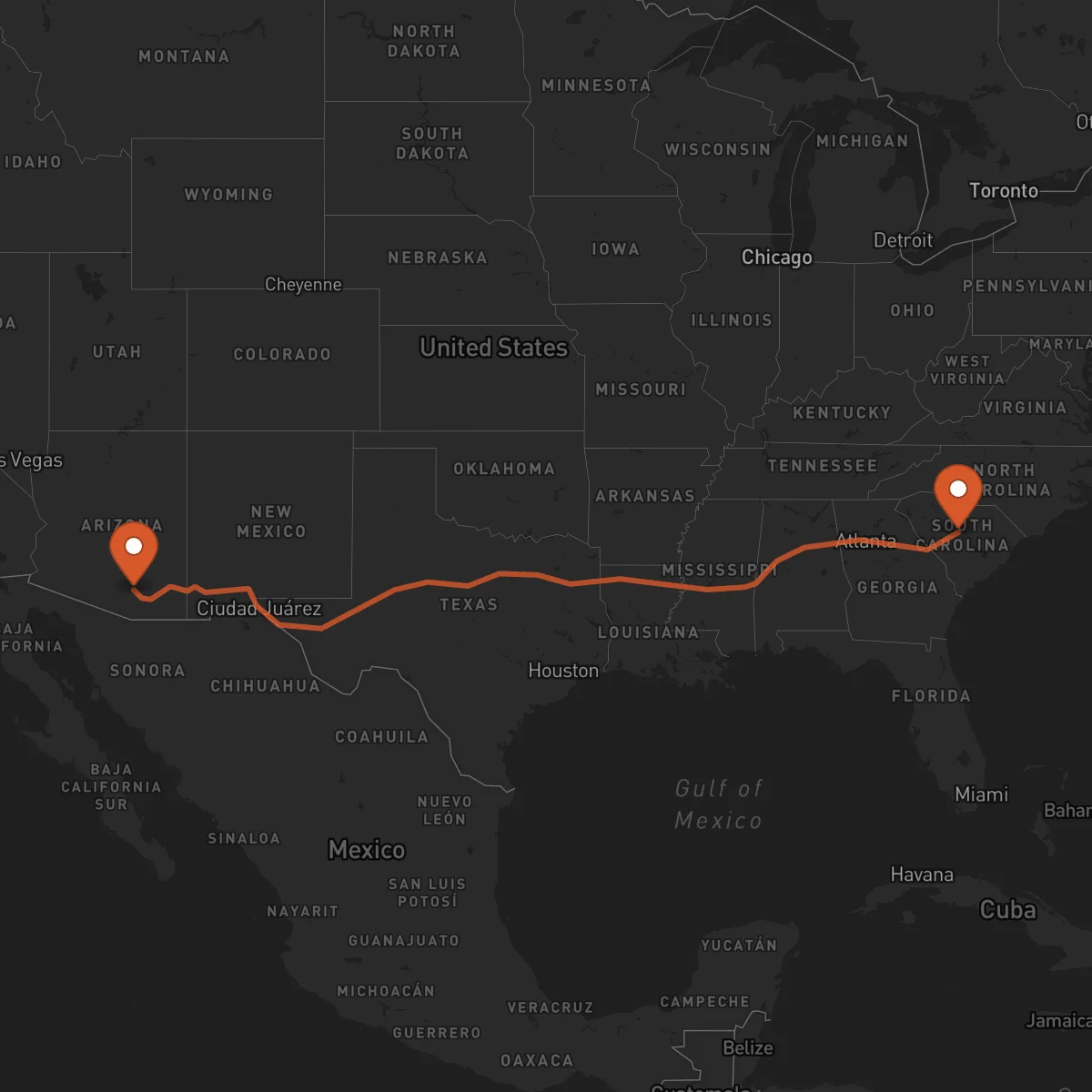
The logistics corridor between Columbia, South Carolina, and Tucson, Arizona, represents a vital connection across the southeastern and southwestern United States. This 2,785 km domestic route traverses diverse landscapes and crosses multiple states, linking the industrial heartland of the East Coast with the growing economic centers of the Southwest. The corridor serves as a critical artery for freight movement, supporting the seamless flow of goods between these two strategically important regions.
The economic significance of this route cannot be overstated. Columbia, situated in South Carolina's industrial corridor, serves as a gateway to the Southeast's manufacturing and distribution networks. Meanwhile, Tucson anchors Arizona's logistics infrastructure, connecting to the broader Southwest and Pacific trade routes. The corridor facilitates trade between the manufacturing-heavy Southeast and the technology, aerospace, and mining sectors that dominate the Southwest economy.
This route primarily follows major interstate highways including I-20 and I-10, providing reliable and efficient transportation infrastructure. The journey crosses through key logistics hubs in Atlanta, Dallas, and El Paso, offering multiple opportunities for transloading and distribution. Control Terrestre leverages this established infrastructure to provide full truckload (FTL) services that ensure your cargo moves efficiently across this extensive distance. Our specialized carriers are equipped to handle the varying terrain and climate conditions encountered along this cross-country route, from the humid subtropical climate of the Southeast to the arid conditions of the Southwest.
Services for this Route
Available services for the corridor Columbia - Tucson
 Origin
Columbia
Columbia, South Carolina, serves as a strategic logistics hub in the southeastern United States. Located at the confluence of major interstate highways I-20, I-26, and I-77, Columbia provides excellent connectivity to regional and national freight networks. The city's central location within South Carolina makes it an ideal distribution point for goods moving throughout the Southeast. Columbia's economy is anchored by government services, healthcare, and education, but it has also developed significant manufacturing and logistics sectors. The presence of multiple industrial parks and warehousing facilities, combined with the nearby Port of Charleston, creates a robust logistics ecosystem that supports efficient freight movement in all directions.
 Destination
Tucson
Tucson, Arizona, occupies a strategic position in the southwestern United States, serving as a critical logistics gateway to Mexico and the broader Southwest region. The city's location along Interstate 10 provides direct connections to major markets including Phoenix, Los Angeles, and El Paso. Tucson's economy is diverse, with strong aerospace and defense industries, mining operations, and growing technology sectors. The city's proximity to the U.S.-Mexico border and its role as a distribution center for goods moving between the two countries enhance its importance in North American supply chains. Tucson's transportation infrastructure includes a major international airport, extensive highway networks, and rail connections that facilitate the efficient movement of freight throughout the region.










