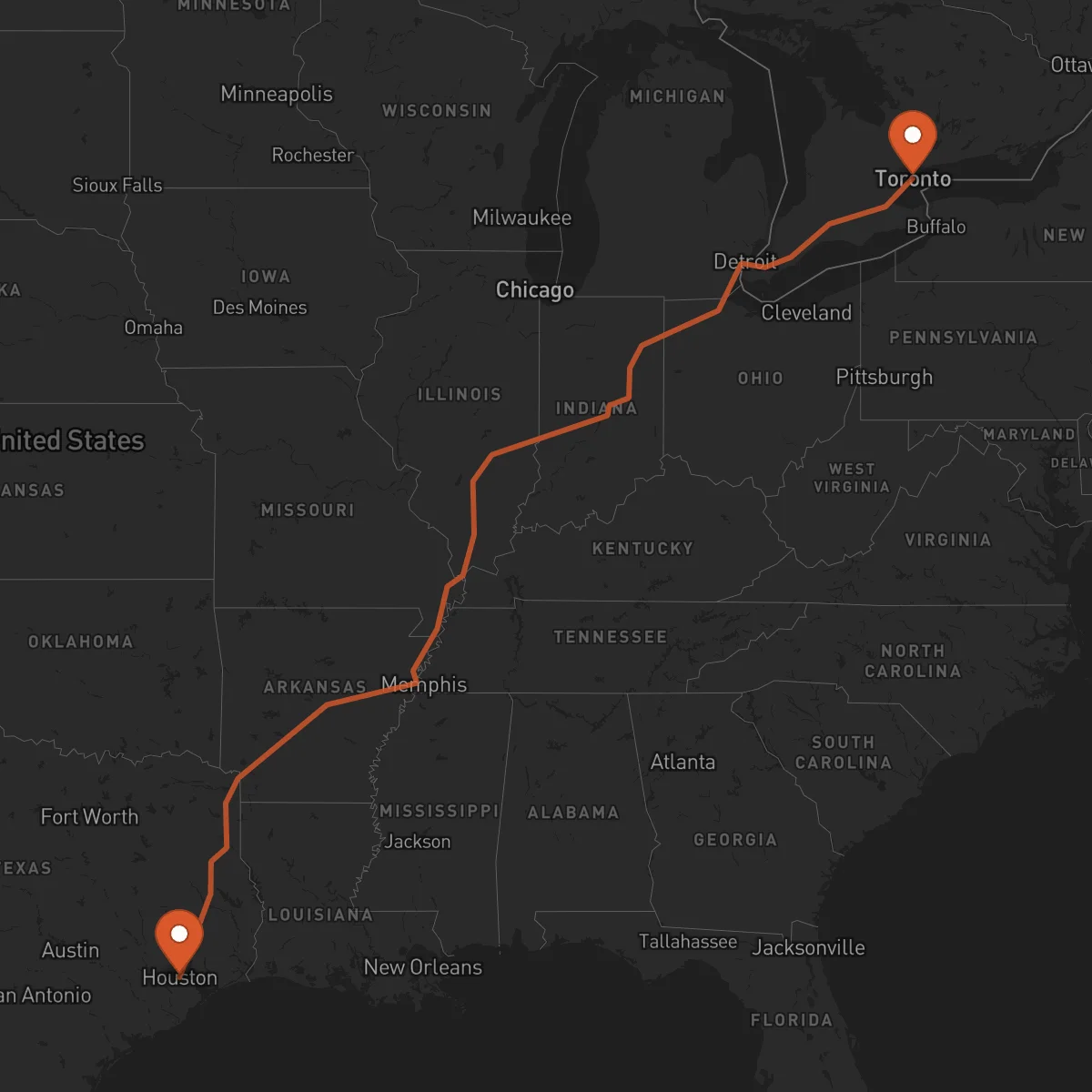
Toronto to Houston
Houston → TorontoFTL freight transportation service between Toronto and Houston. Reliable logistics solutions for your business.
Route Description
Everything you need to know about the corridor Toronto - Houston
The Toronto-Houston corridor represents a vital logistics link connecting Canada's largest economic center with one of the United States' most dynamic industrial hubs. This cross-border route spans approximately 2,094 kilometers and facilitates the movement of diverse cargo between two major North American markets. The corridor serves as a critical artery for trade, enabling seamless freight transportation between Ontario's manufacturing heartland and Texas's energy and petrochemical powerhouse.
The economic significance of this corridor is underscored by the complementary industrial strengths of both regions. Toronto's advanced manufacturing, automotive, and technology sectors create demand for specialized components, raw materials, and finished goods that flow southward. Meanwhile, Houston's dominance in energy, chemical processing, and aerospace industries generates substantial outbound freight, including petroleum products, industrial equipment, and specialized materials. This bidirectional flow creates consistent opportunities for full truckload (FTL) freight services.
Transportation infrastructure along this corridor includes major highways such as I-69, I-65, and I-10, providing reliable connectivity across multiple states. The route accommodates various equipment types, from standard dry vans to specialized tankers and flatbeds, ensuring flexibility for diverse cargo requirements. Control Terrestre leverages this infrastructure through our network of certified transportation partners, offering seamless cross-border operations with expertise in customs clearance, documentation, and regulatory compliance. Our strategic approach ensures efficient transit times and reliable service for companies moving freight between these key economic centers.
Services for this Route
Available services for the corridor Toronto - Houston
 Origin
Toronto serves as a strategic logistics hub in Canada, positioned at the heart of North America's most populous region. The city's location provides excellent connectivity through major highways including the 401, 407, and QEW, facilitating efficient distribution throughout Ontario and beyond. Toronto's transportation infrastructure includes Pearson International Airport, extensive rail networks, and the Port of Toronto, creating multimodal capabilities for diverse shipping needs.
The Greater Toronto Area (GTA) is Canada's economic engine, hosting headquarters of major corporations and thriving in sectors such as financial services, technology, advanced manufacturing, and automotive production. The region's strong industrial base generates substantial freight volumes, particularly in automotive parts, electronics, pharmaceuticals, and consumer goods. Toronto's proximity to the U.S. border (approximately 2-3 hours to major crossings) makes it an ideal origin point for cross-border freight operations, with established trade relationships driving consistent demand for reliable transportation services.
 Destination
Houston
Houston stands as a critical logistics hub in the southern United States, strategically positioned near the Gulf of Mexico and major international trade routes. The city's location provides exceptional connectivity through extensive highway networks, including I-10, I-45, and I-69, facilitating efficient distribution throughout Texas and the broader southern region. Houston's transportation infrastructure includes George Bush Intercontinental Airport, extensive rail networks, and the Port of Houston, one of the busiest ports in the nation, creating robust multimodal capabilities.
The Houston metropolitan area is renowned as the energy capital of the world, with dominant sectors including oil and gas, petrochemical refining, and related industries. The region also excels in aerospace manufacturing, healthcare, and technology, creating diverse freight generation opportunities. Houston's industrial base produces substantial outbound freight volumes, particularly in energy products, industrial equipment, chemicals, and specialized materials. The city's proximity to major manufacturing centers and its role as a distribution hub for the southern United States make it a crucial destination for cross-border freight operations, with consistent demand for reliable transportation services.










