Toronto to Denver
Denver → TorontoFTL freight transportation service between Toronto and Denver. Reliable logistics solutions for your business.
Route Description
Everything you need to know about the corridor Toronto - Denver
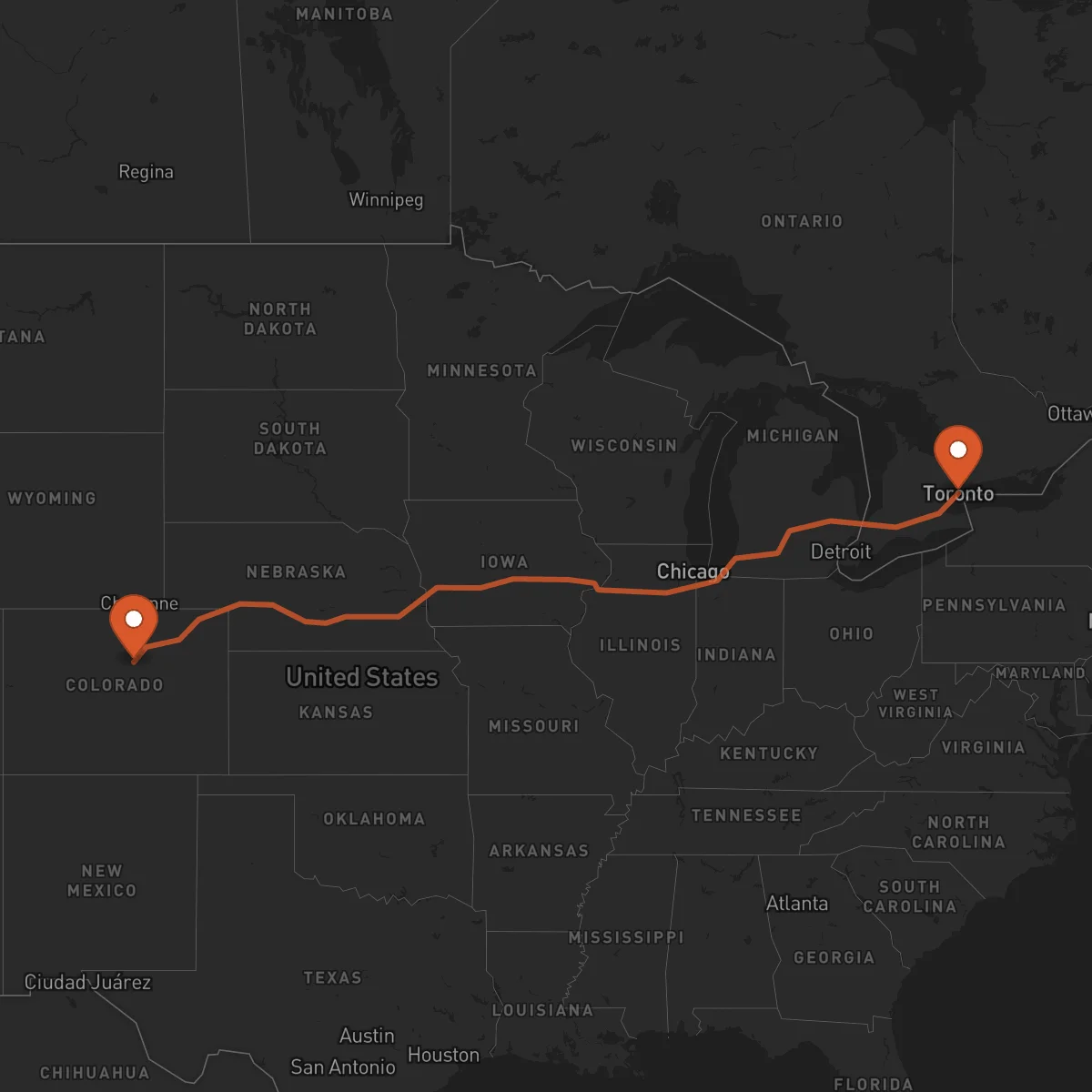
The Toronto-Denver corridor represents a vital cross-border freight transportation route connecting Canada's largest economic center with one of the United States' most dynamic industrial hubs. This 2,161-kilometer corridor traverses the Great Lakes region and the American Midwest, linking Ontario's manufacturing powerhouse with Colorado's growing logistics and technology sectors. The route serves as a critical artery for North American supply chains, facilitating the movement of goods between two major economic regions.
The corridor's strategic importance is underscored by its passage through key industrial centers including Detroit, Chicago, and Omaha. Toronto's diverse manufacturing base, encompassing automotive, aerospace, and advanced technology sectors, creates substantial outbound freight volumes. Meanwhile, Denver's strategic location at the intersection of major interstate highways (I-70, I-25, and I-76) makes it an ideal distribution hub for the Rocky Mountain region and beyond.
Control Terrestre's expertise in cross-border operations ensures seamless transportation across this corridor. Our C-TPAT-certified carriers navigate the complexities of US-Canada border crossings, particularly at key points like Detroit-Windsor and Pembina. We provide comprehensive FTL services that accommodate the diverse cargo types flowing between these regions, from automotive components and industrial machinery to high-tech equipment and consumer goods. Our dedicated fleet options and experienced drivers ensure reliable, time-sensitive deliveries across this extensive route.
Services for this Route
Available services for the corridor Toronto - Denver
 Origin
Toronto stands as Canada's premier logistics hub, strategically positioned on the northern shore of Lake Ontario with access to major transportation networks. The Greater Toronto Area (GTA) hosts North America's second-largest concentration of corporate headquarters and serves as Ontario's manufacturing epicenter. The city's extensive infrastructure includes Pearson International Airport, one of Canada's busiest cargo facilities, and the Port of Toronto, providing multimodal shipping capabilities. Toronto's advanced highway system, anchored by Highway 401 (the busiest in North America), facilitates efficient ground transportation throughout the region and beyond.
 Destination
Denver
Denver's strategic location at the intersection of the Great Plains and the Rocky Mountains makes it a crucial logistics hub for the western United States. The city's elevation of 1,600 meters above sea level provides unique advantages for distribution networks, serving as a natural gateway to the Mountain West and Pacific Northwest. Denver International Airport, the largest in North America by land area, handles significant air cargo volumes, while the city's extensive highway network (including I-70, I-25, and I-76) connects to major markets across the western states. The region's growing technology and aerospace sectors create consistent demand for reliable freight transportation services.










