Toronto to Chicago
Chicago → TorontoFTL freight transportation service between Toronto and Chicago. Reliable logistics solutions for your business.
Route Description
Everything you need to know about the corridor Toronto - Chicago
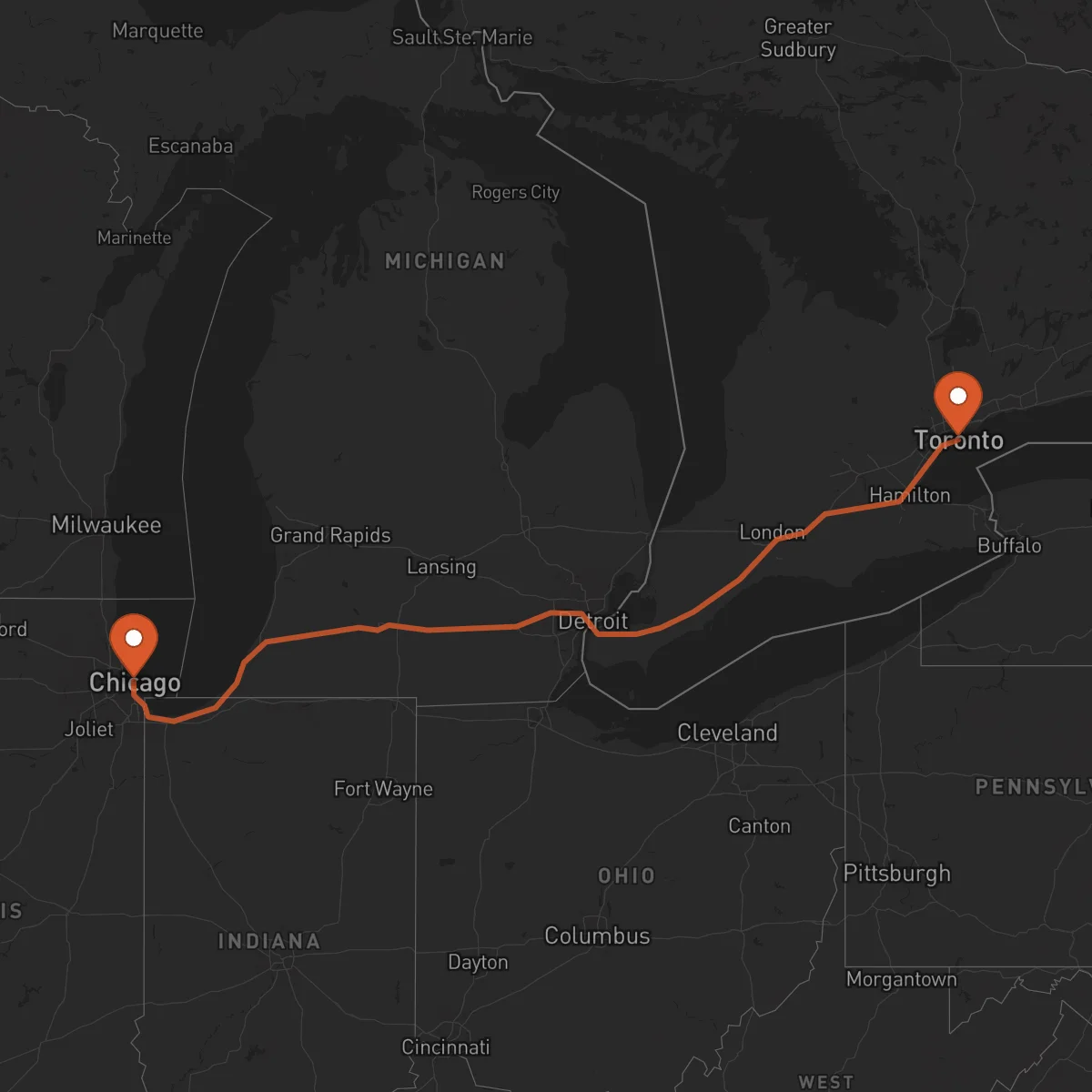
The Toronto-Chicago corridor represents a vital trade artery between Canada and the United States, connecting two of North America's most important economic centers. This 701 km cross-border route facilitates the movement of goods between Ontario's manufacturing powerhouse and the Midwest's industrial heartland. The corridor serves as a critical link in the supply chain for companies operating across both nations, enabling seamless freight transportation through a well-established network of highways and border crossings.
The region's economic significance stems from its diverse industrial base. Toronto stands as Canada's financial and technological hub, while Chicago anchors a vast manufacturing and distribution network in the American Midwest. Together, these cities form a dynamic economic ecosystem where automotive parts, electronics, pharmaceuticals, and consumer goods flow continuously. The corridor particularly benefits from the strong automotive manufacturing presence in both regions, with numerous suppliers and assembly plants relying on just-in-time delivery systems.
Transportation infrastructure along this route is robust, primarily utilizing Highway 401 through Ontario and I-90/I-94 through the United States. The corridor crosses at key border points including the Detroit-Windsor crossing or the Blue Water Bridge at Sarnia-Port Huron, both equipped with modern customs facilities and FAST program lanes for expedited processing. Control Terrestre leverages this infrastructure through our network of certified carriers, ensuring your full truckload shipments move efficiently across this international boundary while maintaining compliance with all cross-border regulations.
Services for this Route
Available services for the corridor Toronto - Chicago
 Origin
Toronto serves as Canada's primary logistics gateway to the United States, strategically positioned along the Quebec-Windsor Corridor. The city's location provides immediate access to major highways including the 401, North America's busiest highway, which connects directly to US border crossings. Toronto's Pearson International Airport and extensive rail networks complement its road infrastructure, creating a multimodal transportation hub. The region's economic strength lies in its diverse sectors including financial services, technology, automotive manufacturing, and advanced manufacturing. With over 6 million residents in the Greater Toronto Area, the city generates substantial freight volume and serves as a distribution center for much of Central and Eastern Canada.
 Destination
Chicago
Chicago stands as America's premier freight logistics hub, often called the "crossroads of America" due to its central geographic location and unparalleled transportation infrastructure. The city sits at the intersection of major interstate highways including I-90, I-94, and I-80, providing direct access to all regions of the United States. Chicago's six Class I railroads and two major airports create a comprehensive transportation network that handles more freight than any other North American city. The region's economy thrives on manufacturing, food processing, printing, and publishing, with a particular strength in industrial machinery and fabricated metal products. Chicago's strategic position makes it a natural distribution center for the entire Midwest region.










