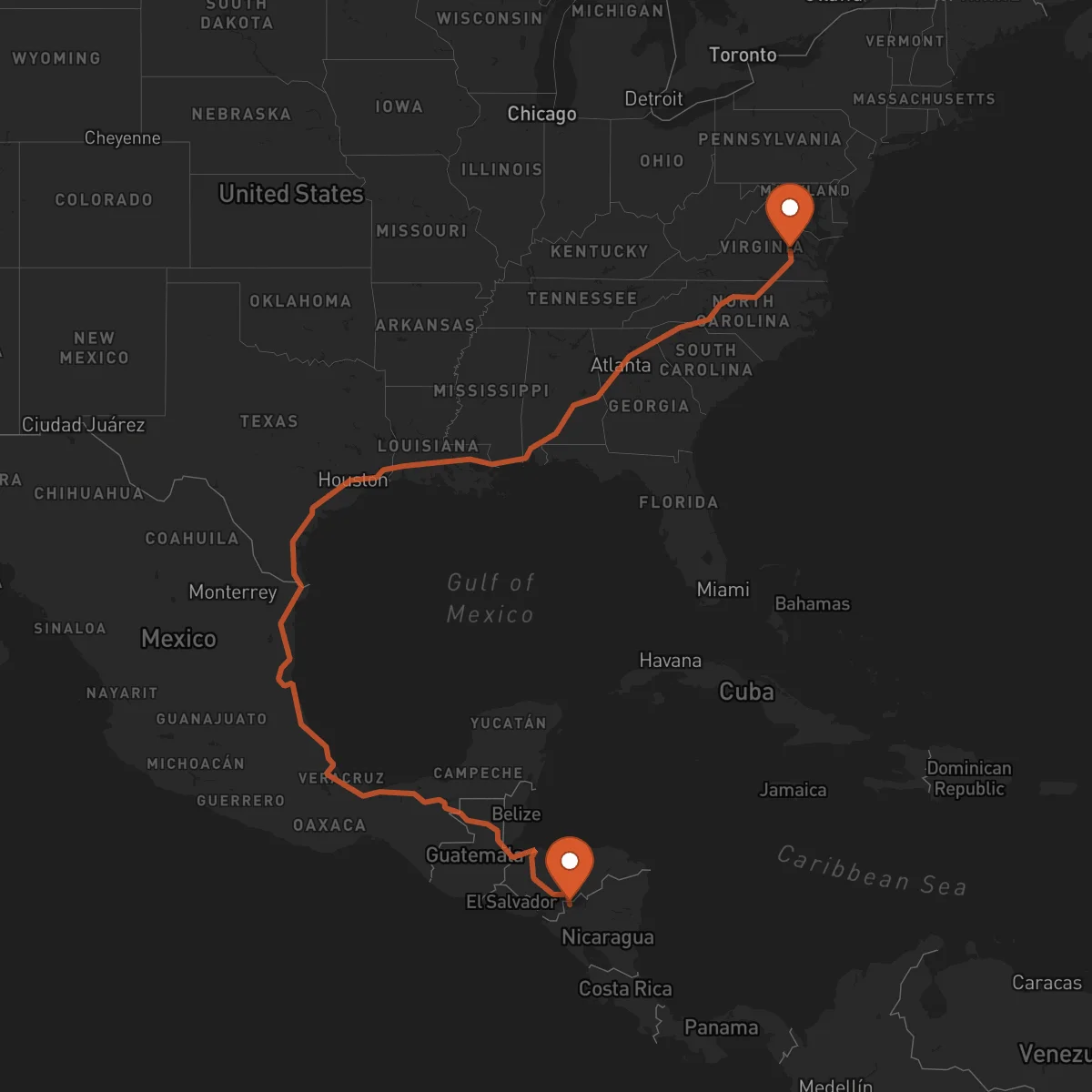
Richmond to Ocotal
Ocotal → RichmondFTL freight transportation service between Richmond and Ocotal. Reliable logistics solutions for your business.
Route Description
Everything you need to know about the corridor Richmond - Ocotal
The Richmond, Virginia to Ocotal, Nicaragua corridor represents a vital north-south logistics artery connecting the industrial heartland of the U.S. East Coast with the growing markets of Central America. Spanning approximately 2,805 kilometers, this cross-border route is strategically critical for supply chains requiring reliable, full truckload (FTL) movement between these regions. The corridor facilitates the flow of goods through a complex network of highways and multiple international borders, underpinning trade in raw materials, manufactured goods, and agricultural products. Its importance is magnified by the economic interdependence between the United States and Central American nations, where this route serves as a primary conduit for imports and exports.
Economically, the corridor bridges diverse industrial zones. The Richmond area is a hub for advanced manufacturing, agriculture, and distribution, while the Ocotal region in Nicaragua's Nueva Segovia department is characterized by coffee production, livestock, textiles, and cross-border commerce with Honduras. Key industries leveraging this route include agricultural processors, automotive parts distributors, consumer goods manufacturers, and retail logistics networks. The transportation infrastructure relies on a sequential highway system: primarily Interstate 95 south from Richmond, transitioning through the U.S.-Mexico border crossings (such as El Paso or Laredo), then traversing Mexico's federal highway network (like the Pan-American Highway/CA-1) before entering Nicaragua via the Honduran border at Las Manos and continuing on Nicaraguan roads to Ocotal.
Navigating this corridor requires expert management of customs and regulatory frameworks at multiple points. Critical border considerations include U.S. export documentation, Mexican transit regulations, and Nicaraguan import customs clearance. Success depends on providers with certifications like C-TPAT, FAST, and BASC to expedite clearance and ensure security compliance. Control Terrestre facilitates seamless operations on this demanding corridor by leveraging its alliance of certified providers. We coordinate the entire FTL journey as a single, manageable solution, handling the intricacies of cross-border paperwork, customs brokerage support, and dedicated equipment scheduling. Our focus on human-centric communication and green transportation practices ensures clients have a transparent, reliable partner for this complex international lane, from door in Richmond to door in Ocotal, without the complexity of consolidated freight.
Services for this Route
Available services for the corridor Richmond - Ocotal
 Origin
Richmond
Richmond, Virginia, serves as a strategic logistics origin due to its prime location on the U.S. East Coast, approximately 100 miles from the Port of Virginia in Norfolk. This positioning offers seamless access to international maritime shipping and a robust domestic distribution network. The city is a major economic engine for the region, with a diverse industrial base encompassing advanced manufacturing (chemicals, plastics, and fabricated metals), agriculture (particularly tobacco and poultry), and a significant technology and professional services sector. Its infrastructure is highly developed, featuring direct access to Interstate 95—the primary north-south artery on the Eastern Seaboard—extensive rail intermodal facilities, and a major international airport. This multi-modal connectivity makes Richmond an ideal fulfillment and shipping hub for goods destined for the southern United States and, critically, for cross-border export corridors into Mexico and Central America.
 Destination
Ocotal
Ocotal, the capital of Nicaragua's Nueva Segovia department, is a strategic logistics destination and regional commercial center in northern Nicaragua. Its location near the Honduran border (at Las Manos) makes it a key gateway for trade between Nicaragua and Honduras, and by extension, a pivotal endpoint for corridors originating in the United States. The local economy is driven by agriculture, notably high-quality coffee production for export, alongside livestock, dairy, and artisanal textiles. Infrastructure for freight includes connectivity to the Pan-American Highway (CA-1), which is the main thoroughfare for overland transport across Central America. While regional road conditions can vary, Ocotal's role as a departmental capital ensures it has established warehousing, distribution services, and customs processing capabilities to handle inbound international freight, serving as a vital link for distributing goods throughout northern Nicaragua and into neighboring countries.










