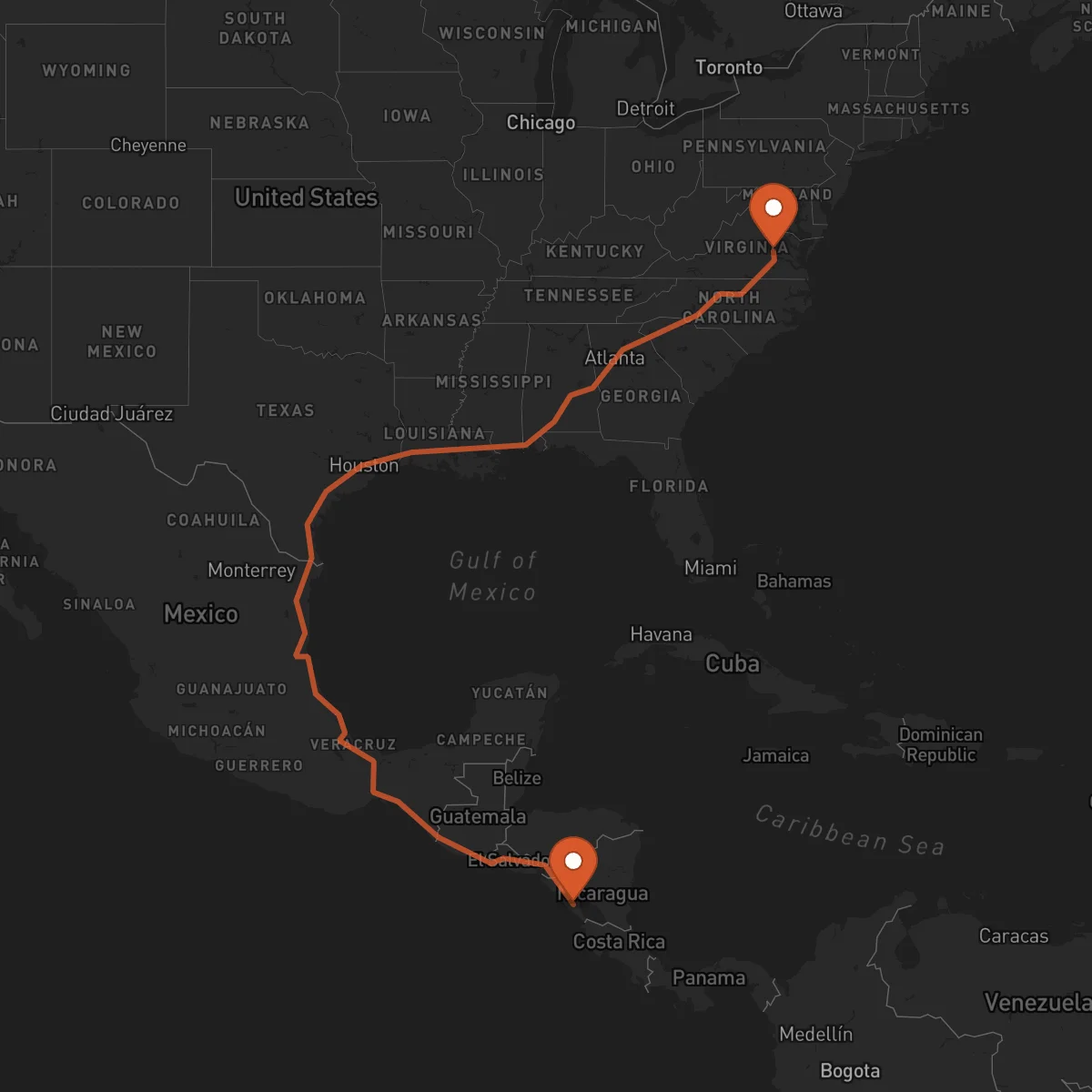
Richmond to Jinotepe
Jinotepe → RichmondFTL freight transportation service between Richmond and Jinotepe. Reliable logistics solutions for your business.
Route Description
Everything you need to know about the corridor Richmond - Jinotepe
The freight corridor connecting Richmond, Virginia, to Jinotepe, Carazo, Nicaragua, represents a critical North-South trade link through the heart of Central America. This cross-border route is strategically vital for moving full truckload (FTL) cargo between the industrial Southeast United States and the growing markets of Nicaragua, facilitating essential supply chain flows for regional economic integration. The approximately 2,987 km journey traverses diverse landscapes and multiple international boundaries, requiring sophisticated logistics coordination to ensure efficient, secure, and compliant transportation. Control Terrestre leverages its robust alliance of certified providers to expertly manage this complex corridor, transforming a challenging long-haul into a reliable solution for our clients.
Economically, this corridor bridges the manufacturing, agricultural, and distribution hubs of Virginia with Nicaragua's key production zones. The U.S. segment serves a region known for advanced manufacturing, chemicals, and agricultural outputs, while Nicaragua's economy relies heavily on agriculture (coffee, beef, seafood), textiles, and light manufacturing for export. The primary industries utilizing this route include agricultural commodity shippers, industrial manufacturers moving raw materials and finished goods, and companies engaged in retail distribution across Central America. The consistent demand is driven by the need to connect U.S. production centers with Nicaraguan consumption markets and export processing zones.
Transportation infrastructure is layered, beginning with major U.S. highways like I-95 South and I-85, transitioning through the Gulf Coast states before reaching the Texas/Mexico border. The most significant border crossing for this corridor is typically the Laredo, Texas / Nuevo Laredo, Mexico gateway, a major freight corridor requiring meticulous customs clearance. From there, the route continues through Mexico's federal highway network towards the Guatemalan border (such as Tecún Umán / Ciudad Hidalgo), and then through Guatemala and Honduras before entering Nicaragua at the El Guasaule border crossing. Each border presents unique documentation, customs, and regulatory considerations, including compliance with programs like C-TPAT and FAST for expedited processing. Control Terrestre’s expertise lies in navigating these multinational requirements, managing all documentation, and coordinating with our provider network to ensure seamless transitions at each checkpoint.
Our approach to this corridor is defined by specialization and partnership. We exclusively provide dedicated FTL solutions—including dry vans, reefers, and specialized equipment for oversized or hazardous cargo—matching specific shipment needs to the right carrier. Our providers' certifications (C-TPAT, FAST, BASC) are instrumental in mitigating risk and delays at borders. We handle the entire journey as a single, managed service from door-to-door, providing our clients with one point of contact and full visibility. By focusing solely on full truckload and leveraging deep regional knowledge, Control Terrestre optimizes this long-distance corridor for reliability, security, and efficiency, allowing our clients to focus on their core business rather than the complexities of transnational ground freight.
Services for this Route
Available services for the corridor Richmond - Jinotepe
 Origin
Richmond
Richmond, Virginia, is a pivotal logistics hub in the Mid-Atlantic United States, offering a strategic location with excellent connectivity to national and international markets. Its central position within the East Coast megalopolis provides efficient access to the populous Northeast, Southeast, and Midwest via a dense network of interstate highways, primarily I-95 and I-64. The city is a major intermodal center, served by significant rail yards and located within a day's drive of multiple major ports, including the Port of Virginia in Hampton Roads, which handles substantial container and break-bulk cargo. This infrastructure makes Richmond an optimal origin point for consolidation and dispatch of full truckload freight heading south and toward the Gulf Coast border crossings.
Richmond's economy is diverse and robust, supported by key industries that generate consistent freight demand. Major sectors include advanced manufacturing (particularly chemicals, plastics, and electronics), agriculture and food processing (tobacco, poultry, and packaged goods), and a growing distribution and logistics sector itself. The presence of numerous corporate headquarters and manufacturing plants creates steady flows of outbound finished goods, raw materials, and export cargo. This economic base ensures reliable volume for dedicated and spot FTL services moving from the region into international trade corridors.
The available transportation infrastructure is comprehensive. Beyond the interstate system, Richmond is bisected by major U.S. routes like US-1 and US-60. Its intermodal facilities connect directly to Class I railroads (CSX, Norfolk Southern), offering flexible multimodal options. The city's proximity to the Port of Virginia provides a vital link for global trade, though for the corridor to Nicaragua, the primary trucking route utilizes the highway network southward through the Carolinas, Georgia, Alabama, and into Texas. This well-developed domestic infrastructure allows Control Terrestre to efficiently collect cargo from Richmond-area shippers and commence the long-haul phase with minimal initial transit delays.
 Destination
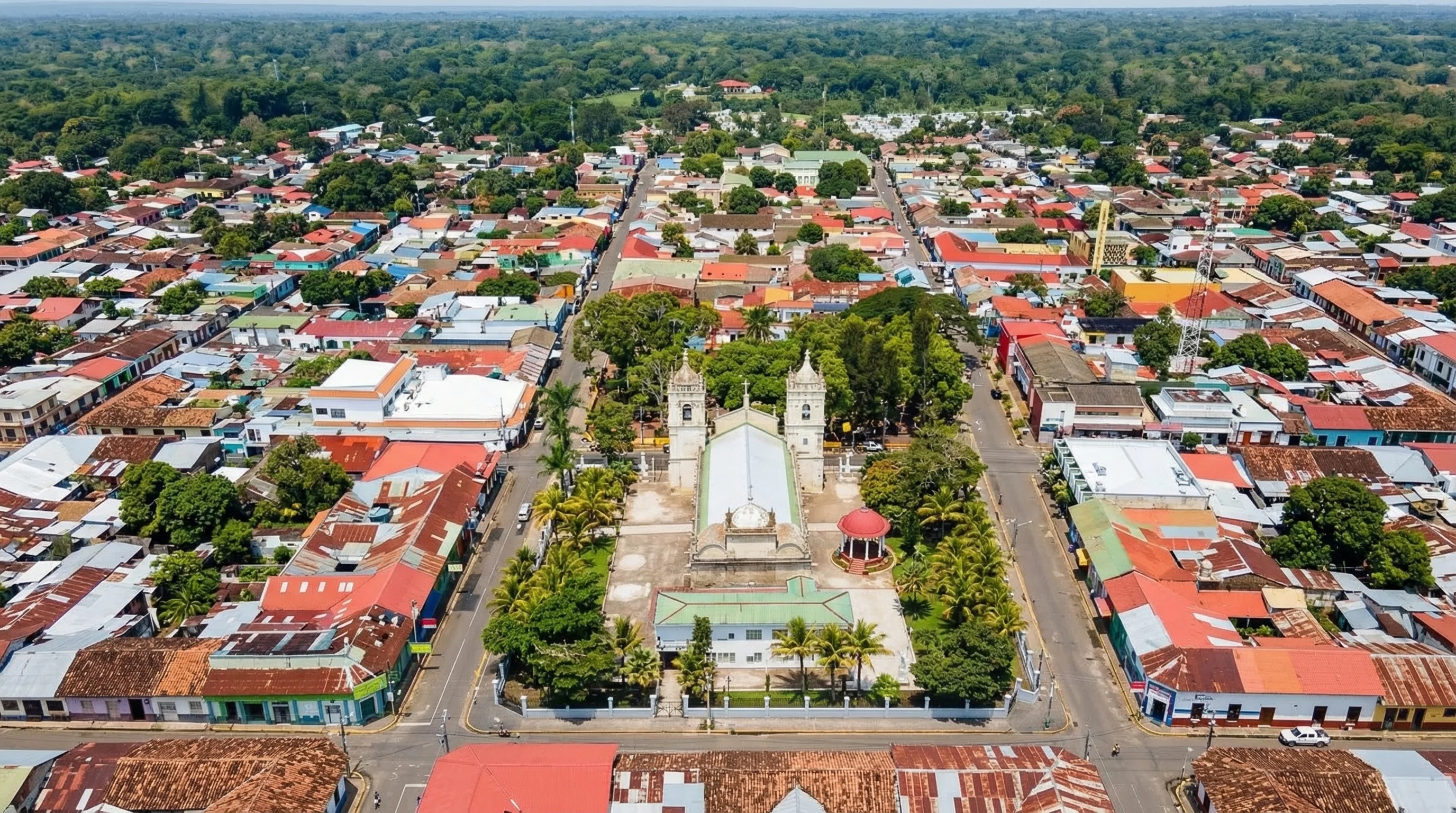
Jinotepe, the capital of Carazo Department in Nicaragua, serves as a key agricultural and light industrial center in the Pacific lowlands, strategically positioned for logistics in southern Nicaragua. Its location provides direct access to the Pan-American Highway ( Nicaragua's RN1), the country's main north-south artery, facilitating connectivity to the capital, Managua (approximately 45 km north), and the critical border crossing at El Guasaule with Honduras. This positioning makes Jinotepe a natural distribution point for the Carazo, Masaya, and Rivas regions, allowing for efficient last-mile delivery from the main international corridor.
The local economy is predominantly driven by agriculture, with the surrounding valleys producing significant quantities of coffee, sugarcane, beans, and livestock (beef and dairy). Additionally, the region hosts various food processing plants, textile maquilas (export assembly factories), and smaller-scale manufacturing enterprises. These industries are major generators of both inbound freight (importing raw materials, machinery, and packaging) and outbound freight (exporting agricultural commodities and manufactured goods). The consistent seasonal and year-round production cycles create predictable demand for reliable FTL transportation services to and from this area.
Transportation infrastructure in and around Jinotepe is functional and focused on the primary highway network. The RN1 provides the essential link north to Managua's international airport (Augusto C. Sandino) and major seaports (Corinto on the Pacific), and south to the border. While local roads may vary in condition, the core corridor is maintained for commercial traffic. For Control Terrestre's operations, Jinotepe represents a crucial destination node where cargo can be efficiently offloaded and distributed locally or consolidated for further movement within Nicaragua. The city's infrastructure supports standard 48' and 53' dry van and refrigerated equipment, which are the mainstays of our FTL service on this route, ensuring we can handle the diverse cargo types produced in the region.










