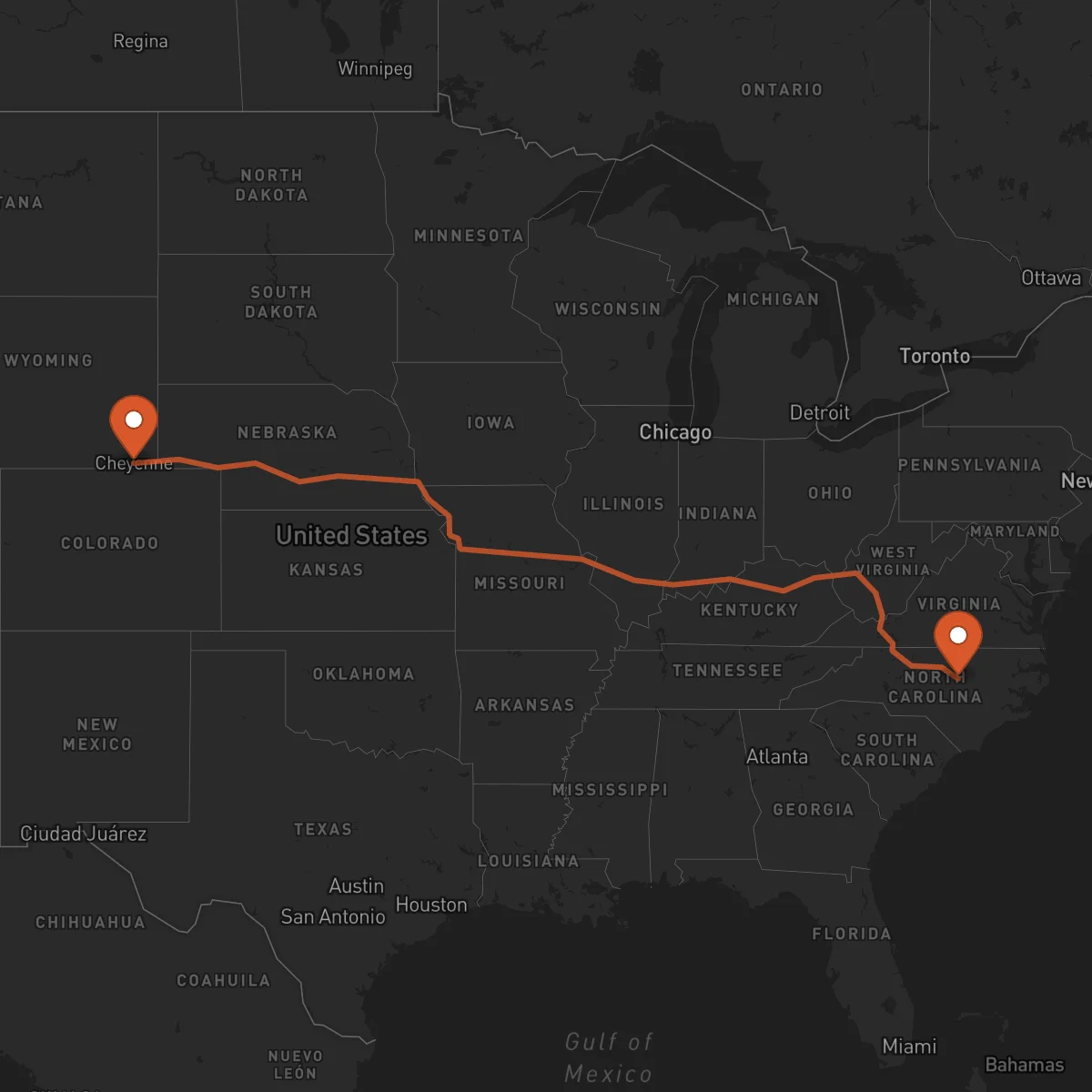
Raleigh to Cheyenne
Cheyenne → RaleighFTL freight transportation service between Raleigh and Cheyenne. Reliable logistics solutions for your business.
Route Description
Everything you need to know about the corridor Raleigh - Cheyenne
The Raleigh-Cheyenne corridor represents a vital freight transportation link between North Carolina's Research Triangle and Wyoming's capital, spanning approximately 2,346 kilometers across diverse American landscapes. This domestic route connects the industrial and technological hubs of the East Coast with the energy-rich Rocky Mountain region, facilitating the movement of goods between two distinct economic ecosystems. The corridor traverses major interstate highways including I-40, I-70, and I-25, providing reliable access through multiple states and ensuring consistent freight movement regardless of regional disruptions.
This transportation corridor serves critical industries including advanced manufacturing, aerospace, energy, and agricultural equipment. Raleigh's concentration of technology firms and research institutions creates demand for specialized freight services, while Cheyenne's role as a logistics hub for Wyoming's mining and energy sectors requires robust transportation solutions. The route also supports cross-industry supply chains, moving everything from precision electronics to heavy machinery between these complementary economic zones.
Control Terrestre optimizes freight operations along this corridor through our network of certified transportation providers. Our full truckload (FTL) services ensure dedicated capacity for time-sensitive shipments, while our specialized equipment options accommodate diverse cargo requirements. We leverage our providers' C-TPAT and FAST certifications to streamline cross-dock operations and maintain compliance throughout the journey, providing our clients with reliable, secure transportation between these strategic locations.
Services for this Route
Available services for the corridor Raleigh - Cheyenne
 Origin
Raleigh
Raleigh, North Carolina, serves as a strategic logistics hub in the Southeast, anchored by the Research Triangle's concentration of technology, education, and research institutions. The city's location provides excellent access to major transportation networks including I-40, I-85, and I-95, connecting to both coastal ports and inland distribution centers. Raleigh's infrastructure includes Raleigh-Durham International Airport and proximity to the Port of Wilmington, creating multimodal shipping options for businesses in the region.
The local economy thrives on advanced manufacturing, biotechnology, information technology, and research and development sectors. Major employers include IBM, Cisco Systems, and numerous pharmaceutical companies, all requiring reliable freight transportation for specialized equipment and materials. The area's robust industrial base creates consistent demand for full truckload services, particularly for time-sensitive shipments between research facilities, manufacturing plants, and distribution centers.
 Destination
Cheyenne
Cheyenne, Wyoming, occupies a strategic position as the state's capital and largest city, serving as a critical logistics gateway to the Rocky Mountain region. Located at the intersection of I-25 and I-80, Cheyenne provides direct access to major freight corridors connecting the Midwest, West Coast, and Mountain states. The city's transportation infrastructure includes Warren Airfield and rail connections through Union Pacific, supporting comprehensive multimodal freight operations.
The local economy centers on government services, energy production, and transportation logistics, with significant contributions from mining, oil and gas extraction, and agricultural equipment manufacturing. Cheyenne's role as a distribution hub for Wyoming's natural resources creates substantial demand for specialized freight services, particularly for heavy equipment, hazardous materials, and oversized cargo. The city's logistics infrastructure supports both inbound raw materials and outbound finished products, making it an essential node in regional supply chains.










