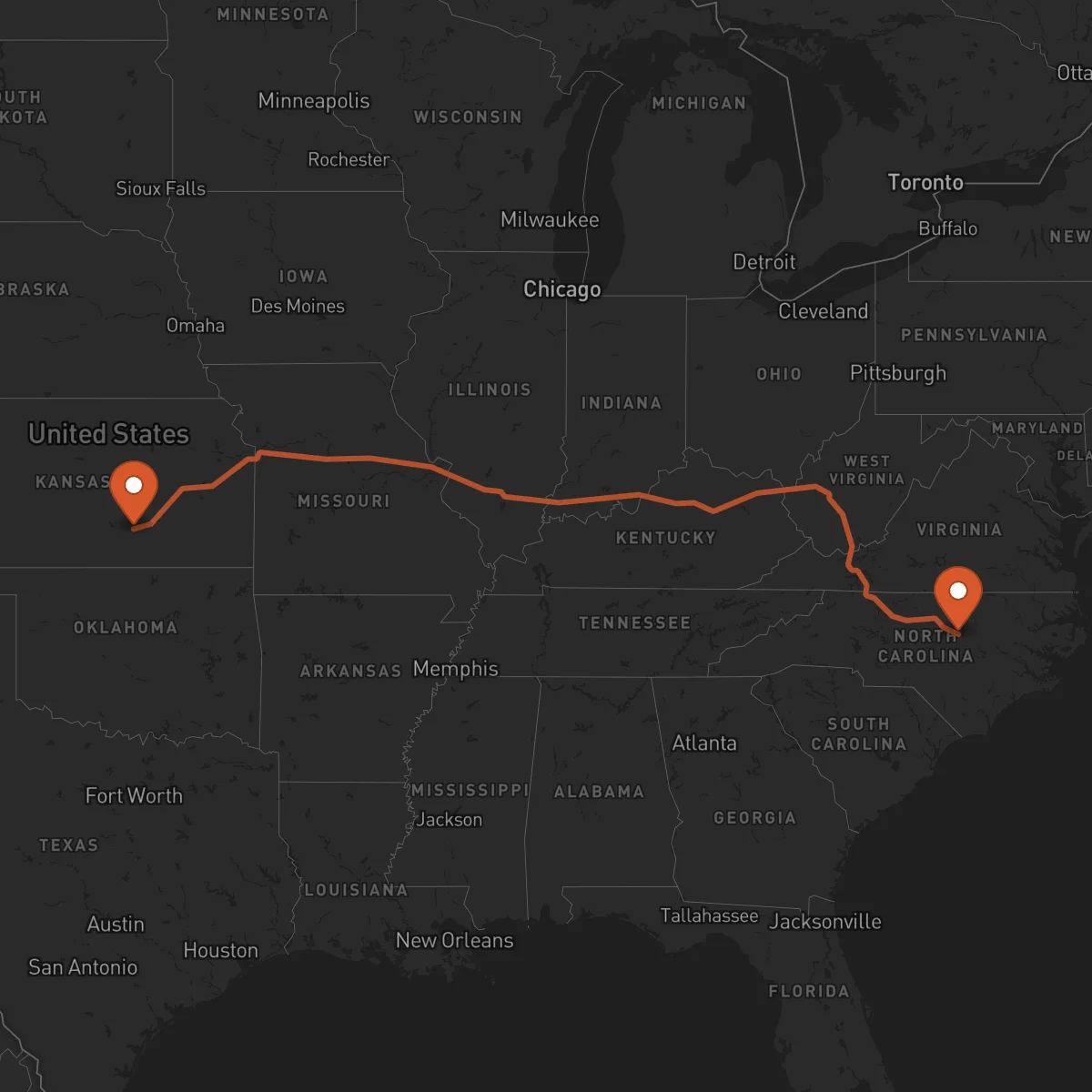
Raleigh to Wichita
Wichita → RaleighFTL freight transportation service between Raleigh and Wichita. Reliable logistics solutions for your business.
Route Description
Everything you need to know about the corridor Raleigh - Wichita
The Raleigh to Wichita corridor represents a vital freight transportation route connecting North Carolina's Research Triangle to the heart of America's aviation industry. This 1677 km domestic route traverses six states, linking the eastern seaboard's technological hub with the Midwest's manufacturing powerhouse. The corridor serves as a crucial artery for specialized cargo moving between the East Coast's research and development centers and the central United States' production facilities.
The economic significance of this route extends beyond simple point-to-point transportation. Raleigh, as part of North Carolina's Research Triangle, generates high-value, technology-driven freight that requires specialized handling and timely delivery. Meanwhile, Wichita's position as the "Air Capital of the World" creates demand for precision logistics services supporting the aerospace manufacturing sector. The corridor facilitates the movement of components, raw materials, and finished products between these complementary economic ecosystems.
Control Terrestre provides comprehensive FTL (Full Truckload) transportation services along this corridor, utilizing our network of certified carriers to ensure reliable, secure freight movement. Our strategic partnerships with transportation providers along the route enable us to offer consistent service quality, real-time tracking, and specialized handling for sensitive cargo. We understand the unique requirements of both technology and aerospace freight, providing the expertise needed to maintain the integrity of shipments throughout the journey.
Services for this Route
Available services for the corridor Raleigh - Wichita
 Origin
Raleigh
Raleigh, North Carolina serves as a strategic logistics hub in the southeastern United States, positioned within the renowned Research Triangle alongside Durham and Chapel Hill. The city's location provides excellent access to major East Coast markets, with proximity to the Port of Virginia and extensive highway networks including I-40 and I-85. Raleigh's infrastructure includes Raleigh-Durham International Airport, supporting air freight operations, and a well-developed network of warehousing and distribution centers catering to the technology and research sectors.
The economic landscape of Raleigh is dominated by technology, research, and education sectors, with major employers including IBM, Cisco Systems, and numerous biotechnology firms. This creates a consistent demand for specialized freight transportation services capable of handling sensitive electronic equipment, laboratory materials, and high-value technology products. The city's growing population and business environment continue to expand logistics requirements, making it an increasingly important origin point for domestic freight movements.
 Destination
Wichita
Wichita, Kansas stands as a critical logistics destination in the American Midwest, strategically positioned at the intersection of major transportation routes including I-35, I-135, and I-235. The city's location provides central access to the continental United States, making it an ideal distribution point for regional and national freight operations. Wichita's Dwight D. Eisenhower National Airport supports significant air cargo operations, while the city's extensive rail connections complement its road transportation infrastructure.
The economic foundation of Wichita centers on aerospace manufacturing, with companies like Boeing, Spirit AeroSystems, and Textron Aviation driving the local economy. This industrial concentration creates specialized logistics needs, particularly for oversized components, precision-engineered parts, and time-sensitive manufacturing materials. The city's manufacturing ecosystem extends beyond aerospace to include food processing, machinery production, and healthcare equipment manufacturing, all requiring reliable freight transportation services to support their supply chains.










