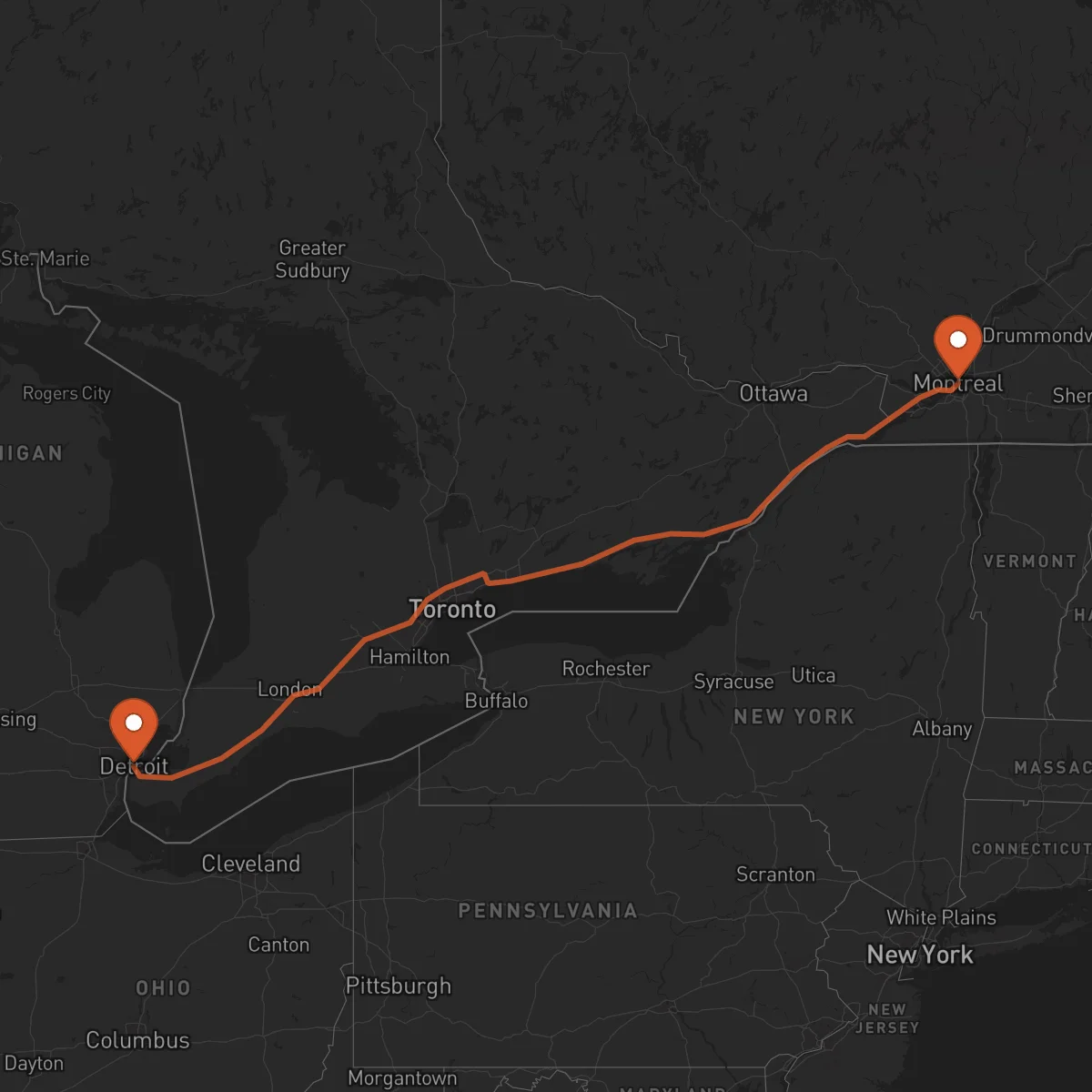
Montreal to Detroit
Detroit → MontrealFTL freight transportation service between Montreal and Detroit. Reliable logistics solutions for your business.
Route Description
Everything you need to know about the corridor Montreal - Detroit
The Montreal-Detroit corridor represents a vital trade artery connecting the industrial heartland of Canada with the automotive capital of the United States. This 836-kilometer cross-border route traverses the Great Lakes region, facilitating the movement of goods between two major economic centers. The corridor's strategic importance stems from its role in supporting North American manufacturing and automotive supply chains, with both cities serving as critical nodes in the continental logistics network.
The region's economic foundation is built on automotive manufacturing, aerospace, advanced manufacturing, and technology sectors. Montreal's diverse industrial base complements Detroit's automotive dominance, creating a symbiotic relationship where parts, components, and finished goods flow continuously between the two cities. Major automotive manufacturers, suppliers, and logistics providers rely on this corridor for just-in-time delivery of critical components and materials.
Transportation infrastructure along this route includes major highways such as Autoroute 20/40 in Quebec, Highway 401 through Ontario, and I-75 through Michigan. The corridor benefits from multiple border crossing options, with the Ambassador Bridge and Detroit-Windsor Tunnel serving as primary crossing points. Control Terrestre's expertise in cross-border operations ensures seamless customs clearance and compliance with both Canadian and US regulations, minimizing delays and optimizing transit times for our clients' shipments.
Services for this Route
Available services for the corridor Montreal - Detroit
 Origin
Montreal stands as a strategic logistics hub in eastern Canada, leveraging its position along the St. Lawrence River and proximity to major US markets. The city's Port of Montreal serves as a critical gateway for international trade, while its extensive rail network connects to continental distribution systems. Montreal's advanced transportation infrastructure includes multiple intermodal terminals, warehousing facilities, and a comprehensive highway network that facilitates efficient distribution throughout Quebec and beyond. The city's economic diversity, encompassing aerospace, technology, pharmaceuticals, and manufacturing sectors, creates consistent freight demand and establishes Montreal as a key origin point for cross-border shipments.
 Destination
Detroit
Detroit's strategic location in the Midwest United States positions it as a critical logistics center for North American commerce. The city's automotive heritage has evolved into a sophisticated manufacturing ecosystem, supported by advanced logistics infrastructure including the Port of Detroit, multiple intermodal facilities, and direct access to major interstate highways. Detroit's central location provides efficient distribution capabilities to major US markets within a day's drive, while its proximity to Canada facilitates seamless cross-border operations. The city's economic revitalization has strengthened its role as a logistics hub, with growing sectors in technology, healthcare, and advanced manufacturing creating new freight transportation opportunities.










