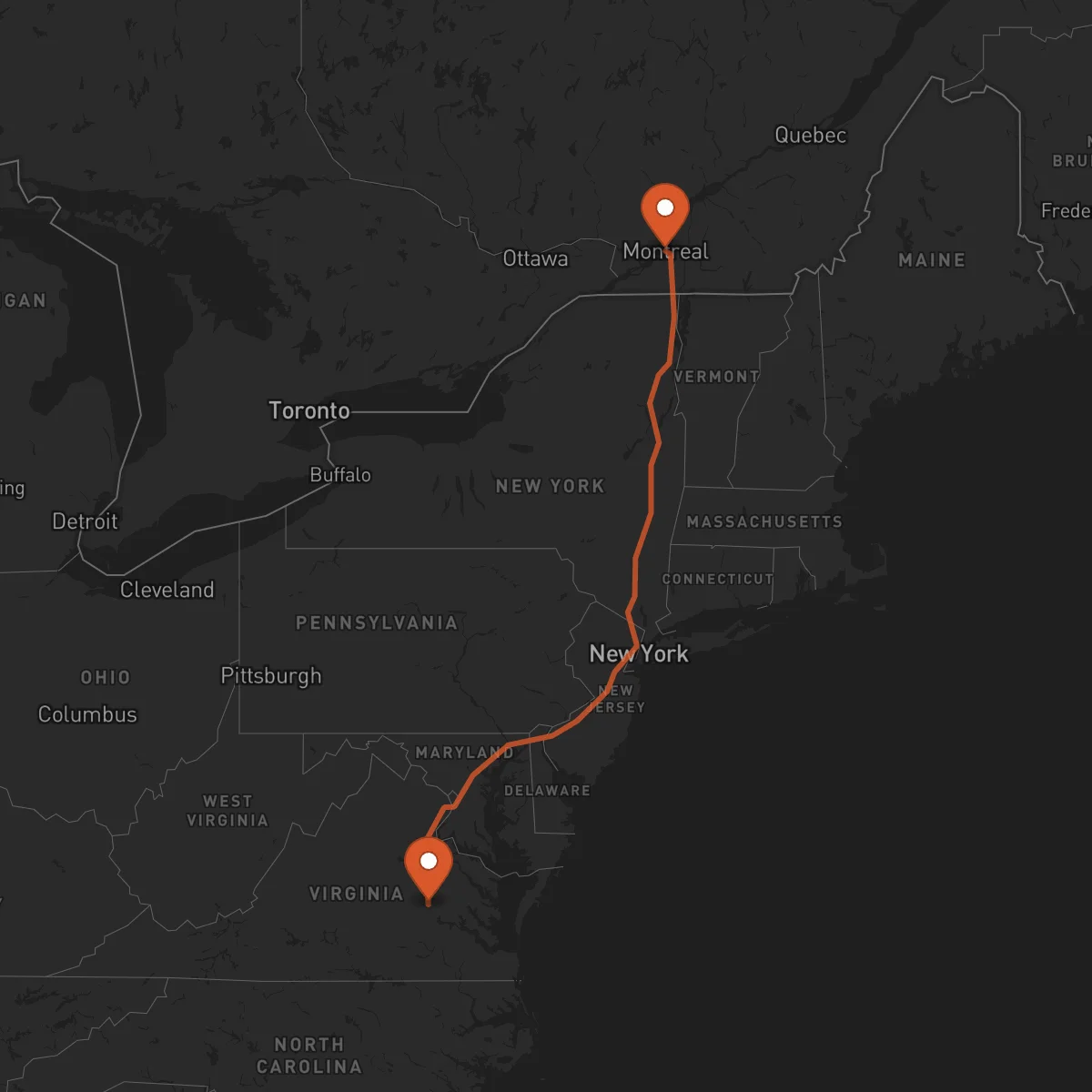
Montreal to Richmond
Richmond → MontrealFTL freight transportation service between Montreal and Richmond. Reliable logistics solutions for your business.
Route Description
Everything you need to know about the corridor Montreal - Richmond
The Montreal to Richmond corridor represents a vital cross-border logistics route connecting Canada's largest province with the Mid-Atlantic region of the United States. This 942 km transportation link facilitates the movement of goods between Quebec's industrial powerhouse and Virginia's growing logistics hub, serving as a critical artery for North American supply chains. The route traverses diverse economic regions, connecting manufacturing centers, distribution hubs, and consumer markets across two nations.
The corridor benefits from excellent transportation infrastructure, primarily utilizing Interstate 81 and connecting highways that provide efficient north-south movement through the Appalachian region. Major border crossings at the Thousand Islands Bridge or Ogdensburg-Prescott Bridge offer streamlined customs processing for qualified freight forwarders. Control Terrestre's expertise in cross-border operations ensures seamless customs clearance and compliance with both US and Canadian regulations, minimizing delays and optimizing transit times for full truckload shipments.
This route serves diverse industries including automotive manufacturing, aerospace components, food and beverage products, and industrial machinery. Montreal's position as a major port and rail hub complements Richmond's strategic location near the US East Coast ports and its growing manufacturing sector. Control Terrestre provides dedicated FTL services along this corridor, offering temperature-controlled options for sensitive cargo and specialized handling for oversized or hazardous materials shipments.
Services for this Route
Available services for the corridor Montreal - Richmond
 Origin
Montreal stands as Quebec's economic engine and Canada's second-largest metropolitan area, offering exceptional logistics advantages. The city's strategic location on the St. Lawrence River provides direct access to Atlantic shipping routes, while its extensive rail network connects to major Canadian and US destinations. Montreal's industrial base includes aerospace manufacturing, pharmaceuticals, food processing, and technology sectors, creating consistent demand for reliable freight transportation. The city's multimodal infrastructure includes the Port of Montreal, extensive highway connections (A-20, A-40), and proximity to major rail terminals, making it an ideal origin point for cross-border shipments to the US market.
 Destination
Richmond
Richmond serves as Virginia's capital and a growing logistics hub in the Mid-Atlantic region. The city's strategic location provides excellent access to major US East Coast markets within a day's drive, while its proximity to the Port of Virginia enhances its appeal for international trade. Richmond's economy features strong healthcare, finance, and manufacturing sectors, with growing distribution and logistics operations taking advantage of the region's transportation infrastructure. The area offers multiple interstate connections (I-95, I-64, I-85) and access to major rail lines, creating efficient distribution networks for goods arriving from Canada and other international sources.










