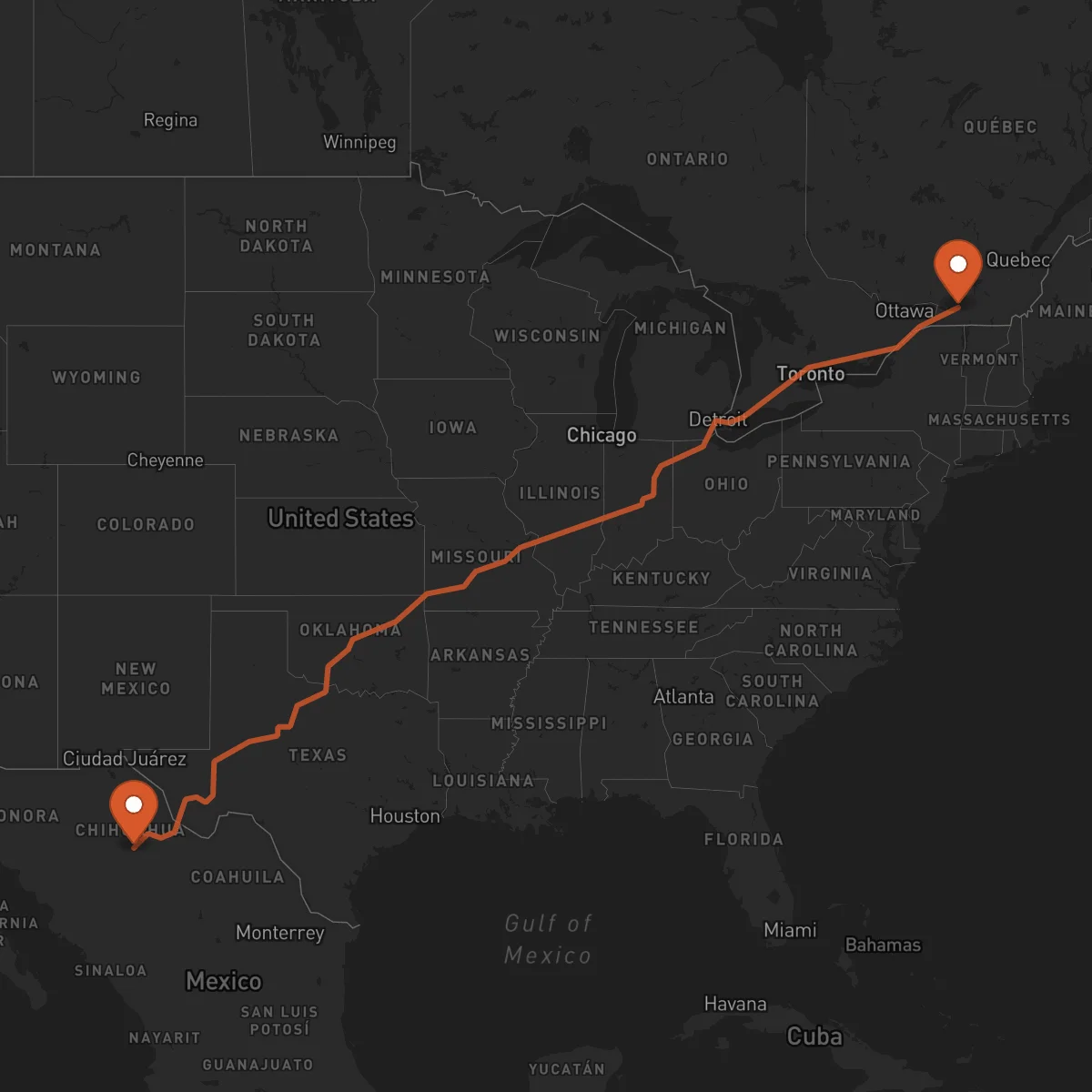
Montreal to Chihuahua
Chihuahua → MontrealFTL freight transportation service between Montreal and Chihuahua. Reliable logistics solutions for your business.
Route Description
Everything you need to know about the corridor Montreal - Chihuahua
The logistics corridor between Montreal and Chihuahua represents a vital commercial link connecting the industrial heart of Canada with the manufacturing hub of northern Mexico. This 3,403 km cross-border route traverses diverse economic regions, facilitating the movement of goods between two major North American markets. The corridor serves as a strategic artery for companies engaged in international trade, particularly those operating under the United States-Mexico-Canada Agreement (USMCA). Control Terrestre specializes in managing the complexities of this international route, ensuring seamless transportation across three countries with varying regulatory requirements and customs procedures.
Services for this Route
Available services for the corridor Montreal - Chihuahua
 Origin
Montreal stands as a premier logistics hub in eastern Canada, strategically positioned along the St. Lawrence River with access to major maritime routes. The city hosts a diverse industrial base including aerospace, pharmaceuticals, advanced manufacturing, and technology sectors. Montreal's extensive transportation infrastructure includes the Port of Montreal, one of North America's busiest ports, comprehensive rail networks operated by CN and CP, and major highways connecting to the U.S. border. The city's proximity to major U.S. markets and its role as a gateway to Atlantic Canada make it an ideal origin point for cross-border freight operations.
 Destination
Chihuahua represents one of Mexico's most important industrial centers, particularly in the automotive, aerospace, and electronics manufacturing sectors. The city's strategic location in northern Mexico provides direct access to U.S. markets while serving as a production center for export-oriented industries. Chihuahua benefits from modern transportation infrastructure including the NAFTA highway corridor, extensive rail connections through Ferromex, and proximity to major border crossings. The region's maquiladora industry and growing technology sector create consistent demand for reliable freight transportation services connecting to Canadian and U.S. suppliers.










