Chihuahua to Montreal
Montreal → ChihuahuaFTL freight transportation service between Chihuahua and Montreal. Reliable logistics solutions for your business.
Route Description
Everything you need to know about the corridor Chihuahua - Montreal
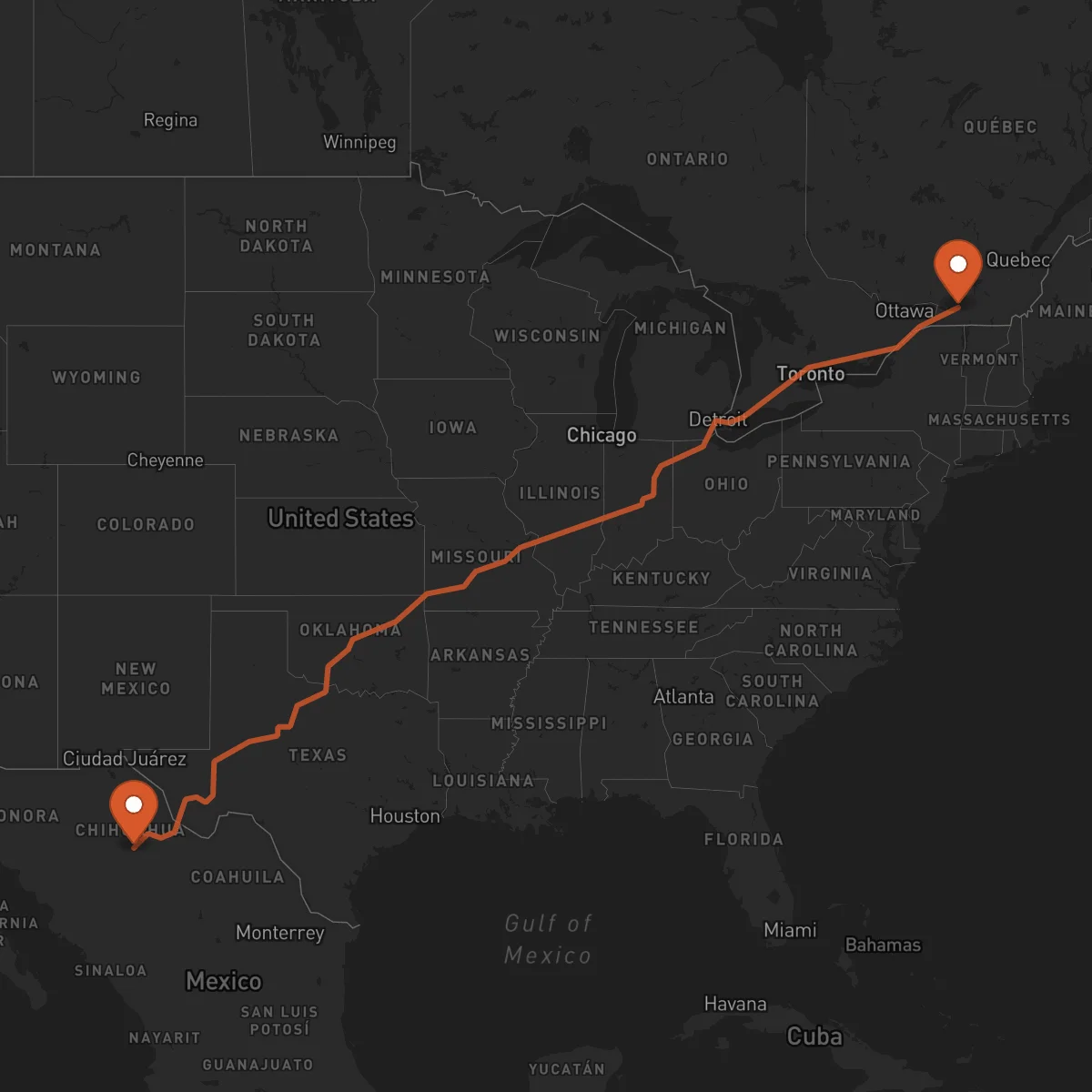
The Chihuahua-Montreal corridor represents a vital logistics link between northern Mexico and eastern Canada, spanning approximately 3,403 kilometers through the heart of North America. This cross-border route connects two major industrial centers, facilitating the movement of goods between Mexico's manufacturing powerhouse and Canada's economic hub. The corridor traverses diverse landscapes and crosses multiple states and provinces, making it a complex but essential trade route for companies operating in both countries.
This route serves as a critical artery for international trade, particularly for industries requiring just-in-time delivery and temperature-controlled transportation. The corridor's significance has grown with the implementation of trade agreements like USMCA, which has further integrated the North American supply chain. Companies rely on this connection to maintain efficient operations between the automotive, aerospace, and electronics sectors that dominate both regions.
Key transportation infrastructure includes Mexico's Federal Highway 45, which connects Chihuahua to the U.S. border, and the extensive network of interstate highways across the United States, including I-35 and I-94. The corridor culminates in Canada's Autoroute 20 and Autoroute 25, providing direct access to Montreal's industrial areas. Major border crossings at El Paso-Ciudad Juárez and various points along the northern U.S. border require careful coordination and compliance with customs regulations.
Control Terrestre facilitates seamless operations along this corridor through our experienced team and certified transportation partners. We navigate the complexities of cross-border documentation, customs clearance, and regulatory compliance, ensuring your cargo moves efficiently between Chihuahua and Montreal. Our dedicated FTL services provide the reliability and security that time-sensitive shipments demand, with real-time tracking and specialized handling for various cargo types throughout the journey.
Services for this Route
Available services for the corridor Chihuahua - Montreal
 Origin
Chihuahua stands as a strategic logistics hub in northern Mexico, serving as the gateway to the country's vast northern region. The city's location near the U.S. border and its position as the capital of Chihuahua state make it a crucial distribution center for both domestic and international commerce. Chihuahua's industrial base includes a strong manufacturing sector, particularly in automotive, aerospace, and electronics, supported by numerous maquiladoras and industrial parks that drive the local economy.
The city benefits from excellent transportation infrastructure, including the Abraham González International Airport, which handles both passenger and cargo operations. Ground transportation is facilitated by Federal Highway 45, connecting Chihuahua to Ciudad Juárez and the U.S. border, as well as other major highways linking to central and southern Mexico. The presence of a railway network further enhances Chihuahua's connectivity, making it an ideal origin point for cross-border freight movements to destinations like Montreal.
 Destination
Montreal serves as a strategic logistics hub in eastern Canada, positioned at the intersection of major trade routes and transportation networks. As the largest city in Quebec and a major port city, Montreal offers unparalleled access to both domestic Canadian markets and international destinations via the St. Lawrence Seaway. The city's location at the confluence of rail, road, air, and maritime transportation makes it an ideal destination for cross-border freight movements from Mexico and the United States.
The Montreal metropolitan area hosts a diverse industrial base, with particular strength in aerospace, pharmaceuticals, electronics, and advanced manufacturing. The city is home to major corporations and research institutions, creating a robust demand for efficient logistics solutions. Montreal's transportation infrastructure includes Pierre Elliott Trudeau International Airport, the Port of Montreal (one of Canada's busiest ports), and an extensive network of highways including Autoroute 20 and Autoroute 25. The presence of major rail terminals and intermodal facilities further enhances Montreal's capability to handle complex supply chain requirements, making it a key destination for freight movements along the Chihuahua-Montreal corridor.










