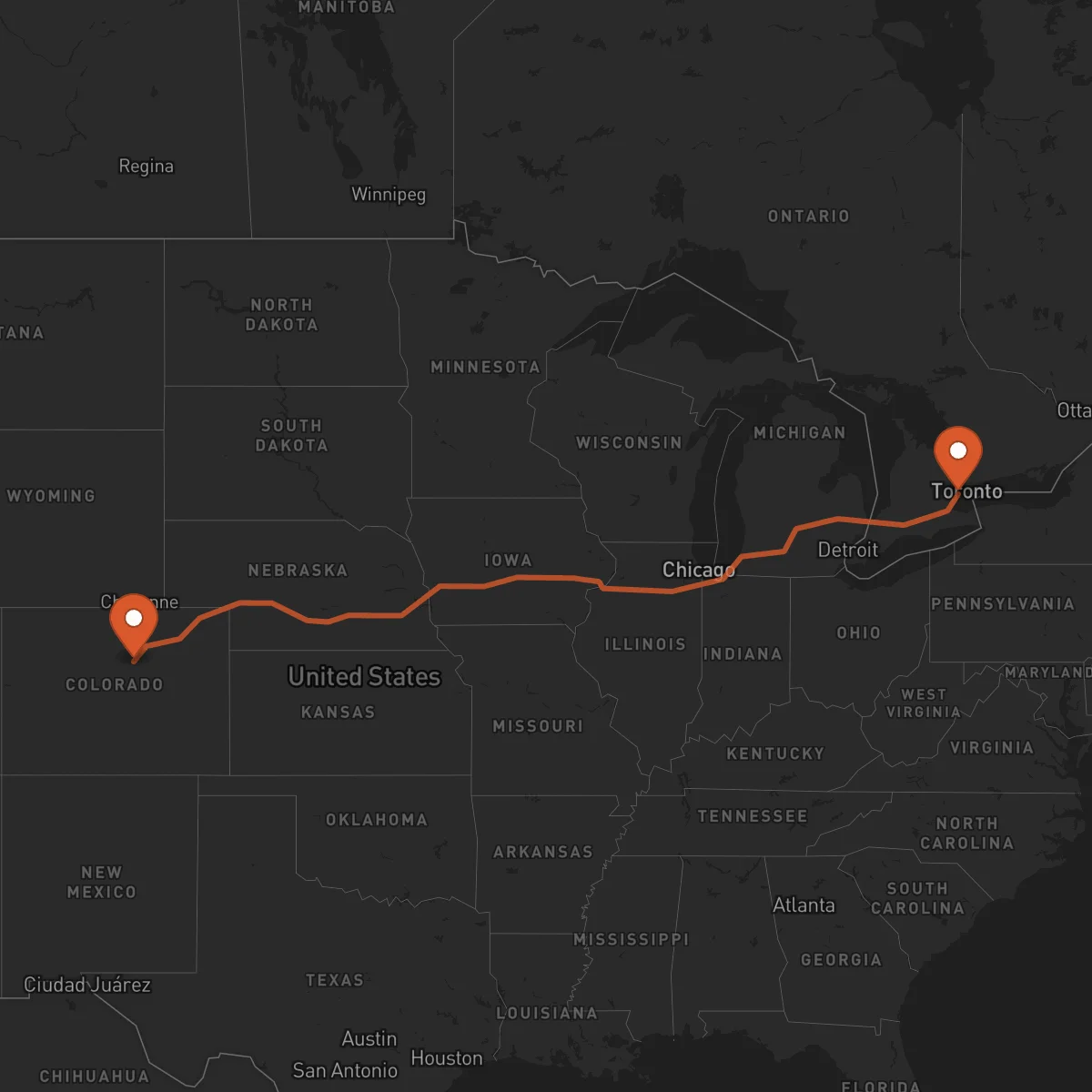
Mississauga to Denver
Denver → MississaugaFTL freight transportation service between Mississauga and Denver. Reliable logistics solutions for your business.
Route Description
Everything you need to know about the corridor Mississauga - Denver
The Mississauga-Denver corridor represents a vital cross-border logistics route connecting the Greater Toronto Area with the heart of the Rocky Mountain region. This 2,140 km transportation link serves as a crucial artery for North American commerce, facilitating the movement of goods between Canada's manufacturing powerhouse and Colorado's growing industrial and technology sectors. The route traverses major economic zones, connecting the Great Lakes industrial corridor with the Mountain West region.
The corridor's strategic importance stems from the complementary economic profiles of both regions. Mississauga, as part of the Greater Toronto Area, serves as a major distribution hub for Canadian and international markets, while Denver functions as a key logistics center for the western United States, with strong aerospace, technology, and energy sectors. This complementary relationship drives consistent freight volumes between these two dynamic markets.
Transportation along this corridor primarily utilizes Interstate 29 and Interstate 25, providing reliable access through major metropolitan areas and industrial zones. The route crosses the Canada-US border at key points such as the Detroit-Windsor crossing or the Sarnia-Port Huron crossing, depending on specific origin and destination points. Control Terrestre's expertise in cross-border operations ensures seamless customs clearance and compliance with all regulatory requirements, minimizing delays and optimizing transit times for full truckload shipments between Mississauga and Denver.
Services for this Route
Available services for the corridor Mississauga - Denver
 Origin
Mississauga stands as a premier logistics hub in Canada, strategically positioned within the Greater Toronto Area. Its proximity to major international airports, including Toronto Pearson International Airport, and extensive rail connections make it an ideal origin point for freight distribution. The city hosts numerous warehousing and distribution centers, serving as a gateway for goods entering and exiting the Canadian market. Mississauga's robust transportation infrastructure includes major highways such as the 401, 407, and QEW, providing excellent connectivity to both Canadian and US markets.
The city's economic landscape is dominated by advanced manufacturing, pharmaceuticals, automotive parts, and technology sectors. These industries generate substantial freight volumes requiring reliable transportation solutions. Mississauga's location near the Canada-US border, combined with its concentration of logistics facilities and cross-docking operations, makes it particularly well-suited for companies seeking efficient distribution networks across North America.
 Destination
Denver
Denver serves as a strategic logistics hub in the western United States, leveraging its central Rocky Mountain location to provide access to major markets across the region. The city's elevation and geographic position make it a natural distribution point for goods moving throughout the Mountain West, Southwest, and Pacific Northwest regions. Denver International Airport, one of the largest cargo airports in the country, combined with extensive rail connections and highway access, creates a multimodal transportation environment ideal for freight operations.
The Denver metropolitan area hosts a diverse industrial base, including aerospace, technology, energy, and outdoor recreation manufacturing. These sectors drive consistent demand for freight transportation, particularly for specialized equipment and time-sensitive deliveries. The city's proximity to major interstate highways, including I-70, I-25, and I-76, ensures efficient connectivity to both coastal and inland markets, making Denver an optimal destination for cross-country freight movements.










