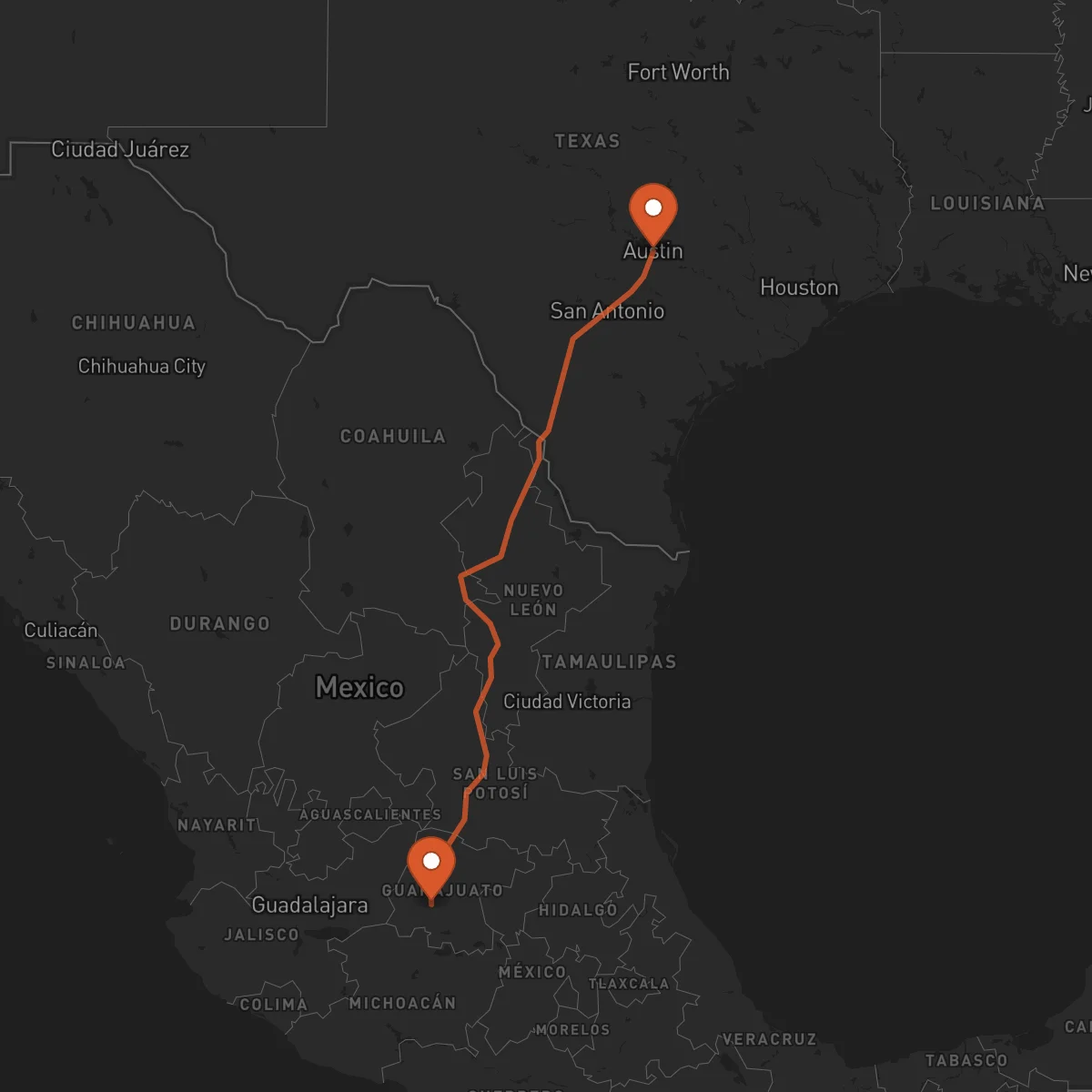
Irapuato to Austin
Austin → IrapuatoFTL freight transportation service between Irapuato and Austin. Reliable logistics solutions for your business.
Route Description
Everything you need to know about the corridor Irapuato - Austin
The Irapuato-Austin corridor represents a vital logistics connection between the industrial heart of central Mexico and one of the most dynamic technology and business hubs in the United States. This 1126 km cross-border route links Guanajuato's automotive and manufacturing powerhouse with Texas's booming technology and innovation ecosystem, facilitating the seamless movement of goods that drive both regional economies. The corridor traverses key industrial zones, crossing through strategic points that connect Mexico's manufacturing sector with North American supply chains.
This transportation route is particularly significant due to the complementary economic activities in both regions. Irapuato serves as a crucial node in Mexico's automotive and aerospace supply chains, while Austin has emerged as a leading center for technology, advanced manufacturing, and research and development. The corridor enables the efficient flow of automotive components, electronic equipment, industrial machinery, and specialized parts that are essential for just-in-time manufacturing processes and modern supply chain operations.
Transportation along this corridor primarily utilizes Mexico's Federal Highway 45 and its connections to U.S. Interstate systems, providing reliable access through established border crossings. Control Terrestre optimizes this route through our specialized cross-border expertise, ensuring compliance with all customs regulations and providing dedicated FTL services that maintain cargo integrity throughout the journey. Our strategic partnerships with certified carriers and our deep understanding of both Mexican and U.S. transportation requirements allow us to deliver consistent, reliable service that meets the demanding needs of industries operating in both markets.
Services for this Route
Available services for the corridor Irapuato - Austin
 Origin
Irapuato
Irapuato stands as one of Guanajuato's most important industrial and logistics centers, strategically positioned in Mexico's central highlands. The city benefits from its location within the Bajío region, Mexico's industrial corridor, providing excellent connectivity to major manufacturing hubs like León, Silao, and Querétaro. Irapuato's transportation infrastructure includes direct access to Federal Highway 45, which connects to Mexico's primary north-south logistics routes, along with a robust network of state highways serving surrounding industrial parks and manufacturing facilities.
The city's economy is heavily focused on automotive manufacturing, aerospace components, and advanced industrial production, hosting numerous maquiladora operations and supplier facilities. Irapuato's industrial parks are equipped with modern warehousing and distribution centers, while the city's logistics ecosystem includes certified customs brokers, freight forwarders, and transportation providers specializing in cross-border operations. The presence of industrial parks with rail connections and proximity to major ports like Lázaro Cárdenas further enhances Irapuato's role as a critical logistics node for both domestic and international supply chains.
 Destination
Austin
Austin represents a strategic logistics destination in central Texas, combining technological innovation with robust industrial and manufacturing capabilities. The city's location provides excellent access to major U.S. transportation networks, including Interstate 35, which connects directly to the Irapuato corridor, and proximity to major Texas ports and rail terminals. Austin's transportation infrastructure includes the Austin-Bergstrom International Airport, extensive highway systems, and growing intermodal facilities that support the region's expanding logistics needs.
The Austin metropolitan area has evolved into a major technology and business center, hosting headquarters and operations for numerous global technology companies, advanced manufacturing facilities, and research institutions. The region's economy is characterized by high-tech industries, including semiconductor manufacturing, software development, aerospace, and medical technology. Austin's strategic position within Texas's business-friendly environment, combined with its skilled workforce and innovation ecosystem, makes it an increasingly important destination for specialized freight and time-sensitive cargo moving through North American supply chains.










