Houston to Detroit
Detroit → HoustonFTL freight transportation service between Houston and Detroit. Reliable logistics solutions for your business.
Route Description
Everything you need to know about the corridor Houston - Detroit
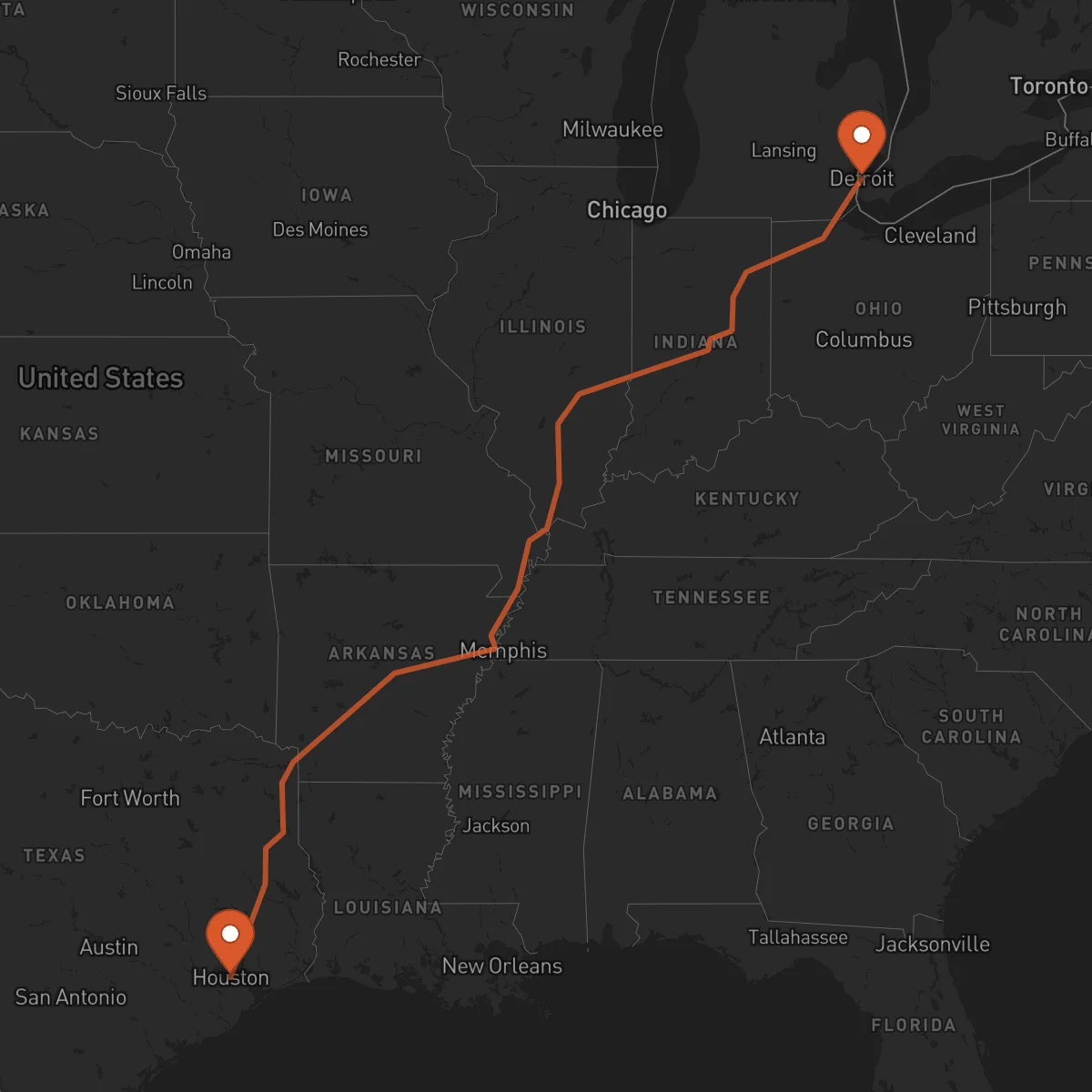
The Houston-Detroit corridor represents one of the most critical freight transportation routes in the United States, connecting the energy and petrochemical hub of Texas with the automotive manufacturing center of Michigan. This 1,780 km route traverses the heart of America's industrial landscape, facilitating the movement of essential goods between two major economic regions. The corridor serves as a vital link in the North American supply chain, supporting industries ranging from automotive and aerospace to energy and consumer goods.
The route primarily follows Interstate 45 and Interstate 75, passing through key logistics hubs including Dallas, Memphis, and Toledo. This infrastructure provides reliable year-round transportation capabilities, though seasonal weather variations require strategic planning for winter operations in the northern sections. Control Terrestre leverages this established infrastructure to provide efficient FTL transportation services, ensuring consistent delivery schedules and optimized routing for our clients' cargo.
Our Houston-Detroit operations support the automotive industry's just-in-time manufacturing requirements, energy sector equipment movements, and cross-sector supply chain needs. We understand the specific requirements of these industries, from temperature-controlled shipments for sensitive components to specialized handling for oversized equipment. Our strategic partnerships with carriers along this corridor ensure capacity availability and competitive pricing, while our advanced tracking systems provide real-time visibility throughout the journey.
Services for this Route
Available services for the corridor Houston - Detroit
 Origin
Houston
Houston stands as a global energy capital and one of America's most important logistics hubs. The Port of Houston, combined with extensive rail connections and a network of interstate highways, creates a multimodal transportation ecosystem that serves as the gateway for energy, petrochemical, and industrial goods moving throughout North America. Houston's strategic Gulf Coast location provides access to international shipping routes while its proximity to major production centers in Texas ensures efficient domestic distribution.
The city's economy is anchored by the energy sector, with numerous refineries, chemical plants, and manufacturing facilities requiring reliable freight transportation. Houston's logistics infrastructure includes the George Bush Intercontinental Airport, two major rail terminals, and a comprehensive highway network centered around I-10, I-45, and I-69. This infrastructure supports the movement of everything from raw materials and industrial equipment to finished products and consumer goods, making Houston an ideal origin point for FTL shipments to destinations across the United States.
 Destination
Detroit
Detroit represents the heart of America's automotive industry and serves as a crucial logistics hub in the Midwest. The city's strategic location in southeastern Michigan provides access to major manufacturing centers, including the renowned 'Motor City' assembly plants and numerous automotive suppliers throughout the region. Detroit's transportation infrastructure includes the Ambassador Bridge and Detroit-Windsor Tunnel for cross-border operations, extensive rail networks, and proximity to major highways I-75, I-94, and I-96.
The Detroit metropolitan area hosts a diverse industrial base beyond automotive, including advanced manufacturing, aerospace, and technology sectors. The region's logistics capabilities are enhanced by the Port of Detroit on the Detroit River and multiple intermodal facilities that facilitate efficient cargo movement. Detroit's central location in the Great Lakes region makes it an ideal destination for freight from across the country, with the city's infrastructure designed to handle high-volume industrial shipments and support just-in-time manufacturing requirements.










