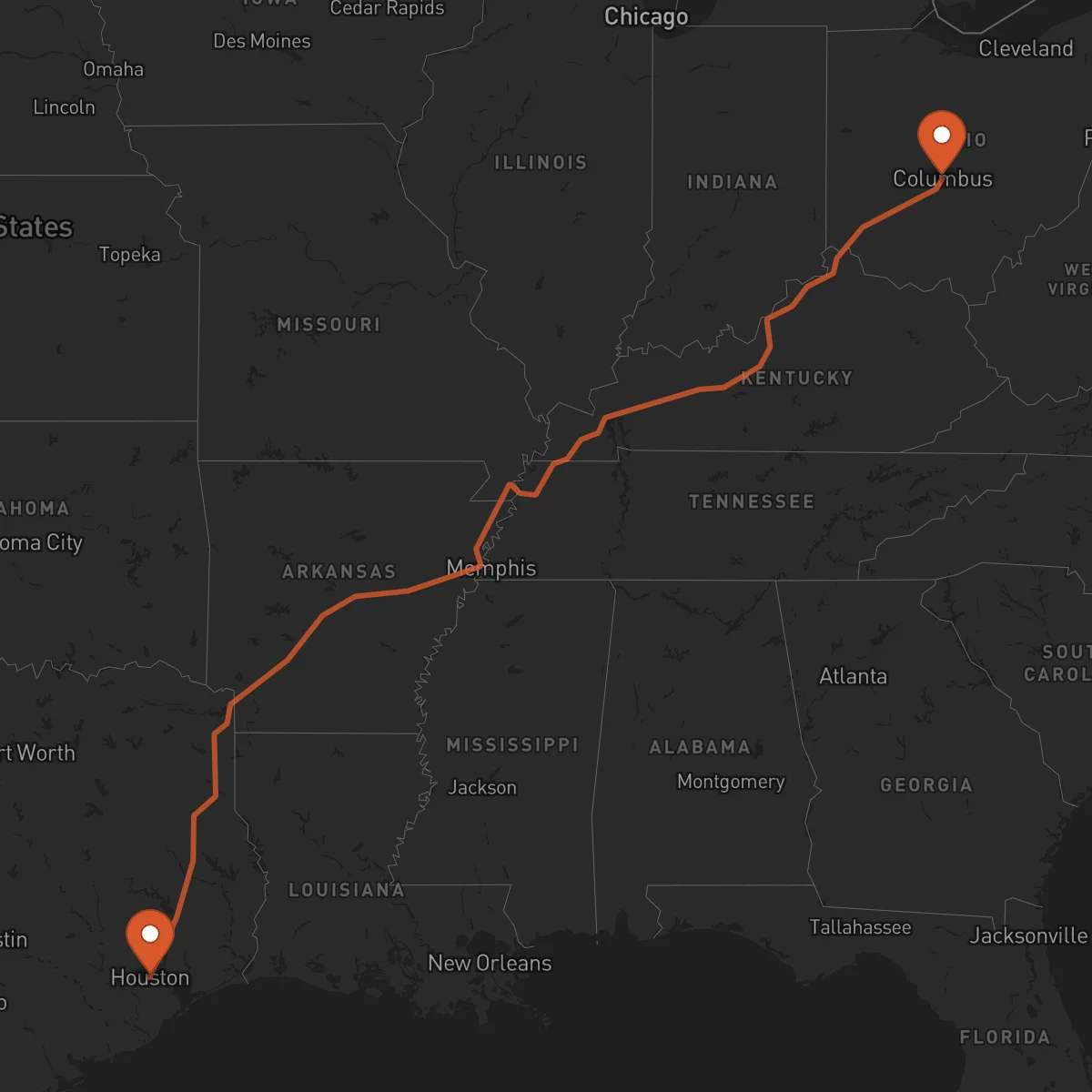
Houston to Columbus
Columbus → HoustonFTL freight transportation service between Houston and Columbus. Reliable logistics solutions for your business.
Route Description
Everything you need to know about the corridor Houston - Columbus
The Houston-Columbus corridor represents one of the most important freight transportation routes in the central United States, connecting Texas' largest economic hub with Ohio's state capital. This 1,597 km route traverses multiple states and crosses diverse industrial regions, facilitating the movement of goods between the Gulf Coast and the Midwest.
The economic significance of this corridor is substantial, linking Houston's energy and petrochemical industries with Columbus' growing manufacturing and distribution sectors. This route enables efficient supply chain operations between two major economic centers, supporting industries ranging from automotive to consumer goods. The corridor benefits from Houston's strategic position as a gateway to international trade and Columbus' role as a logistics hub in the Midwest.
Transportation infrastructure along this corridor is robust, primarily utilizing major highways including I-45, I-30, I-40, and I-70. These interstate connections provide reliable and efficient freight movement across multiple states. The route passes through key logistics centers and industrial zones, offering multiple options for strategic loading and unloading points.
Control Terrestre optimizes freight transportation along this corridor through our extensive network of certified carriers and specialized equipment. Our dedicated services ensure that shipments move efficiently from origin to destination, with real-time tracking and professional handling throughout the journey. We understand the specific requirements of each industry served by this route and provide tailored solutions that meet their unique transportation needs.
Services for this Route
Available services for the corridor Houston - Columbus
 Origin
Houston
Houston stands as a critical logistics hub in the southern United States, offering unparalleled connectivity for freight transportation. The city's strategic location on the Gulf Coast provides direct access to international ports and major rail networks, making it an ideal origin point for nationwide freight movements. Houston's extensive highway system, including I-10, I-45, and I-69, creates multiple efficient routes for cargo distribution.
The city's economy is dominated by the energy sector, with numerous refineries, petrochemical plants, and related industries requiring reliable freight transportation. Additionally, Houston's diverse economy includes significant aerospace, healthcare, and manufacturing sectors, all of which depend on efficient logistics solutions. The Port of Houston, one of the busiest in the nation, further enhances the city's position as a critical logistics center, facilitating both domestic and international freight movements.
 Destination
Columbus
Columbus, Ohio serves as a strategic logistics hub in the Midwest, offering excellent connectivity and distribution capabilities. The city's central location within the state and its proximity to major population centers make it an ideal destination for freight transportation. Columbus benefits from its position at the intersection of several major highways, including I-70 and I-71, providing efficient access to the broader Midwest region.
The Columbus metropolitan area has experienced significant economic growth, particularly in manufacturing, healthcare, and technology sectors. The city hosts several major distribution centers and warehouses, taking advantage of its central location for regional distribution. Columbus' infrastructure includes the Rickenbacker International Airport and its growing cargo operations, complementing the city's strong ground transportation network. The presence of The Ohio State University also contributes to the local economy, creating demand for specialized freight services in research and development sectors.










