Hamilton to Concord
Concord → HamiltonFTL freight transportation service between Hamilton and Concord. Reliable logistics solutions for your business.
Route Description
Everything you need to know about the corridor Hamilton - Concord
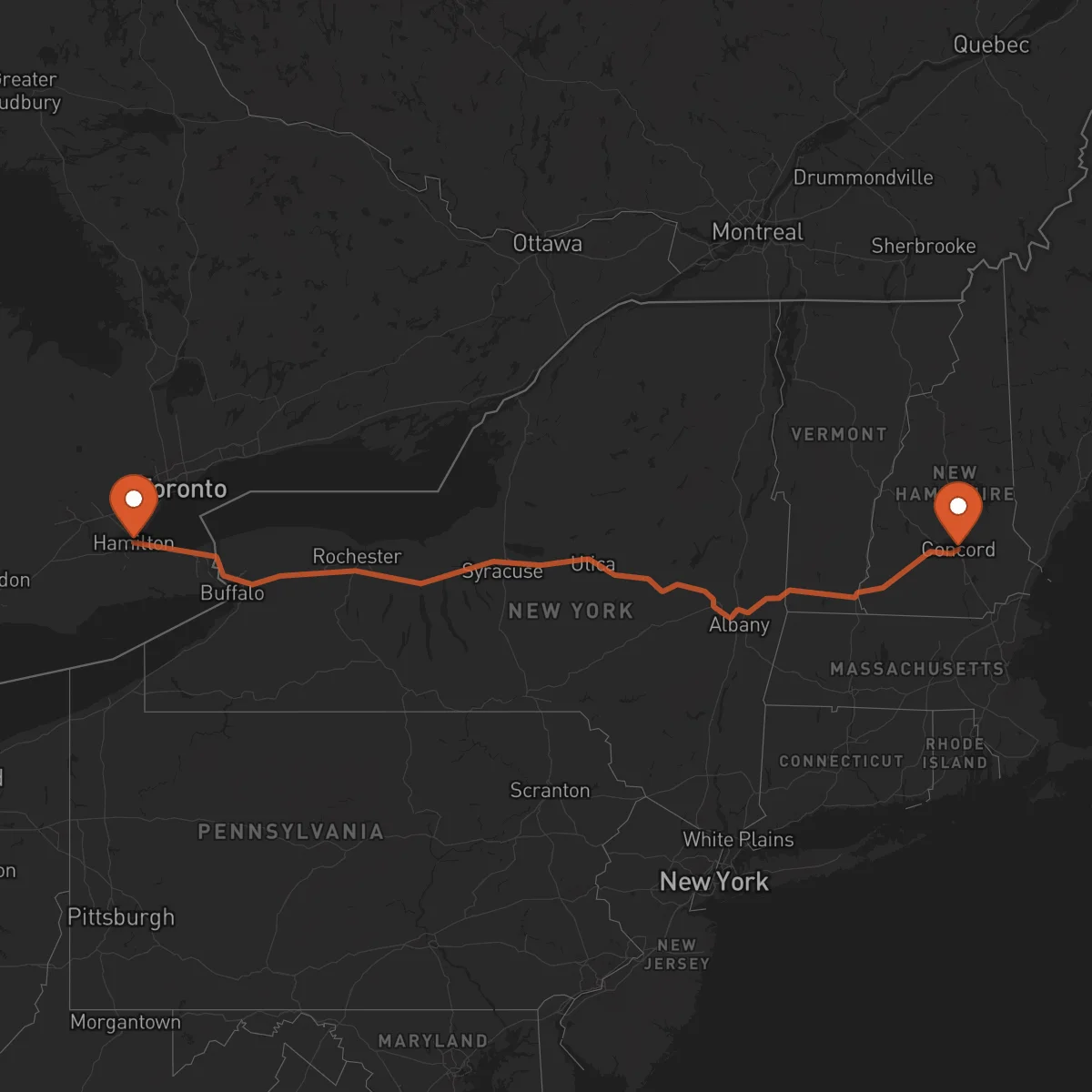
The logistics corridor connecting Hamilton, Ontario, Canada to Concord, New Hampshire, United States represents a vital cross-border transportation route spanning approximately 675 kilometers. This corridor links two important economic centers in North America, facilitating the movement of goods between Canada and the northeastern United States. The route traverses diverse terrain and crosses international borders, making it a strategic pathway for businesses engaged in cross-border trade between these two nations.
The region along this corridor is characterized by a strong industrial presence, with Hamilton serving as a major industrial hub in Canada, known for its steel production, manufacturing, and advanced technology sectors. Concord, as the capital of New Hampshire, hosts a diverse economy including government services, healthcare, education, and manufacturing. The corridor supports industries such as automotive parts, electronics, machinery, and consumer goods, with businesses relying on efficient freight transportation to maintain their supply chains.
Key transportation infrastructure along this route includes major highways such as the QEW (Queen Elizabeth Way) and Highway 401 in Ontario, connecting to Interstate 89 and Interstate 93 in the United States. The corridor typically involves crossing at international border points, with customs clearance being a critical component of cross-border operations. Control Terrestre facilitates seamless operations on this corridor by leveraging our network of certified carriers, ensuring compliance with customs regulations, and providing reliable full truckload (FTL) transportation services that keep your cargo moving efficiently between Hamilton and Concord.
Services for this Route
Available services for the corridor Hamilton - Concord
 Origin
Hamilton, Ontario, is strategically located on the western tip of Lake Ontario, approximately 70 kilometers southwest of Toronto. This positioning makes it a crucial logistics hub with access to major transportation networks including the Queen Elizabeth Way (QEW), Highway 403, and the Canadian National Railway. Hamilton's port facilities on Lake Ontario provide additional multimodal transportation options, enhancing its connectivity to both domestic and international markets. The city's proximity to the U.S. border further strengthens its role in cross-border logistics operations.
The city's economy is anchored by a diverse industrial base, with steel manufacturing historically being a cornerstone of Hamilton's economic identity through companies like ArcelorMittal Dofasco. Beyond steel, Hamilton has developed significant capabilities in advanced manufacturing, aerospace, automotive parts production, and food processing. The presence of McMaster University and other research institutions has fostered growth in technology and innovation sectors. These industries generate substantial freight volumes requiring reliable transportation solutions, making Hamilton an ideal origin point for cross-border freight movements.
 Destination
Concord
Concord, New Hampshire, serves as the state capital and is strategically positioned in the Merrimack Valley region of south-central New Hampshire. Located approximately 100 kilometers north of Boston, Massachusetts, Concord benefits from its proximity to major northeastern U.S. markets while maintaining its own regional significance. The city is well-connected through Interstate 93, which provides direct access to both Boston and northern New England, making it an accessible destination for freight transportation from Canadian origins.
The Concord area's economy is characterized by a mix of government services, healthcare, education, and manufacturing. As the state capital, it hosts numerous state government offices and related services. The healthcare sector is prominent, with Concord Hospital serving as a major employer and healthcare provider for the region. Manufacturing remains important, with companies producing electronics, machinery, and other industrial goods. The presence of educational institutions, including the University of New Hampshire School of Law, contributes to a skilled workforce. These diverse economic activities create consistent demand for freight transportation services, particularly for specialized and time-sensitive cargo moving across the border.










