Greensboro to Tijuana
Tijuana → GreensboroFTL freight transportation service between Greensboro and Tijuana. Reliable logistics solutions for your business.
Route Description
Everything you need to know about the corridor Greensboro - Tijuana
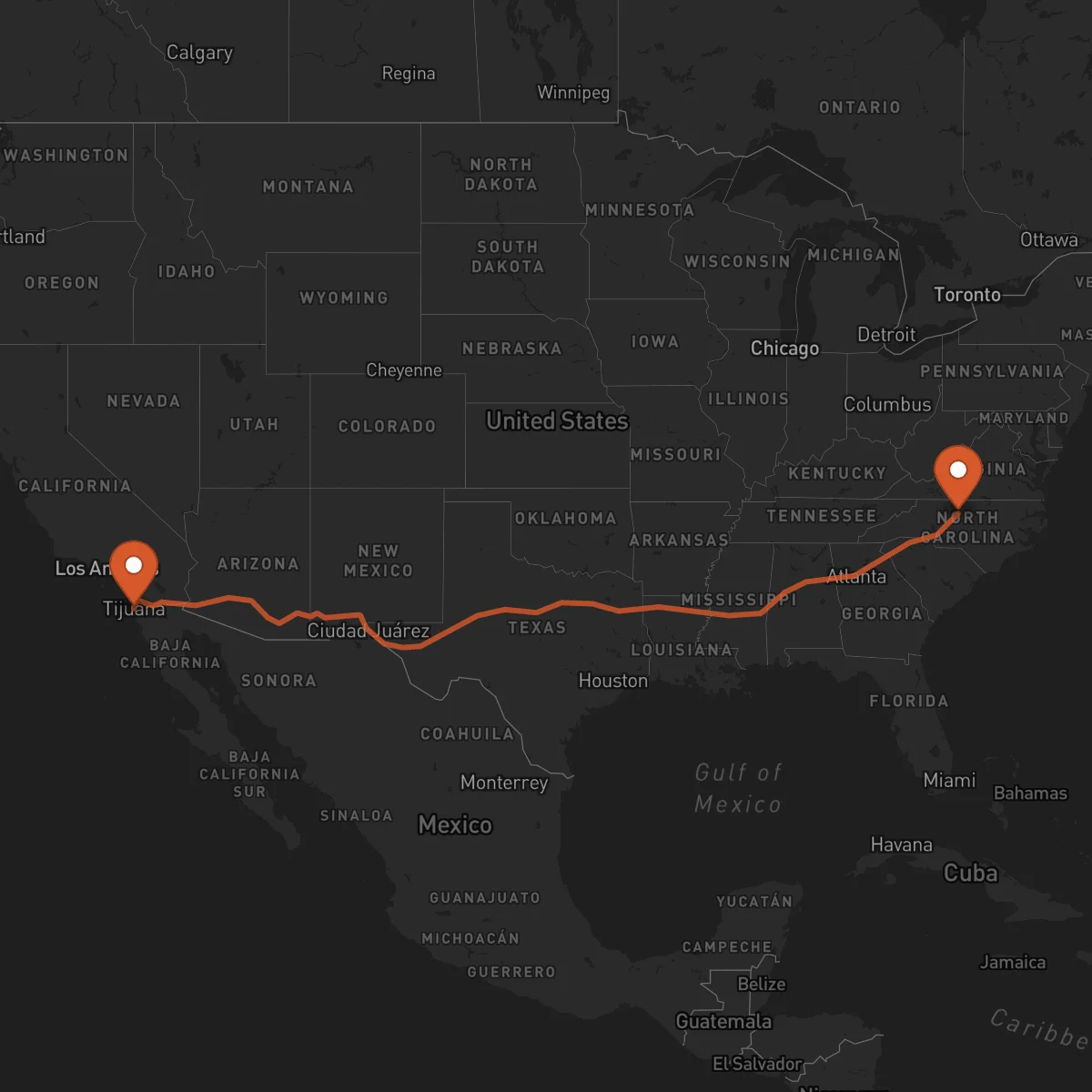
The Greensboro-Tijuana corridor connects the industrial heart of North Carolina with the dynamic manufacturing hub of Baja California, representing a vital trade link between the United States and Mexico. This 3,421 km route facilitates the movement of goods between two major economic regions, supporting the automotive, aerospace, and electronics industries that dominate both markets. The corridor leverages the strategic location of Greensboro, situated near major East Coast ports and manufacturing centers, with Tijuana's position as a gateway to the Pacific and its proximity to San Diego's logistics infrastructure.
The transportation infrastructure along this corridor includes major interstate highways such as I-40, I-20, and I-10, connecting through key logistics hubs like Dallas and Phoenix before reaching the California-Mexico border. The route utilizes primary border crossings at San Ysidro or Otay Mesa, where C-TPAT-certified carriers and customs brokers ensure efficient processing of cross-border shipments. Control Terrestre's expertise in navigating these border procedures, combined with our network of certified carriers, enables seamless freight movement across this extensive trade corridor.
This cross-border route is particularly crucial for companies in the automotive supply chain, medical device manufacturing, and consumer electronics sectors, where just-in-time delivery and supply chain reliability are paramount. Control Terrestre provides dedicated full truckload services along this corridor, offering temperature-controlled options for sensitive cargo and specialized handling for oversized or hazardous materials. Our team coordinates all aspects of the journey, from origin pickup in Greensboro to final delivery in Tijuana, ensuring compliance with both US and Mexican transportation regulations and providing real-time tracking throughout the entire route.
Services for this Route
Available services for the corridor Greensboro - Tijuana
 Origin
Greensboro
Greensboro, North Carolina serves as a strategic logistics hub in the southeastern United States, positioned within the Piedmont Triad region's extensive transportation network. The city benefits from proximity to major East Coast ports including Wilmington and Norfolk, as well as access to three major interstate highways (I-40, I-85, and I-73). Greensboro's central location allows for efficient distribution throughout the eastern United States within a 24-hour drive radius of major metropolitan areas.
The region's economy is anchored by strong manufacturing and logistics sectors, with particular strengths in textiles, biotechnology, and advanced manufacturing. The presence of major distribution centers, including the FedEx hub at Piedmont Triad International Airport, reinforces Greensboro's role as a critical node in North American supply chains. The city's industrial parks and warehouse facilities provide modern infrastructure for freight consolidation and value-added services before cross-border shipment.
 Destination
Tijuana
Tijuana, Baja California stands as Mexico's leading manufacturing and logistics center, strategically positioned along the US-Mexico border just south of San Diego, California. The city's location provides immediate access to the Pacific Ocean, major US transportation networks, and serves as a primary gateway for trade between the United States and Mexico. Tijuana's proximity to San Diego International Airport and the Port of San Diego enhances its connectivity to global markets.
The city's economy is dominated by the medical device, aerospace, electronics, and automotive industries, with over 600 manufacturing plants (maquiladoras) operating in the region. Tijuana's industrial infrastructure includes modern manufacturing parks, specialized logistics zones, and a growing network of cold storage and temperature-controlled facilities. The region's well-developed highway system connects to Mexico's major transportation corridors, facilitating efficient distribution throughout the country and beyond.










