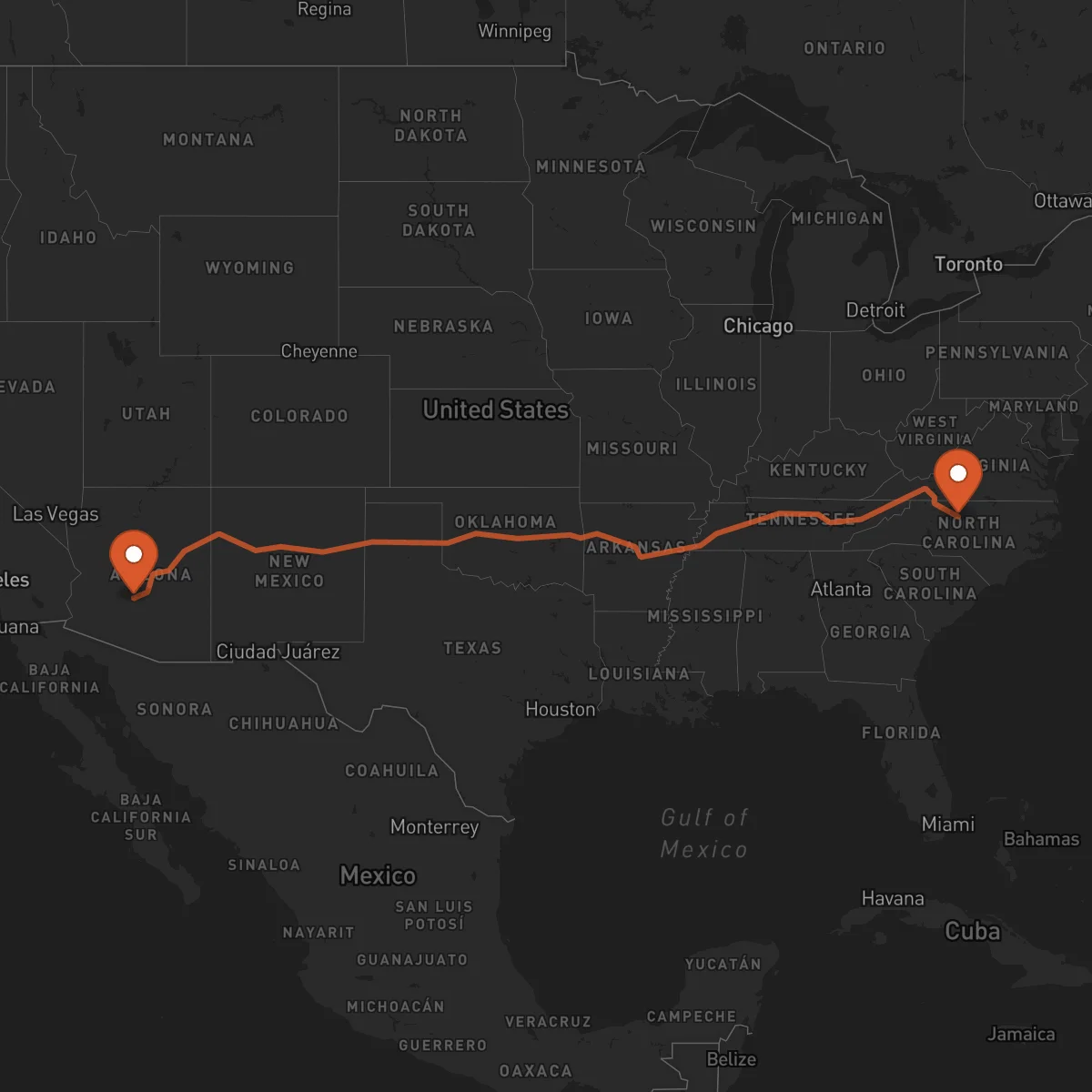
Greensboro to Phoenix
Phoenix → GreensboroFTL freight transportation service between Greensboro and Phoenix. Reliable logistics solutions for your business.
Route Description
Everything you need to know about the corridor Greensboro - Phoenix
The logistics corridor between Greensboro, North Carolina, and Phoenix, Arizona, represents a vital connection between the industrial East Coast and the booming Southwest region of the United States. This 2,950 km route traverses diverse landscapes and crosses multiple states, serving as a critical artery for freight transportation that supports the economic integration of these two dynamic regions.
The route connects Greensboro's established manufacturing and distribution hub with Phoenix's rapidly growing technology, aerospace, and logistics sectors. Along the way, this corridor facilitates the movement of goods through key economic centers including Nashville, Memphis, Dallas, and Tucson. The strategic importance of this connection continues to grow as Phoenix emerges as a major logistics hub for the southwestern United States and Mexico border trade.
This corridor is particularly crucial for industries such as automotive parts, electronics, aerospace components, and consumer goods. Manufacturing facilities in Greensboro require timely delivery of specialized components to support just-in-time production schedules, while Phoenix's expanding e-commerce and retail sectors depend on consistent inbound freight to meet consumer demand.
Control Terrestre provides dedicated full truckload (FTL) services along this corridor, utilizing our extensive network of certified carriers and strategic partnerships. Our expertise in managing cross-country freight ensures reliable, efficient transportation with real-time tracking and dedicated support throughout the journey. We understand the unique requirements of each industry served by this route and tailor our solutions to meet specific cargo handling, scheduling, and delivery needs.
Services for this Route
Available services for the corridor Greensboro - Phoenix
 Origin
Greensboro
Greensboro, located in the Piedmont Triad region of North Carolina, serves as a strategic logistics hub with excellent connectivity to major East Coast markets. The city's central location within the state provides access to a 180-mile radius encompassing over 5 million consumers and numerous major metropolitan areas. Greensboro benefits from its proximity to the Port of Virginia and Port of Wilmington, making it an ideal consolidation point for both inbound and outbound freight.
The region's economy is anchored by strong manufacturing, healthcare, and education sectors. Major employers include Honda Aircraft Company, Mack Trucks, and numerous textile and furniture manufacturers. The presence of major distribution centers for companies like Amazon, FedEx, and UPS further establishes Greensboro as a critical node in the national supply chain. The city's transportation infrastructure includes direct access to Interstate 40/85, a major east-west freight corridor, and proximity to Piedmont Triad International Airport, which handles significant air cargo operations.
 Destination
Phoenix
Phoenix, Arizona, has emerged as one of the fastest-growing logistics hubs in the United States, driven by its strategic location, business-friendly environment, and expanding population. The city's position in the Southwest provides excellent connectivity to major West Coast ports, Mexico, and the broader southwestern region. Phoenix's logistics infrastructure continues to expand with new warehousing and distribution facilities to support the region's economic growth.
The Phoenix metropolitan area hosts a diverse economy with strong representation in aerospace and defense, technology, healthcare, and advanced manufacturing. Major employers include Honeywell Aerospace, Intel, and Boeing, along with a growing number of data centers and logistics companies. The region's transportation infrastructure includes extensive highway networks (I-10, I-17, Loop 101, Loop 202), Phoenix Sky Harbor International Airport (one of the busiest cargo airports in the country), and Union Pacific's intermodal facilities. The city's flat terrain and favorable weather conditions make it particularly suitable for logistics operations year-round.










