El Paso to Raleigh
Raleigh → El PasoFTL freight transportation service between El Paso and Raleigh. Reliable logistics solutions for your business.
Route Description
Everything you need to know about the corridor El Paso - Raleigh
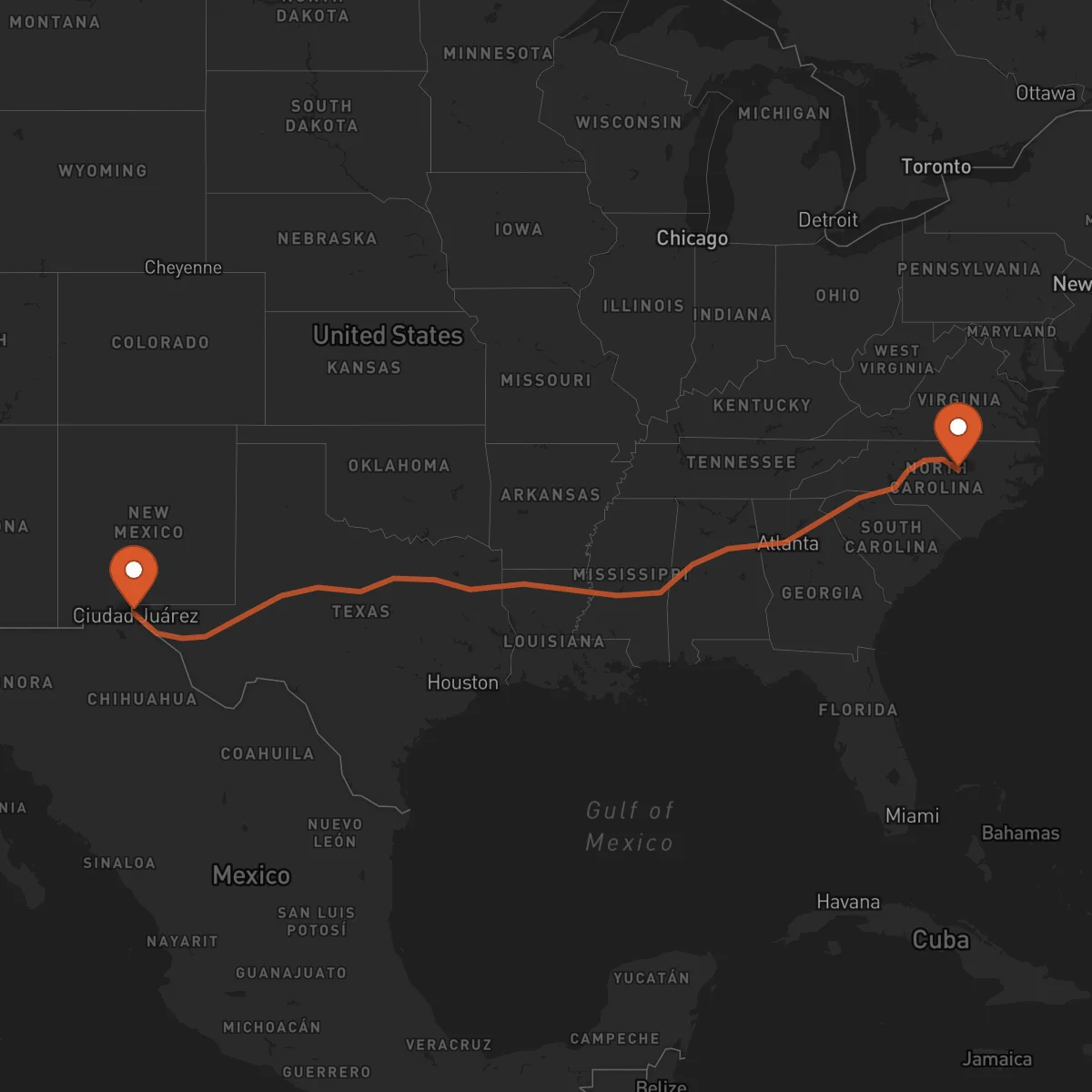
The logistics corridor connecting El Paso, Texas, to Raleigh, North Carolina, represents a vital freight transportation route spanning approximately 2,603 kilometers across the United States. This east-west corridor traverses diverse geographic regions and industrial zones, serving as a critical link between the southwestern border region and the southeastern economic hub. The route facilitates the movement of goods between two dynamic economic centers, supporting supply chain operations for businesses operating across multiple states.
The corridor passes through key states including Texas, Louisiana, Mississippi, Alabama, Georgia, and North Carolina, crossing major industrial and agricultural regions. This strategic pathway connects the manufacturing and distribution capabilities of the Southwest with the growing technology, research, and manufacturing sectors of the Southeast. The route serves as a backbone for interregional commerce, enabling efficient freight movement between the Mexican border and the Atlantic coast.
Major highways facilitating this corridor include I-10 East from El Paso through Texas, I-12 and I-10 across Louisiana, I-59 through Mississippi and Alabama, I-20 through Atlanta, and I-85 North into North Carolina to Raleigh. This interstate network provides reliable, high-capacity transportation infrastructure optimized for full truckload freight movement. Control Terrestre leverages this established infrastructure to provide seamless FTL transportation services, ensuring cargo moves efficiently and securely between these strategic points while maintaining the highest standards of service and reliability.
Services for this Route
Available services for the corridor El Paso - Raleigh
 Origin
El Paso
El Paso, Texas, serves as a strategic gateway for logistics operations, positioned at the U.S.-Mexico border and offering unique advantages for freight transportation. The city's location provides direct access to major cross-border trade routes and connects to the extensive North American transportation network. El Paso's economy is diverse, with strong presence in manufacturing, logistics, military operations, and international trade, making it a critical node in regional supply chains. The city hosts several industrial parks and distribution centers that support both domestic and international freight movement.
The transportation infrastructure in El Paso is robust, featuring multiple interstate highways including I-10, which runs east-west across the southern United States. The city also benefits from El Paso International Airport for air freight options and the Union Pacific Railroad for intermodal services. The border crossing facilities are among the busiest in the country, facilitating efficient freight movement between the United States and Mexico. This comprehensive infrastructure network makes El Paso an ideal origin point for full truckload shipments heading to destinations across the eastern United States.
 Destination
Raleigh
Raleigh, North Carolina, stands as a strategic logistics hub in the southeastern United States, serving as the capital city of North Carolina and a center for technology, research, and education. The Research Triangle area, which includes Raleigh, Durham, and Chapel Hill, hosts numerous technology companies, research institutions, and advanced manufacturing facilities. This creates consistent demand for reliable freight transportation services to support the region's knowledge-based economy. Raleigh's economic diversity extends to healthcare, education, government services, and emerging industries, all requiring efficient logistics solutions.
The city benefits from excellent transportation infrastructure, including proximity to major highways such as I-40, I-85, and I-95, which provide connectivity to regional and national markets. Raleigh-Durham International Airport offers air cargo services, while the nearby Port of Wilmington provides ocean freight access approximately 200 kilometers away. The region's rail network, operated by Norfolk Southern and CSX, supports intermodal transportation options. This comprehensive infrastructure makes Raleigh an ideal destination for full truckload freight shipments, with the capacity to handle diverse cargo types and volumes efficiently.










