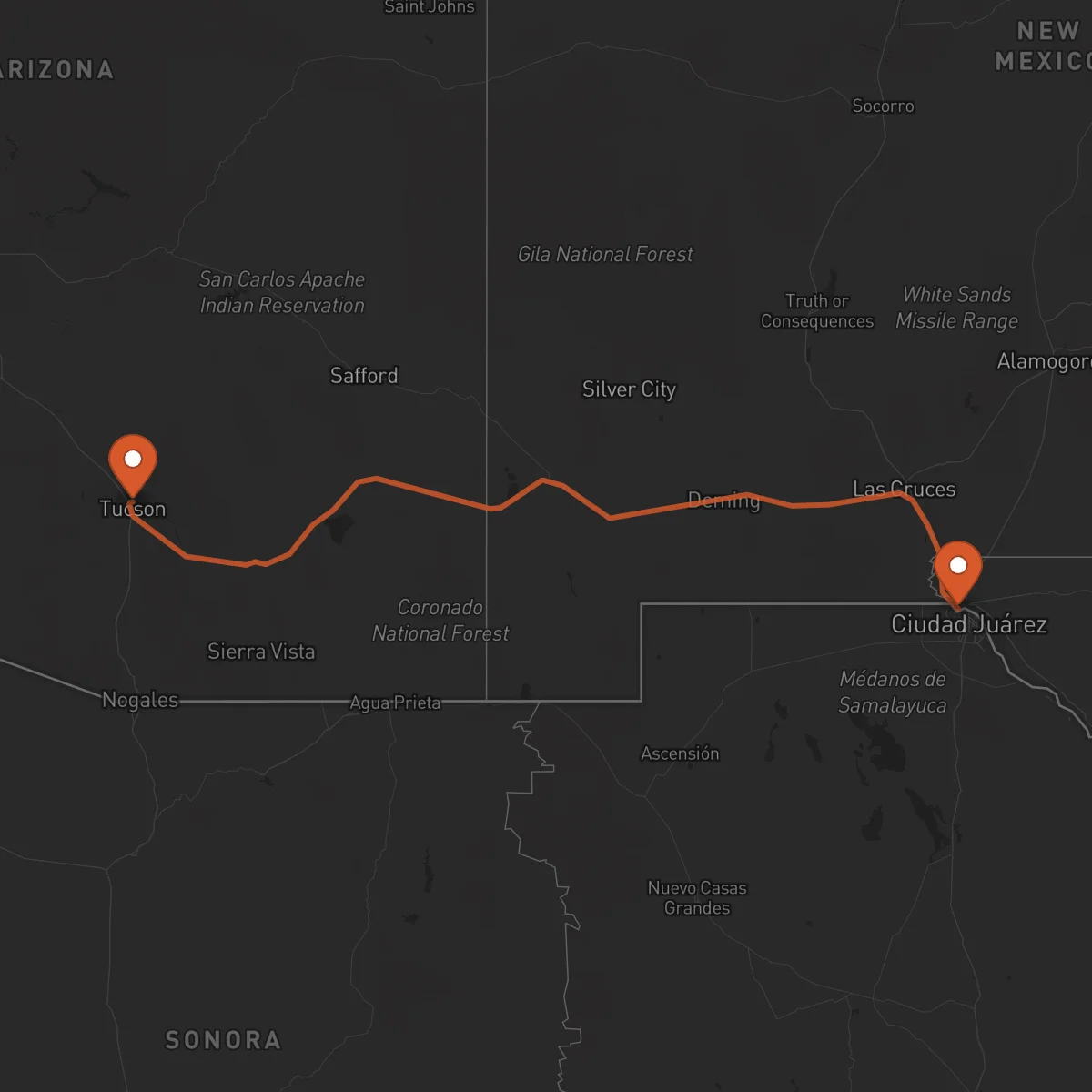
El Paso to Tucson
Tucson → El PasoFTL freight transportation service between El Paso and Tucson. Reliable logistics solutions for your business.
Route Description
Everything you need to know about the corridor El Paso - Tucson
The logistics corridor connecting El Paso, Texas, to Tucson, Arizona, represents a vital artery for freight transportation across the southwestern United States. Spanning approximately 427 kilometers, this route traverses the heart of the Sonoran Desert, linking two major metropolitan areas that serve as crucial hubs for international trade and domestic distribution. This corridor is particularly significant as it connects the U.S.-Mexico border region with the interior western states, facilitating the movement of goods between North American markets and beyond.
The economic importance of this corridor cannot be overstated. El Paso serves as a major gateway for trade with Mexico, while Tucson acts as a distribution center for the broader southwestern region, including California's major ports. The region's economy is driven by manufacturing, electronics, aerospace, defense, and agricultural sectors, all of which rely heavily on efficient freight transportation. Key industries utilizing this corridor include automotive parts, electronics, machinery, and perishable goods, particularly given Tucson's role in food distribution for the region.
Transportation infrastructure along this route is robust, with Interstate 10 serving as the primary freight artery. This major highway offers excellent connectivity, supporting high-capacity freight movement with multiple lanes in each direction. The route also benefits from proximity to rail lines and intermodal facilities, though Control Terrestre specializes in ground transportation solutions. Our fleet of 48' and 53' dry vans and refrigerated trailers is perfectly suited for this corridor, offering dedicated full truckload (FTL) services that ensure your cargo moves efficiently and securely from origin to destination without intermediate stops or transfers.
Services for this Route
Available services for the corridor El Paso - Tucson
 Origin
El Paso
El Paso, Texas, stands as a strategic logistics powerhouse at the U.S.-Mexico border, serving as one of the busiest international crossing points in North America. The city's location offers unparalleled access to both U.S. and Mexican markets, with the El Paso-Ciudad Juárez binational metropolitan area representing one of the largest manufacturing and logistics hubs in the region. El Paso's economy thrives on international trade, with major industries including automotive manufacturing, electronics, medical devices, and consumer goods production. The city boasts exceptional transportation infrastructure, including the Bridge of the Americas and Ysleta-Zaragoza international crossings, extensive highway networks (I-10, US-54, US-62), and the El Paso International Airport. The presence of major intermodal facilities and Union Pacific's extensive rail network further enhances El Paso's capabilities as a freight distribution center, making it an ideal origin point for cross-country shipments.
 Destination
Tucson
Tucson, Arizona, serves as a critical logistics hub in the southwestern United States, strategically positioned to support distribution throughout the region. Located approximately 100 kilometers from the Mexico border and within 600 kilometers of Phoenix and Los Angeles, Tucson offers exceptional connectivity for freight movement across multiple western states. The city's economy is diverse, with strong presence in aerospace and defense (home to Davis-Monthan Air Force Base and Raytheon), optics and photonics (Tucson is known as Optics Valley), healthcare, and agriculture. Tucson's transportation infrastructure includes Interstate 10, which provides direct access to Phoenix, Los Angeles, and El Paso, as well as Interstate 19 connecting to Mexico. The Tucson International Airport and Union Pacific's rail facilities support multimodal transportation options. The region's growing e-commerce sector and its role as a distribution center for southwestern states make Tucson an increasingly important destination for freight transportation, particularly for time-sensitive and high-value cargo.










