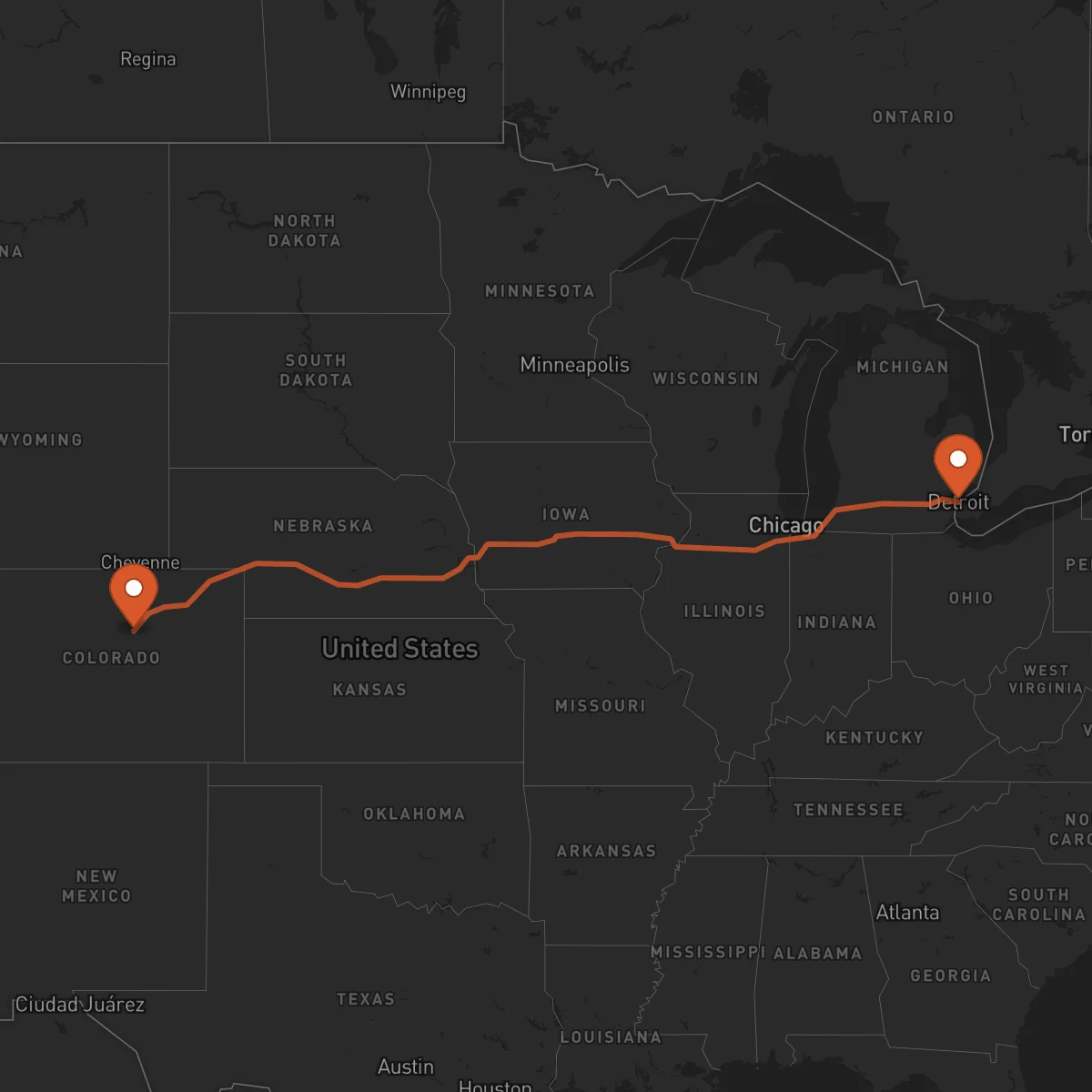
Detroit to Denver
Denver → DetroitFTL freight transportation service between Detroit and Denver. Reliable logistics solutions for your business.
Route Description
Everything you need to know about the corridor Detroit - Denver
The Detroit-Denver corridor represents a vital freight transportation link between the industrial Midwest and the Rocky Mountain region. This 1,858 km route connects two major economic hubs, facilitating the movement of goods across eight states. The corridor serves as a crucial supply chain artery, enabling businesses to transport raw materials, finished products, and specialized cargo between manufacturing centers and distribution networks.
The route traverses diverse economic landscapes, from Detroit's automotive manufacturing base to Denver's growing technology and energy sectors. Major industries utilizing this corridor include automotive parts, industrial equipment, consumer goods, and agricultural products. The journey crosses through key states like Michigan, Indiana, Illinois, Iowa, Nebraska, and Colorado, passing through important logistics hubs such as Chicago and Omaha.
Control Terrestre optimizes operations on this corridor through our network of certified carriers and strategic partnerships. We provide dedicated FTL services with specialized equipment options, including refrigerated units for temperature-sensitive cargo and flatbeds for oversized shipments. Our C-TPAT certified providers ensure secure and compliant cross-border operations, while our real-time tracking systems keep customers informed throughout the journey.
Services for this Route
Available services for the corridor Detroit - Denver
 Origin
Detroit
Detroit stands as a strategic logistics hub in the Midwest, leveraging its position in the Great Lakes region and proximity to major manufacturing centers. The city's extensive infrastructure includes the Ambassador Bridge and Detroit-Windsor Tunnel for cross-border operations, along with multiple rail yards and the Port of Detroit for maritime freight. Detroit's industrial base, particularly automotive manufacturing, creates consistent freight volumes requiring reliable transportation solutions.
The metropolitan area benefits from a dense network of highways including I-75, I-94, and I-96, facilitating efficient connections to other major markets. Detroit's logistics ecosystem includes numerous warehousing facilities, cross-docking operations, and specialized handling capabilities for automotive parts and heavy equipment. The region's skilled workforce and established transportation infrastructure make it an ideal origin point for freight moving across the country.
 Destination
Denver
Denver's strategic location at the intersection of the Great Plains and the Rocky Mountains makes it a crucial logistics gateway for the Mountain West region. The city's transportation infrastructure includes Denver International Airport, one of the largest cargo airports in the country, and an extensive highway network anchored by I-25 and I-70. Denver's central location in the Mountain Time Zone provides logistical advantages for nationwide distribution.
The Denver metropolitan area has evolved into a diverse economic center, with strong presence in technology, aerospace, energy, and healthcare sectors. This economic diversity drives consistent freight demand across multiple industries. The region's logistics infrastructure includes major distribution centers, specialized handling facilities for high-tech equipment, and growing cold storage capabilities. Denver's elevation and climate considerations are well-managed by experienced carriers familiar with mountain transportation challenges.










