Chicago to Montreal
Montreal → ChicagoFTL freight transportation service between Chicago and Montreal. Reliable logistics solutions for your business.
Route Description
Everything you need to know about the corridor Chicago - Montreal
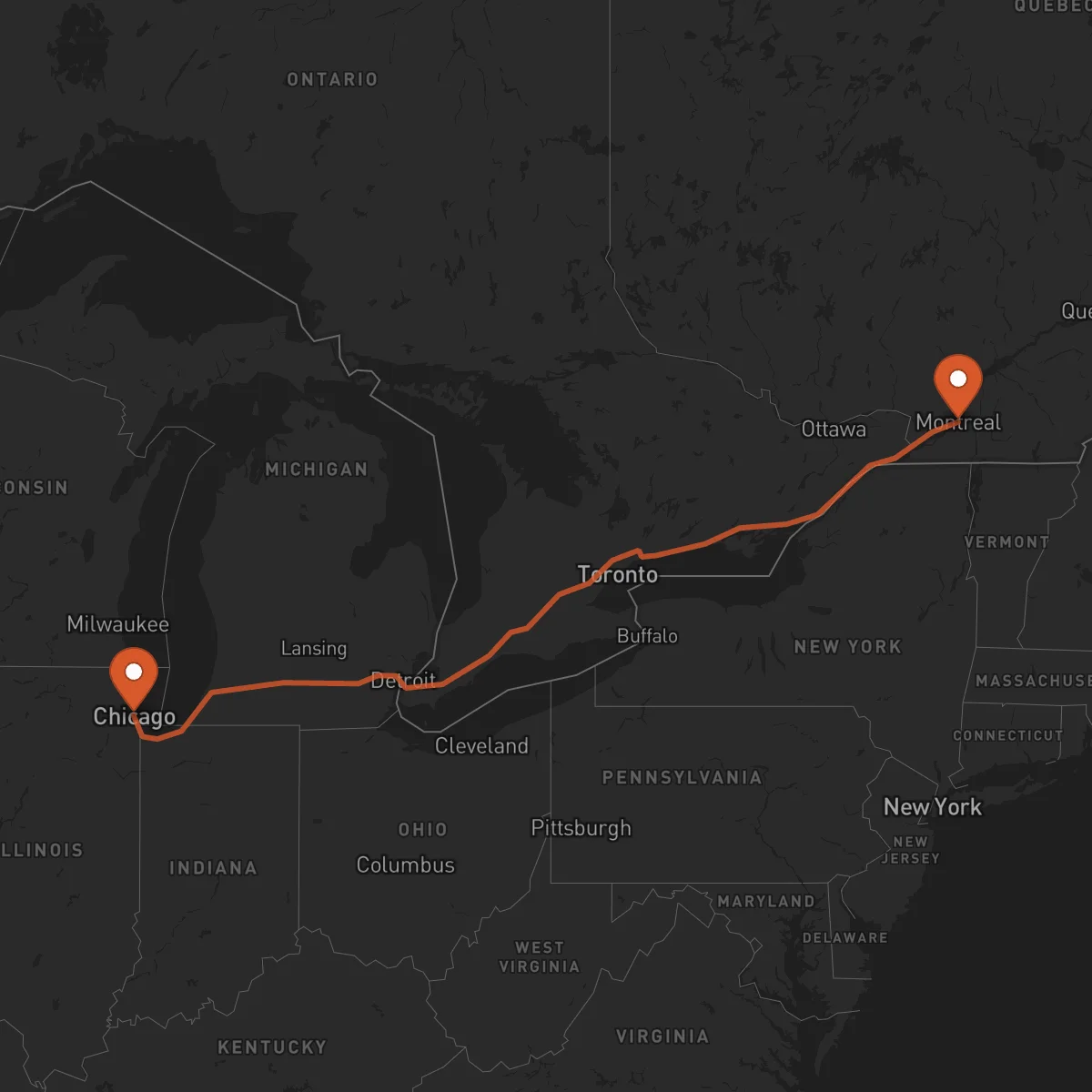
The Chicago-Montreal corridor represents a vital logistics artery connecting the industrial heartland of the United States with Canada's major economic hub. This 1,198 km cross-border route traverses the Great Lakes region and the St. Lawrence River valley, facilitating the movement of goods between two of North America's most significant economic centers. The corridor serves as a critical link in the North American supply chain, supporting billions of dollars in trade between the two nations annually.
The economic significance of this route cannot be overstated. Chicago, as a major transportation and distribution center, connects to Montreal's diverse industrial base, which includes aerospace, pharmaceuticals, electronics, and advanced manufacturing. The corridor handles a wide variety of freight, from raw materials and components to finished goods, with major industries including automotive, technology, consumer products, and industrial equipment relying on this transportation link for their supply chain operations.
Transportation infrastructure along this corridor is exceptionally well-developed, with Interstate 90 and Interstate 94 providing the primary highway routes from Chicago, transitioning to Ontario Provincial Highway 401 and Autoroute 20 in Canada. The corridor includes key border crossings at Detroit-Windsor and potentially the Thousand Islands Bridge, offering multiple options for freight movement. Control Terrestre's expertise in cross-border logistics ensures seamless operations across this corridor, with our certified carriers handling all customs documentation, regulatory compliance, and border procedures efficiently. Our dedicated FTL services provide reliable, direct transportation solutions that maintain the integrity of time-sensitive and high-value shipments throughout this important trade route.
Services for this Route
Available services for the corridor Chicago - Montreal
 Origin
Chicago
Chicago stands as one of North America's premier logistics hubs, strategically positioned in the heart of the Midwest. The city's location at the intersection of major rail lines, interstate highways, and proximity to the Great Lakes makes it an ideal origin point for freight distribution. Chicago's transportation infrastructure includes O'Hare International Airport, one of the busiest cargo airports globally, extensive rail yards operated by major Class I railroads, and a network of interstate highways including I-90, I-94, and I-80 that radiate in all directions.
The city's economic landscape is dominated by manufacturing, technology, finance, and food processing industries. Major corporations in automotive, machinery, electronics, and consumer goods have significant operations in the Chicago metropolitan area, creating substantial freight movement requirements. The region's industrial parks and intermodal facilities provide excellent loading and consolidation capabilities, while Chicago's status as a NAFTA/USMCA trade corridor ensures streamlined processes for cross-border shipments to Canada and Mexico.
 Destination
Montreal represents Canada's leading transportation and logistics center, strategically located on the St. Lawrence River with access to the Atlantic via the St. Lawrence Seaway. The city serves as Quebec's economic capital and a major gateway for international trade, with its port being one of the largest inland ports in North America. Montreal's transportation infrastructure includes Pierre Elliott Trudeau International Airport, extensive rail connections through Canadian National Railway and Canadian Pacific Railway, and a comprehensive highway network including Autoroute 20 and Autoroute 40.
The Montreal metropolitan area hosts a diverse industrial base, with aerospace being particularly prominent through companies like Bombardier and numerous suppliers. The region also excels in pharmaceuticals, technology, advanced manufacturing, and food processing. Montreal's bilingual workforce and proximity to major U.S. markets make it an attractive location for international companies. The city's intermodal facilities and industrial parks provide excellent capabilities for handling various types of freight, while its established trade relationships with the United States ensure efficient cross-border operations.










