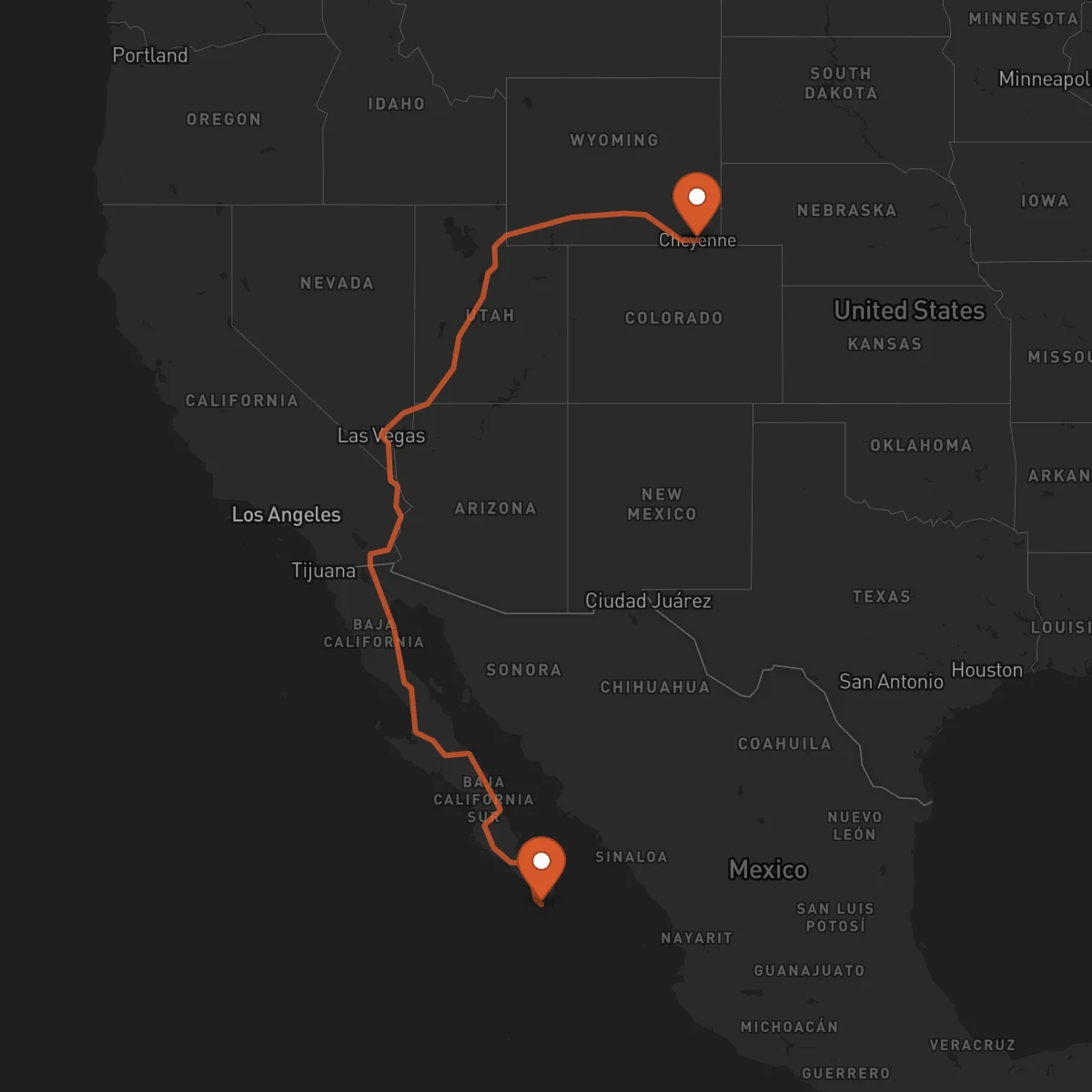
Cheyenne to Los Cabos
Los Cabos → CheyenneFTL freight transportation service between Cheyenne and Los Cabos. Reliable logistics solutions for your business.
Route Description
Everything you need to know about the corridor Cheyenne - Los Cabos
The logistics corridor connecting Cheyenne, Wyoming, to Los Cabos, Baja California Sur, represents a vital cross-border transportation route spanning approximately 2,083 kilometers. This corridor traverses diverse terrains and connects two distinct economic regions, facilitating the movement of goods between the United States and Mexico. The route primarily follows major highways including I-25 and I-10 in the United States, transitioning to Mexican Federal Highways 2 and 1 as it crosses the border, providing a critical link for commerce between these regions.
This corridor serves as a strategic link between the industrial and agricultural heartland of the Rocky Mountain region and the tourism and service-based economy of Baja California Sur. The route passes through key border crossings such as El Paso-Ciudad Juárez, where customs procedures and documentation are efficiently handled by experienced logistics providers. Control Terrestre specializes in navigating these cross-border operations, ensuring seamless freight movement across international boundaries while maintaining compliance with all regulatory requirements.
The corridor supports diverse industries including automotive parts, agricultural products, electronics, and consumer goods. Manufacturing centers in Wyoming and surrounding states utilize this route to export finished products southward, while Los Cabos and the broader Baja California Sur region depend on it for importing essential supplies and equipment. Control Terrestre's expertise in full truckload (FTL) services ensures dedicated transportation solutions that optimize transit times and maintain cargo integrity throughout this extensive journey.
Services for this Route
Available services for the corridor Cheyenne - Los Cabos
 Origin
Cheyenne
Cheyenne, Wyoming serves as a strategic logistics hub in the Rocky Mountain region, offering excellent connectivity to major transportation networks. Located at the intersection of I-25 and I-80, the city provides direct access to both north-south and east-west freight corridors. The region's economy is anchored by government operations, military installations, and a growing technology sector, complemented by traditional industries such as agriculture, energy, and manufacturing. Cheyenne's elevation and central location make it an ideal consolidation point for freight destined for various regions, including cross-border shipments to Mexico.
The city boasts modern warehousing facilities, intermodal yards, and a well-maintained road infrastructure capable of handling heavy freight loads. The presence of the Union Pacific Railroad intermodal facility further enhances Cheyenne's logistics capabilities, offering multimodal transportation options. Local businesses benefit from Wyoming's business-friendly regulations and the city's strategic position as a gateway to both mountain and plains regions, making it an optimal origin point for full truckload shipments requiring reliable transportation to destinations throughout North America.
 Destination
Los Cabos
Los Cabos, located at the southern tip of Baja California Sur, represents a unique logistics destination where tourism-driven demand meets the challenges of a remote peninsula location. The region's economy is primarily centered around hospitality, luxury tourism, and real estate development, creating consistent demand for specialized freight services. Los Cabos relies heavily on efficient logistics operations to maintain its supply chain for both the tourism industry and the local population, as the peninsula's geographic isolation necessitates reliable transportation connections to mainland Mexico and the United States.
The area is served by Highway 1, which runs the entire length of the peninsula, connecting Los Cabos with the border region and beyond. The Los Cabos International Airport and the commercial port of Cabo San Lucas complement the road network, though trucking remains the primary mode for most freight movements. Control Terrestre's expertise in navigating the unique challenges of Baja California Sur's transportation infrastructure ensures that full truckload shipments reach their destination efficiently, supporting the region's continued growth and development while maintaining the high service standards required by the tourism and service sectors.










