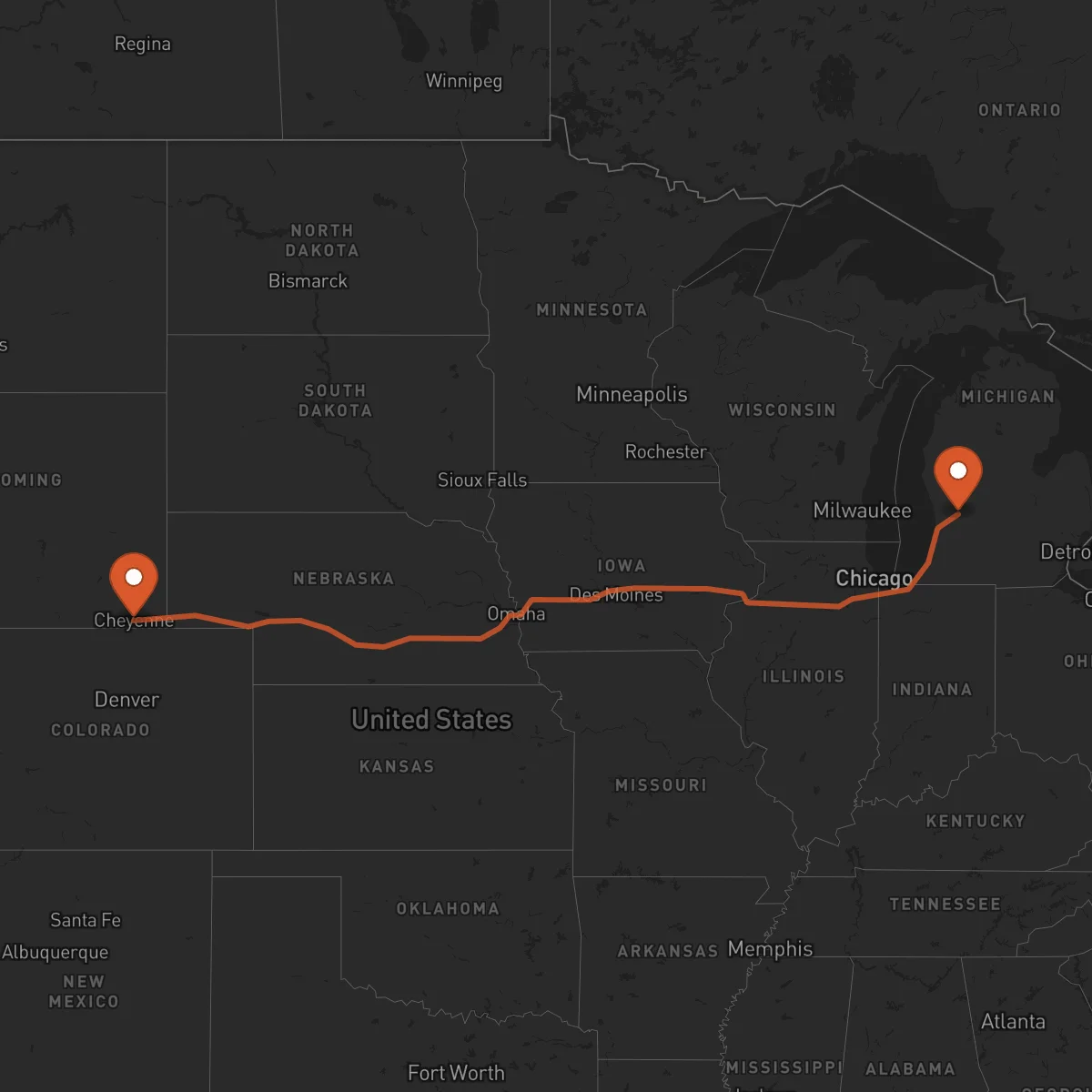
Cheyenne to Grand Rapids
Grand Rapids → CheyenneFTL freight transportation service between Cheyenne and Grand Rapids. Reliable logistics solutions for your business.
Route Description
Everything you need to know about the corridor Cheyenne - Grand Rapids
The logistics corridor between Cheyenne, Wyoming, and Grand Rapids, Michigan, represents a vital domestic transportation route spanning approximately 1,591 kilometers across the heart of the United States. This east-west connection links the Rocky Mountain region with the industrial Midwest, facilitating the movement of goods between two economically significant regions. The corridor traverses multiple states, crossing diverse geographic and economic zones that contribute to its strategic importance in national freight distribution.
This transportation route serves as a critical link between Cheyenne's emerging logistics hub status and Grand Rapids' established manufacturing and distribution center. The corridor connects major economic engines, enabling efficient supply chain operations for businesses operating across the central United States. Industries ranging from automotive and manufacturing to agricultural products and consumer goods rely on this reliable transportation link to maintain their distribution networks and meet market demands.
The primary transportation infrastructure along this corridor includes Interstate 80 East from Cheyenne through Nebraska and Iowa, connecting to Interstate 35 North through Des Moines, and finally transitioning to Interstate 80 East again through Illinois before reaching Michigan. This well-established highway network provides multiple routing options and ensures consistent freight movement. Control Terrestre leverages this infrastructure with our specialized FTL services, offering dedicated truckload solutions that optimize transit times and ensure cargo security throughout the journey from Wyoming to Michigan.
Services for this Route
Available services for the corridor Cheyenne - Grand Rapids
 Origin
Cheyenne
Cheyenne, Wyoming serves as a strategic logistics gateway positioned at the intersection of major transcontinental highways. Located at the base of the Rocky Mountains, Cheyenne benefits from its proximity to Denver while maintaining lower operational costs and less congestion. The city's location at the junction of Interstate 80 and Interstate 25 makes it an ideal origin point for freight distribution across the western and midwestern United States. Cheyenne's elevation and geographic position also provide natural advantages for certain types of cargo handling and storage.
The local economy in Cheyenne is anchored by government, military, and transportation sectors, with growing logistics and distribution activities. The presence of the Union Pacific Railroad and the city's designation as a Foreign Trade Zone enhance its appeal for companies seeking efficient freight consolidation and distribution. The region's agricultural heritage also contributes to diverse cargo flows, particularly in food products and agricultural equipment. Cheyenne's transportation infrastructure includes the Cheyenne Regional Airport, extensive rail connections, and modern warehousing facilities that support full truckload operations.
 Destination
Grand Rapids
Grand Rapids, Michigan stands as a major logistics and manufacturing hub in the American Midwest, strategically positioned to serve both regional and national markets. Located in western Michigan along the Grand River, the city benefits from its proximity to the Great Lakes and major Midwestern population centers. Grand Rapids' location provides excellent access to Chicago, Detroit, and other industrial centers while maintaining efficient connections to both coastal regions. The city's transportation network includes direct highway access via Interstate 96, Interstate 196, and U.S. Route 131, facilitating smooth freight movement.
The economic landscape of Grand Rapids is diverse and robust, with particular strengths in office furniture manufacturing, automotive parts, medical devices, and food processing. The region hosts numerous distribution centers and warehouses that support both local industries and national supply chains. Grand Rapids' industrial base creates consistent demand for full truckload freight services, particularly for just-in-time manufacturing operations and inventory replenishment. The city's logistics infrastructure includes the Gerald R. Ford International Airport, rail connections through CSX and Norfolk Southern, and extensive warehousing and distribution facilities that accommodate various cargo types and specialized handling requirements.


Ready to ship your cargo?
Get a personalized quote for your freight.
Quote Now Cheyenne - Grand Rapids








