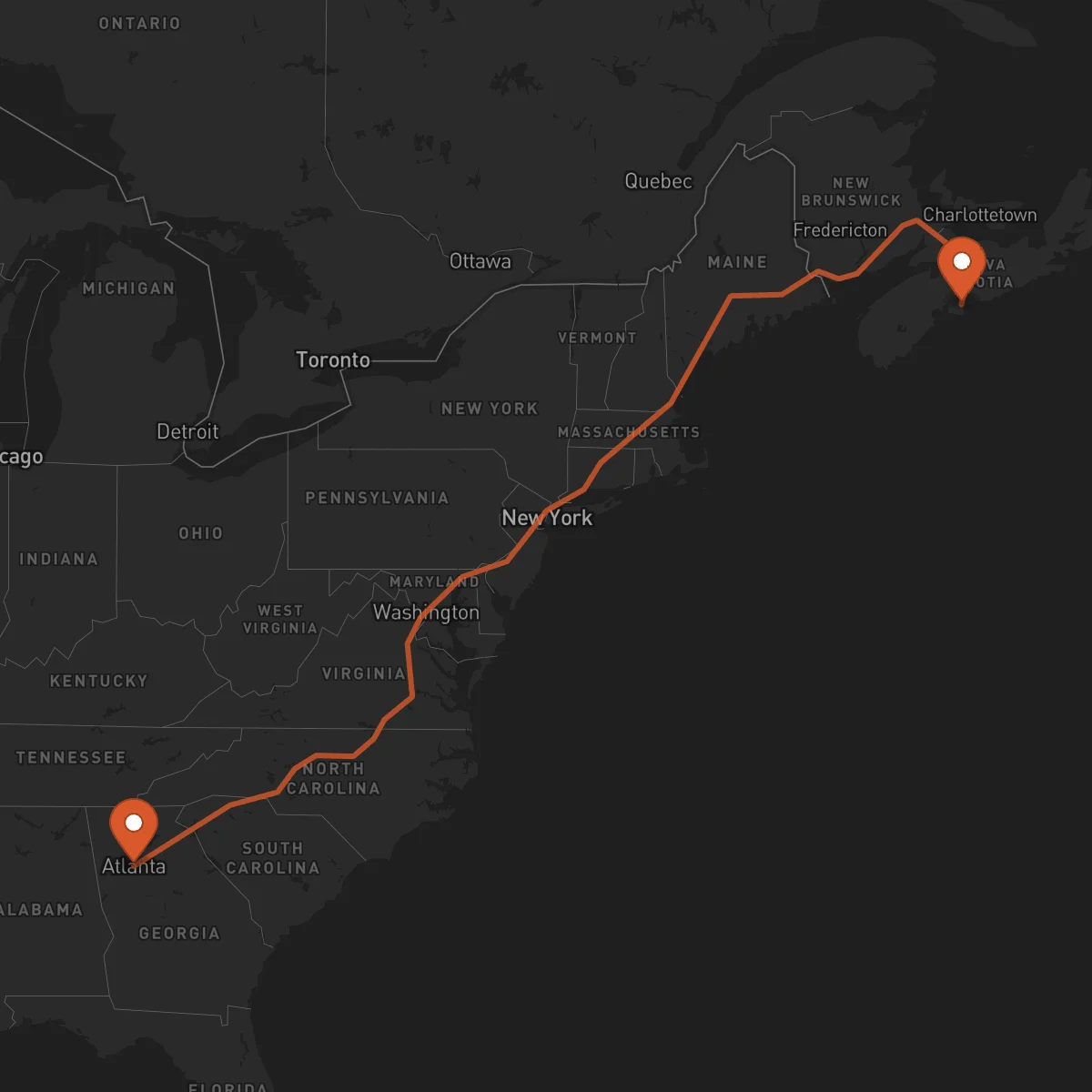
Atlanta to Halifax
Halifax → AtlantaFTL freight transportation service between Atlanta and Halifax. Reliable logistics solutions for your business.
Route Description
Everything you need to know about the corridor Atlanta - Halifax
The Atlanta to Halifax corridor represents a vital north-south freight route connecting the industrial powerhouse of Georgia with the strategic Atlantic port of Nova Scotia. This 2,153-kilometer cross-border corridor serves as a critical link in North American supply chains, facilitating the movement of goods between the southeastern United States and Canadian markets. The route traverses diverse terrain and crosses multiple state and provincial boundaries, requiring expert coordination of logistics operations.
The corridor passes through major transportation hubs including Atlanta, Charlotte, Richmond, and Montreal before reaching Halifax. Interstate 85 and Interstate 95 form the backbone of the southern portion, while Canadian Highway 104 provides the final link to Halifax's deep-water port facilities. This infrastructure supports the efficient movement of full truckload (FTL) freight across the international border at various points, with the most common crossings being at Buffalo-Niagara Falls and Detroit-Windsor.
Control Terrestre specializes in managing the complexities of this cross-border route, ensuring seamless customs clearance and compliance with both US and Canadian regulations. Our experienced team coordinates all aspects of the journey, from pickup in Atlanta's industrial zones to final delivery in Halifax's port facilities or inland distribution centers. We understand the unique requirements of industries such as automotive, manufacturing, and retail that rely on this corridor for their supply chain operations.
Services for this Route
Available services for the corridor Atlanta - Halifax
 Origin
Atlanta
Atlanta serves as a major logistics hub in the southeastern United States, strategically positioned at the intersection of multiple interstate highways. The city's Hartsfield-Jackson International Airport, one of the world's busiest, complements its robust ground transportation network. Atlanta's economy is diverse, with strong representation in logistics, professional services, media operations, and information technology. The metropolitan area hosts numerous distribution centers and warehouses, making it an ideal origin point for freight movements. Major industries include automotive manufacturing, food and beverage production, and consumer goods distribution. The city's transportation infrastructure includes direct access to I-75, I-85, and I-20, providing efficient connections to both northern and western markets.
 Destination
Halifax
Halifax, as the capital of Nova Scotia and home to the largest port in Atlantic Canada, plays a crucial role in international trade and logistics. The Port of Halifax offers year-round ice-free access and deep-water berths capable of handling the largest container ships. The city's strategic Atlantic location makes it a gateway for goods entering and leaving North America, particularly for trade with Europe and the Mediterranean. Halifax's economy is anchored by the port, defense, and public sector, with growing technology and healthcare industries. The city's transportation infrastructure includes direct rail connections to central Canada and the United States, as well as comprehensive highway access via Highway 102 and Highway 104. This multimodal capability makes Halifax an efficient destination for full truckload freight from southern markets.










