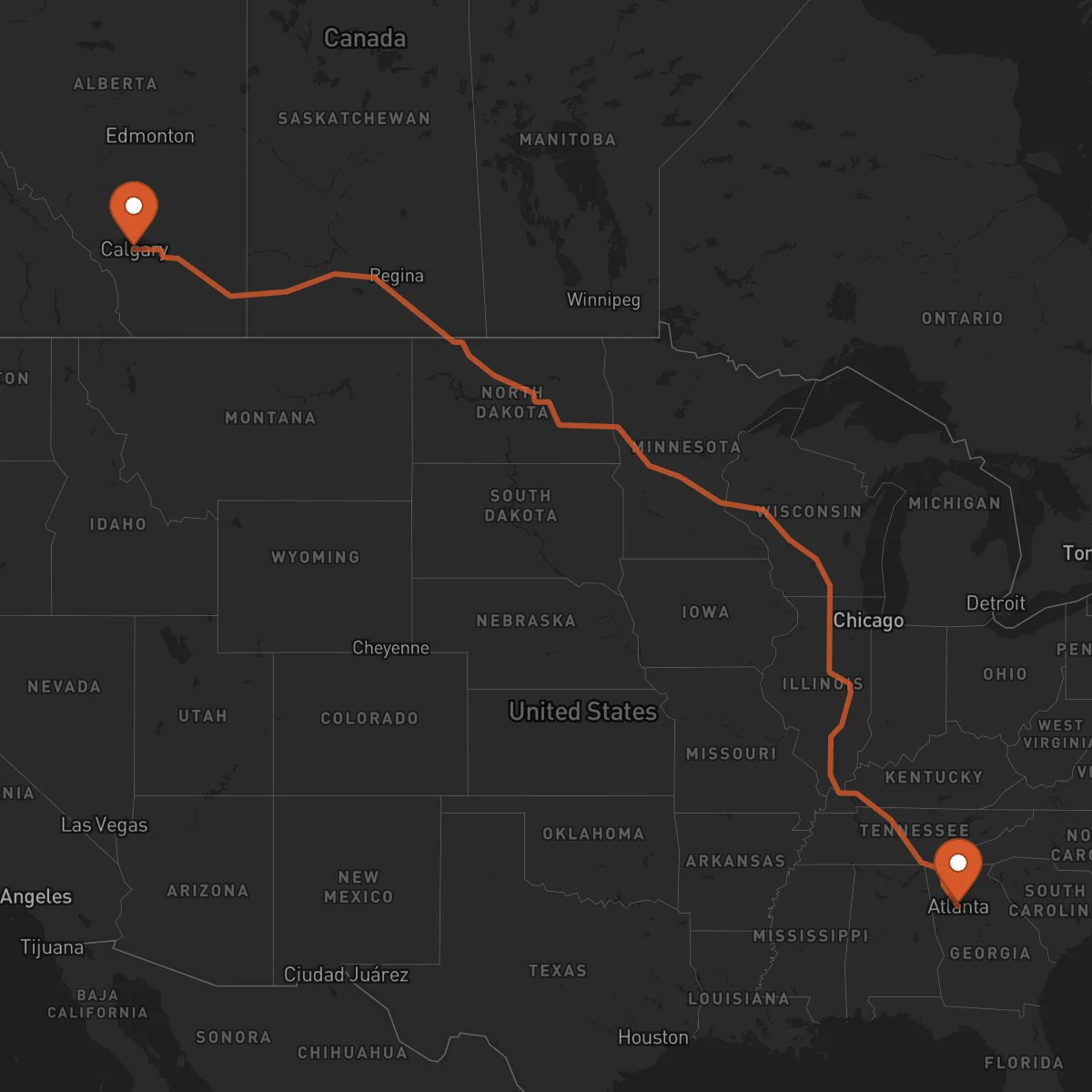
Atlanta to Calgary
Calgary → AtlantaFTL freight transportation service between Atlanta and Calgary. Reliable logistics solutions for your business.
Route Description
Everything you need to know about the corridor Atlanta - Calgary
The Atlanta to Calgary corridor is a vital cross-border freight route connecting the southeastern United States with western Canada. This 3,069-kilometer journey traverses diverse landscapes and economic zones, serving as a critical link in the North American supply chain. The route facilitates the movement of goods between two major economic centers, supporting trade and commerce across multiple industries.
The corridor passes through several key states and provinces, utilizing major transportation arteries such as I-75, I-24, I-57, I-64, I-70, I-76, I-80, and various Canadian highways including the Trans-Canada Highway. This extensive network of interstates and highways ensures efficient and reliable transportation of freight across the continent. The route crosses the US-Canada border at multiple points, with the most commonly used being the Pembina-Emerson crossing in North Dakota, which offers streamlined customs processes for commercial vehicles.
Control Terrestre specializes in managing the complexities of this cross-border corridor, offering comprehensive FTL services that ensure your cargo moves seamlessly from origin to destination. Our expertise in customs clearance, border crossing procedures, and regulatory compliance means your freight experiences minimal delays and maximum efficiency. We understand the unique challenges of this route and provide tailored solutions to meet your specific transportation needs, whether you're shipping automotive parts, agricultural products, or industrial equipment between these two strategic markets.
Services for this Route
Available services for the corridor Atlanta - Calgary
 Origin
Atlanta
Atlanta serves as a major logistics hub in the southeastern United States, offering unparalleled connectivity and infrastructure. Located at the intersection of three major interstate highways (I-20, I-75, and I-85), Atlanta provides excellent access to both coastal ports and inland destinations. The city's Hartsfield-Jackson International Airport, one of the world's busiest, further enhances its position as a key distribution center. Atlanta's economy is diverse, with strong sectors in automotive manufacturing, technology, film and entertainment, logistics, and professional services. The city's strategic location makes it an ideal origin point for freight moving north to Canada or west to other US markets.
 Destination
Calgary stands as a major economic center in western Canada, serving as the gateway to the country's energy-rich prairie provinces. The city's strategic location at the intersection of the Trans-Canada Highway and the CANAMEX Corridor makes it a crucial logistics hub for freight moving between Canada and the United States. Calgary's economy is primarily driven by the energy sector, including oil and gas, but also encompasses technology, manufacturing, and agriculture. The city's proximity to the Canadian Rockies and its well-developed transportation infrastructure, including major rail connections and Calgary International Airport, make it an ideal destination for a wide range of freight shipments.










