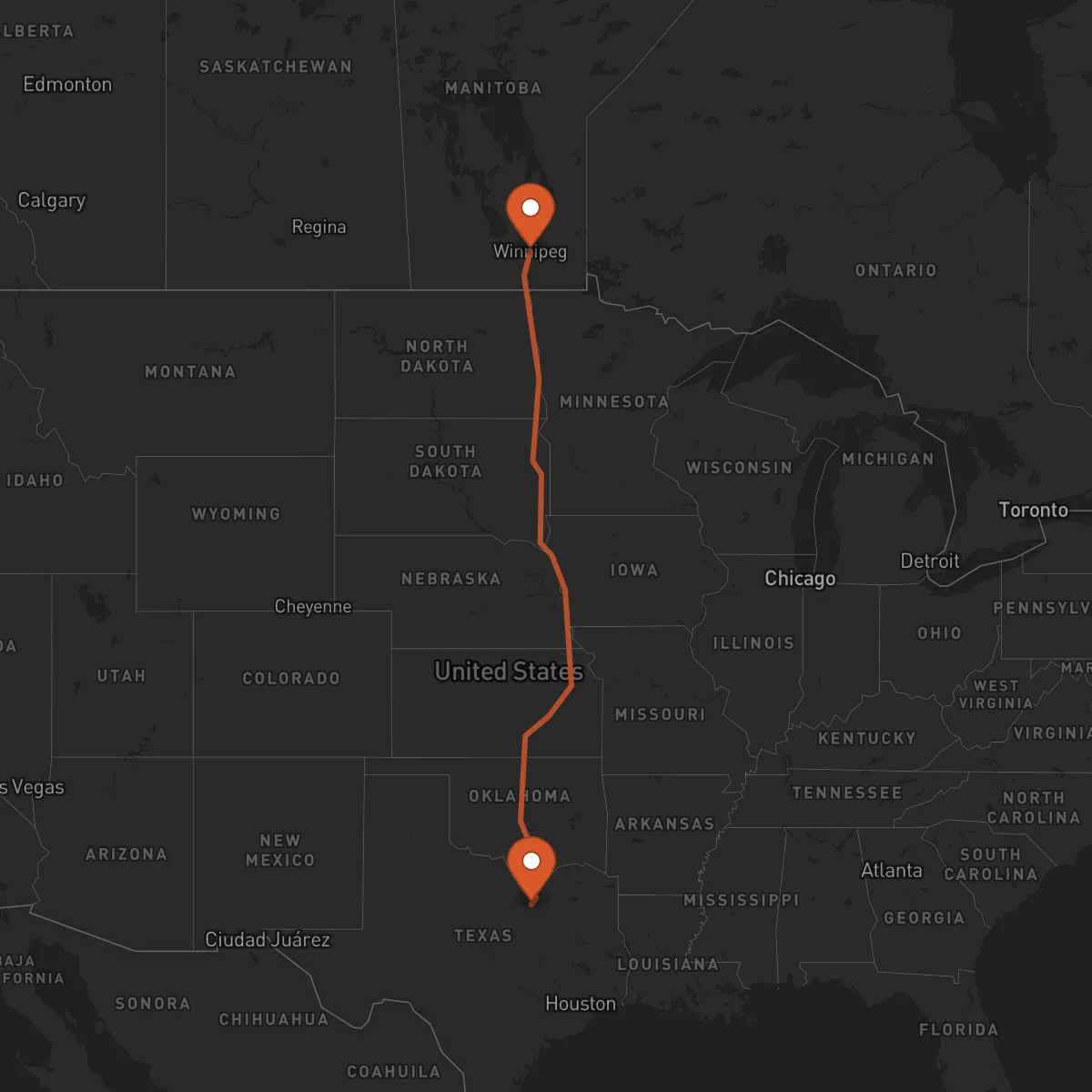
Arlington to Winnipeg
Winnipeg → ArlingtonFTL freight transportation service between Arlington and Winnipeg. Reliable logistics solutions for your business.
Route Description
Everything you need to know about the corridor Arlington - Winnipeg
The logistics corridor connecting Arlington, Texas, to Winnipeg, Manitoba, represents a vital cross-border freight transportation route in North America. This corridor spans approximately 1,908 kilometers and serves as a crucial link between the central United States and Canada's Prairie provinces. The route facilitates the movement of goods between major industrial and commercial centers, supporting the integrated supply chains of both nations.
This corridor traverses diverse economic regions, connecting the Dallas-Fort Worth metropolitan area's manufacturing and technology sectors with Winnipeg's role as a major transportation and distribution hub for Western Canada. The route passes through key states and provinces including Texas, Oklahoma, Kansas, Nebraska, South Dakota, North Dakota, and Manitoba, crossing the international border at Pembina, North Dakota, or other strategic points.
Major industries utilizing this corridor include automotive parts manufacturing, agricultural products, industrial machinery, and consumer goods. The primary transportation infrastructure consists of Interstate 35 North to Interstate 29 North in the United States, connecting to Provincial Trunk Highway 75 in Manitoba. Control Terrestre facilitates seamless operations on this corridor through our network of certified carriers, expertise in cross-border documentation, and specialized services for full truckload (FTL) shipments. Our strategic partnerships ensure reliable transit times and compliance with all customs regulations for both northbound and southbound freight movements.
Services for this Route
Available services for the corridor Arlington - Winnipeg
 Origin
Arlington
Arlington, Texas, is strategically positioned in the Dallas-Fort Worth metropolitan area, one of the largest economic centers in the United States. The city benefits from its proximity to major transportation infrastructure, including the Dallas/Fort Worth International Airport and the Alliance Texas intermodal logistics hub. Arlington's location provides excellent access to Interstate 20 and Interstate 35, facilitating efficient distribution throughout the central United States.
The region is home to diverse industries including automotive manufacturing, aerospace and defense, technology, and healthcare. Major employers in the area include General Motors, which operates a large assembly plant in nearby Arlington, and various defense contractors supporting nearby military installations. The city's robust industrial base creates consistent demand for freight transportation services, particularly for full truckload shipments of automotive components, industrial equipment, and manufactured goods.
 Destination
Winnipeg, Manitoba, serves as the economic and transportation heart of Western Canada, strategically located at the confluence of the Red and Assiniboine Rivers. The city is known as the 'Gateway to the West' due to its central position in the Canadian transportation network. Winnipeg's location provides critical access to major highways including the Trans-Canada Highway and Provincial Trunk Highway 75, which connects directly to the United States border.
The city's economy is diverse, with strong sectors in manufacturing, transportation and logistics, agriculture, and information technology. Winnipeg is home to major companies such as Boeing Canada, StandardAero, and various agricultural processing facilities. The city's transportation infrastructure includes the Winnipeg James Armstrong Richardson International Airport and the Port of Churchill, providing multimodal shipping options. Winnipeg's role as a distribution center for goods destined for northern Canada and its position as a major border crossing point make it a key destination for cross-border freight transportation.










