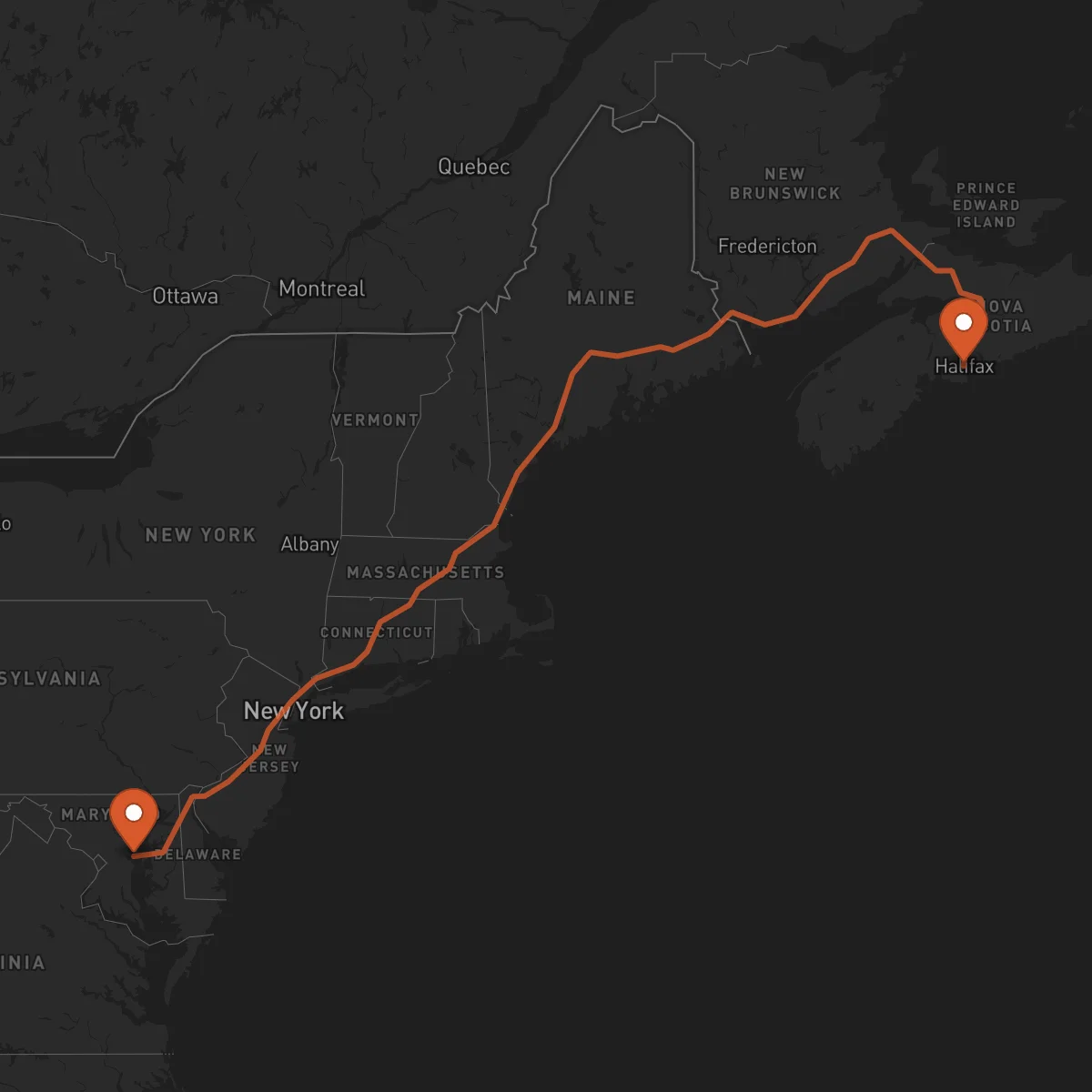
Annapolis to Halifax
Halifax → AnnapolisFTL freight transportation service between Annapolis and Halifax. Reliable logistics solutions for your business.
Route Description
Everything you need to know about the corridor Annapolis - Halifax
The logistics corridor between Annapolis, Maryland, and Halifax, Nova Scotia, represents a vital cross-border connection linking the Mid-Atlantic region of the United States with Atlantic Canada. This 1239-kilometer route traverses diverse terrain and crosses international borders, making it a strategic pathway for trade between these two important economic regions. The corridor facilitates the movement of goods between the busy port of Baltimore and the Atlantic gateway of Halifax, creating a seamless supply chain link that supports both regional and international commerce.
The economic significance of this corridor is substantial, connecting Annapolis's proximity to major East Coast markets with Halifax's role as a key maritime hub. Annapolis benefits from its location near Washington D.C. and Baltimore, while Halifax serves as Canada's Atlantic gateway with its deep-water port and international airport. This route supports critical industries including automotive parts, manufacturing components, agricultural products, and retail goods. The corridor also plays a crucial role in seasonal freight movements, particularly during harvest seasons and holiday retail peaks.
Transportation infrastructure along this route includes major highways such as I-95, I-81, and the Trans-Canada Highway (Route 104). The corridor crosses the international border at Calais-St. Stephen, Maine, requiring efficient customs clearance procedures. Control Terrestre's expertise in cross-border operations ensures smooth transit through these processes, with our C-TPAT and FAST-certified partners facilitating expedited clearance. Our dedicated fleet options and experienced drivers are well-versed in the specific documentation requirements and regulatory compliance needed for this international route, providing reliable door-to-door service that maintains the integrity of time-sensitive shipments.
Services for this Route
Available services for the corridor Annapolis - Halifax
 Origin
Annapolis
Annapolis, Maryland, serves as a strategic origin point for logistics operations, benefiting from its location in the Baltimore-Washington metropolitan area. The city's proximity to major transportation hubs including the Port of Baltimore, Baltimore/Washington International Airport, and extensive highway networks makes it an ideal starting point for freight movements. Annapolis itself is part of a region with strong maritime heritage and growing logistics infrastructure, supported by its location along the Chesapeake Bay and access to multiple transportation modes.
The economic landscape of Annapolis and surrounding Anne Arundel County features diverse industries including advanced manufacturing, defense contracting, healthcare technology, and maritime services. The region's strong presence in government contracting and professional services creates consistent freight demand for specialized equipment and technology components. Additionally, the area's agricultural heritage continues to support food and beverage logistics, while the growing biotechnology sector requires temperature-controlled transportation solutions for sensitive materials.
 Destination
Halifax
Halifax, Nova Scotia, stands as Atlantic Canada's premier logistics hub, strategically positioned as the region's primary gateway to international markets. The city's deep-water port, Halifax Port Authority, is ice-free year-round and serves as a critical entry point for goods destined throughout the Maritimes and beyond. Complemented by Halifax Stanfield International Airport and extensive highway connections, Halifax offers multimodal transportation capabilities that make it an ideal destination for freight operations.
The economic foundation of Halifax is built on a diverse mix of industries including ocean technology, aerospace and defense, information technology, and financial services. The city's role as the capital of Nova Scotia drives significant government-related freight movements, while its growing ocean technology sector requires specialized logistics for equipment and components. Halifax's status as a regional distribution center for Atlantic Canada means it handles substantial volumes of retail and e-commerce freight, supported by a robust warehousing and distribution network that facilitates last-mile delivery throughout the Maritime provinces.










