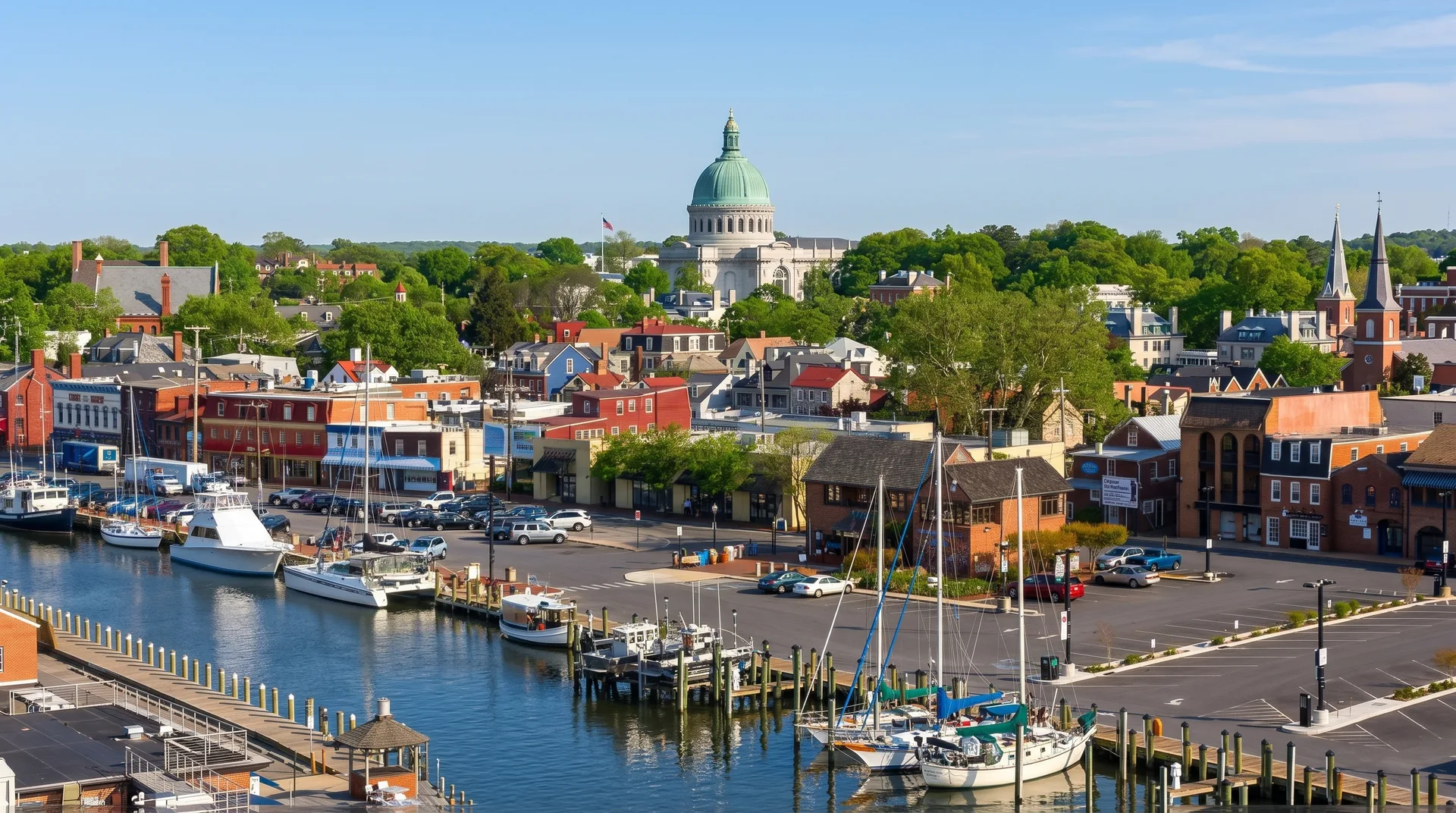

Ground Freight Transportation in Maryland: Strategic Connectivity in the Washington-Baltimore Corridor
Maryland occupies a privileged position at the heart of the most important economic corridor on the U.S. East Coast. With the Port of Baltimore as one of the main entry points for imported goods, immediate proximity to Washington DC, and location between the major markets of the Northeast and Southeast, the state functions as a critical logistics node for supply chains serving more than 40% of the American population. At Control Terrestre, we operate in Maryland with FTL solutions designed to leverage its exceptional connectivity and serve the demands of its specialized industrial sectors.
Maryland's diversified economy, with strengths in biotechnology, defense, information technology, advanced manufacturing, and government services, generates sophisticated logistics requirements that go beyond basic transportation. Companies operating in Maryland require services that understand both the particularities of international trade through its ports and the demands of high-precision, high-value-added industries.
Infrastructure and Connectivity
Maryland's interstate highway system forms one of the densest networks on the East Coast. Interstate 95, the main artery of North American commerce, crosses the state connecting Baltimore with Washington DC, Philadelphia, and northeastern markets. This highway handles some of the highest commercial traffic volumes in the country, being fundamental for north-south movements on the East Coast.
Interstate 70 crosses the state from east to west, connecting Baltimore with Frederick and continuing toward Pennsylvania, Ohio, and the Midwest. Interstate 270 functions as a technology corridor between Washington DC and Frederick, concentrating biotechnology, information technology, and professional services companies. Interstate 83 connects Baltimore with York and Harrisburg in Pennsylvania, facilitating movements toward the northeastern interior.
Interstate 68 crosses western mountainous Maryland, connecting with West Virginia and providing access to Appalachian regions. Interstate 695 (Baltimore Beltway) circles Baltimore, offering access to industrial and port zones without crossing the urban core. Interstate 495 and Interstate 95 form the Capital Beltway around Washington DC, a critical node for regional distribution.
The Port of Baltimore represents first-tier logistics infrastructure, specialized in roll-on/roll-off vehicles (national leader in automobile imports), containers, bulk cargo (coal, sugar, salt), heavy machinery, and special projects. Seagirt and Dundalk terminals handle millions of containers annually. The port functions as a preferred entry point for importers seeking direct access to the Mid-Atlantic market without the congestion of larger ports.
The rail system operated by CSX and Norfolk Southern provides robust intermodal connectivity. Baltimore functions as an important rail hub, facilitating double-stack container movements toward the country's interior.
Baltimore-Washington International Airport (BWI) adds air cargo capacity for high-value products and urgent movements, complementing ground and maritime options.
Key Industries and Sectors
Maryland's biotechnology and pharmaceutical industry represents one of the most important clusters in the United States. The I-270 corridor, known as the "Technology Corridor," concentrates research, development, and manufacturing companies for biopharmaceutical products, medical devices, and biotechnology. Transportation of these products requires compliance with strict temperature control, security, and traceability protocols.
The aerospace and defense sector maintains significant presence, with Lockheed Martin, Northrop Grumman facilities, and multiple defense contractors. Military bases at Aberdeen Proving Ground, Fort Meade (NSA headquarters), and Patuxent River Naval Air Station generate logistics demands for military equipment, aerospace components, and specialized technology.
The automotive industry uses the Port of Baltimore as the main entry point for vehicles imported from Europe and Asia. Vehicle processing operations and ground redistribution to dealerships across the country generate constant flows. Auto parts transportation for manufacturing in neighboring states complements this activity.
The seafood industry, centered on Chesapeake Bay, is emblematic of Maryland. Catching and processing blue crabs, oysters, clams, and fish generates refrigerated transportation needs to regional and national markets. The seasonal nature of fishing creates demand peaks during summer months.
The information technology and cybersecurity sector concentrates around Fort Meade and the I-270 corridor, with companies developing network equipment, servers, electronic components, and communication devices requiring specialized transportation.
Maryland's agriculture includes significant poultry production, particularly on the state's Eastern Shore, plus corn, soybeans, and dairy products. Transportation of processed poultry products requires reliable cold chain.
The construction and materials sector, driven by continuous growth in the Baltimore-Washington metropolitan area, generates demand for construction materials, finishes, and equipment that moves primarily by road.
Our Solutions for Maryland
Control Terrestre operates in Maryland with deep knowledge of the Baltimore-Washington corridor and its regional connections. Our full truckload (FTL) services connect Maryland with Mexico, the rest of the United States, and Canada, facilitating continental supply chains.
For biotechnology and pharmaceutical industries, we provide refrigerated transportation with 48' and 53' units that maintain rigorous thermal control necessary for temperature-sensitive products. Our services handle movements of biopharmaceutical products, medical devices, and research materials requiring specific conditions.
Our import and export services coordinate ground transportation connected with the Port of Baltimore. We facilitate container movements from Seagirt and Dundalk terminals to final destinations in the United States or Mexico, as well as transportation from origins to port facilities for export. This capability is fundamental for companies importing vehicles, machinery, or containerized merchandise.
Full and Tandem dry vans handle automotive components, manufactured products, electronic equipment, and general merchandise. For the defense and aerospace sector, we coordinate specialized equipment transportation with appropriate security protocols.
Dedicated services are especially relevant for companies in the I-270 technology corridor or manufacturing plants with recurring transportation needs between Maryland and other strategic locations. Dedicated routes between facilities provide operational predictability and resource optimization.
For Chesapeake Bay seafood products, our refrigerated transportation maintains the cold chains necessary for crabs, oysters, and fish during movement to nearby urban markets or more distant destinations.
Expedited freight serves urgent situations common in high-technology industries and just-in-time manufacturing. Spot services offer flexibility for unscheduled needs or seasonal variations in freight volume.
Through our provider network, some partners hold C-TPAT, FAST, and SmartWay certifications, relevant for cross-border operations and companies with sustainability requirements in their supply chains.
Frequently Asked Questions
Can Control Terrestre handle pharmaceutical product transportation from Maryland?
Yes, we operate transportation of products requiring rigorous temperature control, including pharmaceutical and biotechnology products. Our refrigerated units maintain specific thermal conditions throughout transit. We understand pharmaceutical industry requirements in terms of traceability and protocol compliance. This capability is relevant for companies in the I-270 biotechnology corridor that distribute products to national or international markets.
Can you coordinate transportation from the Port of Baltimore to Mexico?
Indeed, our import and export services facilitate ground movement of merchandise arriving at the Port of Baltimore with final destination in Mexico. We coordinate container pickup from terminals, complete ground transit, and border crossing. This capability is especially relevant for Mexican importers using Baltimore as an entry point due to its operational efficiency and direct access to interstate routes toward the south and west.
What solutions do you offer for companies with operations in the Baltimore-Washington area?
For companies in the Baltimore-Washington corridor, we provide services that adapt to the dynamics of this high-density region. Dedicated services can be structured for regular routes between facilities in Maryland and other locations in the United States, Mexico, or Canada. For distribution operations serving both northeastern and southeastern markets, Maryland functions as a strategic distribution point, and our FTL services facilitate efficient connections in both directions from this central location.


Freight experts
Ground freight from North to Central America with full coverage and 24/7 monitoring.








