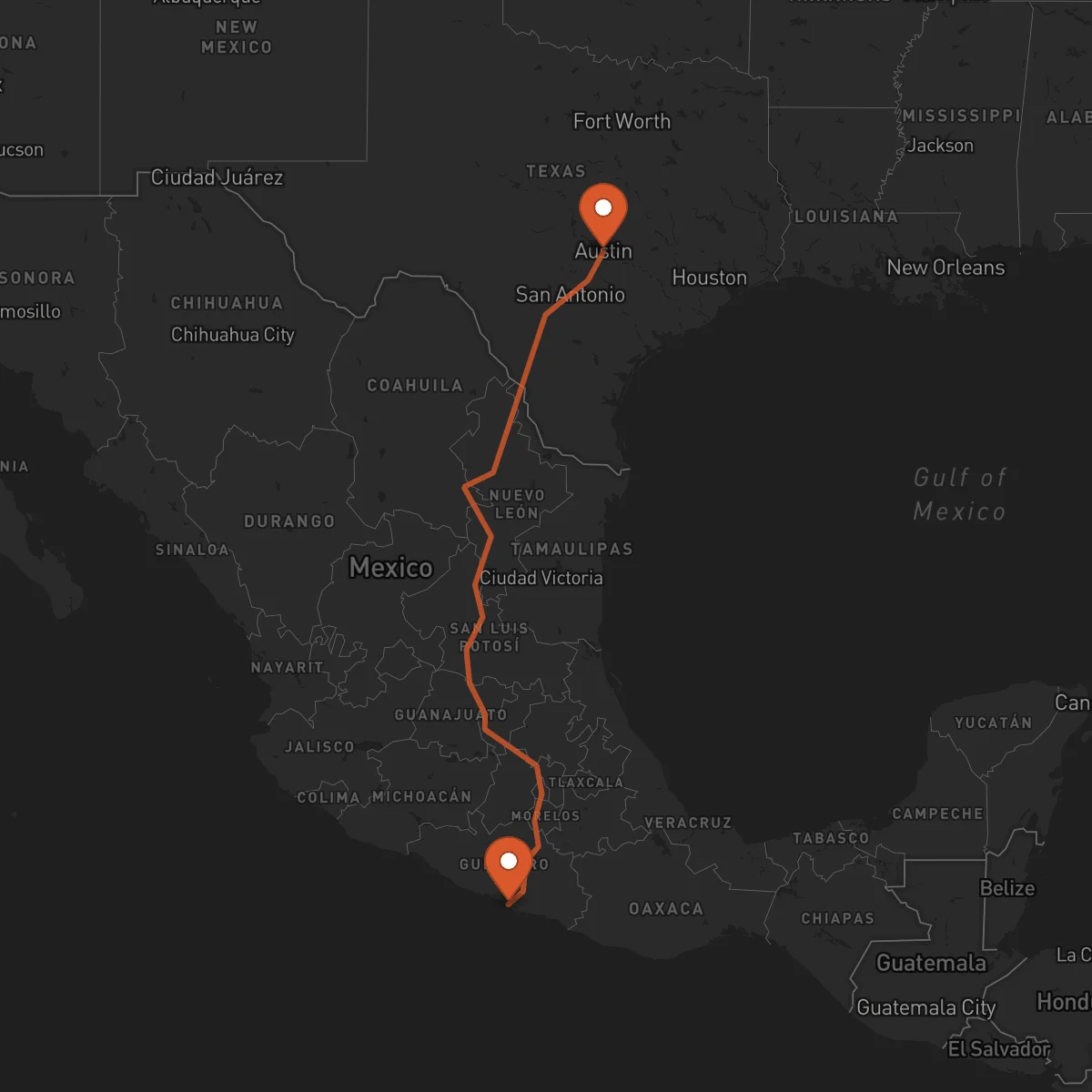
Acapulco to Austin
Austin → AcapulcoFTL freight transportation service between Acapulco and Austin. Reliable logistics solutions for your business.
Route Description
Everything you need to know about the corridor Acapulco - Austin
The Acapulco-Austin corridor represents a vital logistics connection between the Pacific coast of Mexico and the heart of Texas, spanning approximately 1,506 kilometers. This strategic route facilitates the movement of goods from one of Mexico's most important Pacific ports to a key technology and industrial hub in the United States. The corridor traverses diverse terrain and crosses the Mexico-United States border, requiring expert knowledge of cross-border operations and customs procedures.
This route serves as a crucial link for industries seeking to connect Mexican manufacturing and export capabilities with American markets. The economic relationship between the coastal region of Guerrero and the technology-driven economy of Austin creates a dynamic flow of goods, with electronics, automotive components, and industrial machinery being among the primary commodities transported. The corridor benefits from Mexico's improving logistics infrastructure and Texas's position as a gateway to the central United States.
Transportation along this corridor primarily utilizes Mexico's Federal Highway 95D and Federal Highway 85, connecting to major U.S. interstate systems. The route requires careful coordination at border crossings, with Laredo being the most common point of entry due to its extensive infrastructure and processing capabilities. Control Terrestre's expertise in cross-border operations ensures seamless transit through customs, compliance with both Mexican and U.S. regulations, and efficient delivery to Austin's industrial and commercial centers.
Services for this Route
Available services for the corridor Acapulco - Austin
 Origin
Acapulco, located on Mexico's Pacific coast in Guerrero state, serves as a strategic gateway for international trade with its maritime connections and proximity to major industrial centers. The port city's infrastructure includes access to Federal Highway 95D, which provides direct connections to Mexico's interior and northern border. Acapulco's economic activity centers around tourism, fishing, and manufacturing, with growing importance in electronics assembly and agricultural exports. The region's transportation network includes the Juan Álvarez International Airport and port facilities that complement ground transportation options, making it an ideal origin point for freight moving to the United States.
 Destination
Austin
Austin, Texas stands as a major technology and business hub in the American Southwest, strategically positioned to serve as a distribution center for the central United States. The city's economic landscape is dominated by technology companies, semiconductor manufacturing, and research institutions, creating consistent demand for inbound freight from international sources. Austin's transportation infrastructure includes major highways such as I-35, which connects directly to the Mexican border, and Austin-Bergstrom International Airport. The city's location provides excellent access to both coastal ports and inland manufacturing centers, making it an ideal destination for cross-border freight operations.










