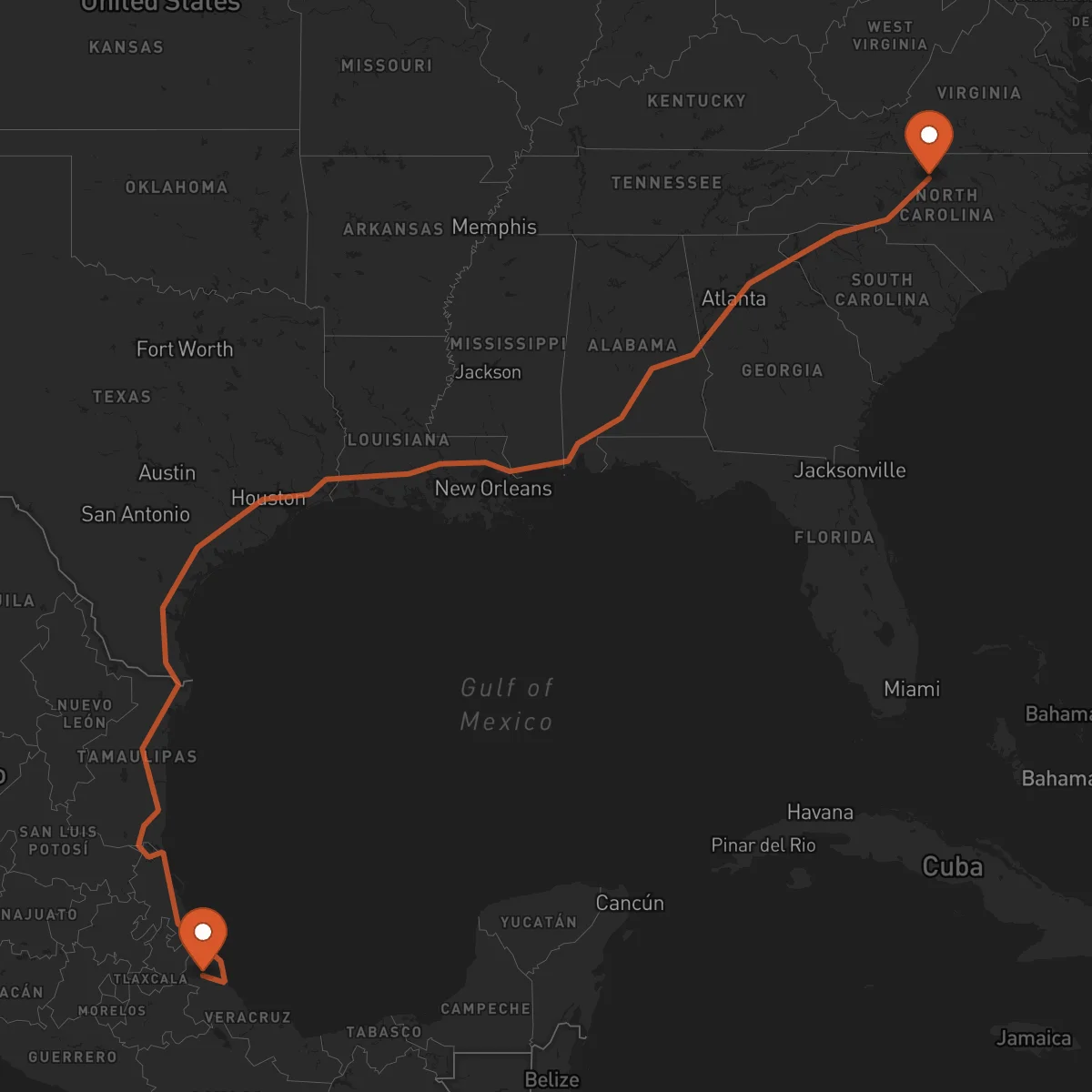
Xalapa to Greensboro
Greensboro → XalapaFTL freight transportation service between Xalapa and Greensboro. Reliable logistics solutions for your business.
Route Description
Everything you need to know about the corridor Xalapa - Greensboro
The logistics corridor between Xalapa, Veracruz and Greensboro, North Carolina represents a vital trade route connecting Mexico's Gulf Coast with the southeastern United States. This 2,484 km cross-border route facilitates the movement of goods between two dynamic industrial regions, supporting the growing trade relationship between Mexico and the United States. The corridor leverages Mexico's strategic geographic position and the United States' robust manufacturing and distribution networks.
The region's economic activity centers around manufacturing, automotive components, electronics, and agricultural products. Xalapa serves as a key logistics hub in Veracruz state, while Greensboro has established itself as a major distribution center in North Carolina's Piedmont Triad region. This corridor supports industries including automotive, aerospace, textiles, and consumer goods, with many companies utilizing it for just-in-time inventory management and supply chain optimization.
Transportation infrastructure includes Mexico's Federal Highway 180 and Federal Highway 190 connecting to U.S. Interstate 85, providing efficient north-south connectivity. The Laredo and Nuevo Laredo border crossings serve as primary entry points into the United States, offering streamlined customs processing for qualified freight forwarders. Control Terrestre's expertise in cross-border operations ensures seamless transit through these critical checkpoints, with our C-TPAT and FAST certifications enabling expedited processing and reduced wait times for our clients' shipments.
Services for this Route
Available services for the corridor Xalapa - Greensboro
 Origin
Xalapa, the capital of Veracruz state, occupies a strategic position in eastern Mexico with excellent connectivity to major ports including Veracruz and Coatzacoalcos. The city benefits from its proximity to Mexico's Gulf Coast, providing access to maritime shipping routes and international trade networks. Xalapa's transportation infrastructure includes well-maintained highways connecting to Mexico City and other industrial centers, along with a developing logistics park system that supports regional distribution operations.
The region's economy is diverse, with strong presence in coffee production, floral exports, and light manufacturing. Xalapa has emerged as a technology and education hub, hosting several universities that contribute to a skilled workforce. The area's agricultural sector produces tropical fruits, vegetables, and ornamental plants, creating demand for temperature-controlled transportation services. Local industries increasingly require reliable freight transportation to serve both domestic Mexican markets and export destinations in the United States.
 Destination
Greensboro
Greensboro, located in North Carolina's Piedmont Triad region, serves as a major logistics and distribution hub in the southeastern United States. The city's strategic location provides access to a population of over 20 million people within a 500-mile radius, making it ideal for regional distribution centers. Greensboro benefits from excellent transportation infrastructure, including proximity to Piedmont Triad International Airport, multiple interstate highways (I-40, I-85, I-73), and direct rail connections via Norfolk Southern and CSX Transportation.
The region's economy is anchored by advanced manufacturing, logistics, healthcare, and education sectors. Greensboro has attracted significant investment in e-commerce fulfillment centers, automotive parts distribution, and textile manufacturing. The presence of major companies and distribution centers has created a robust demand for freight transportation services, particularly for time-sensitive and high-value shipments. The city's logistics infrastructure includes modern warehousing facilities, cross-docking operations, and integrated transportation networks that support efficient supply chain management.










