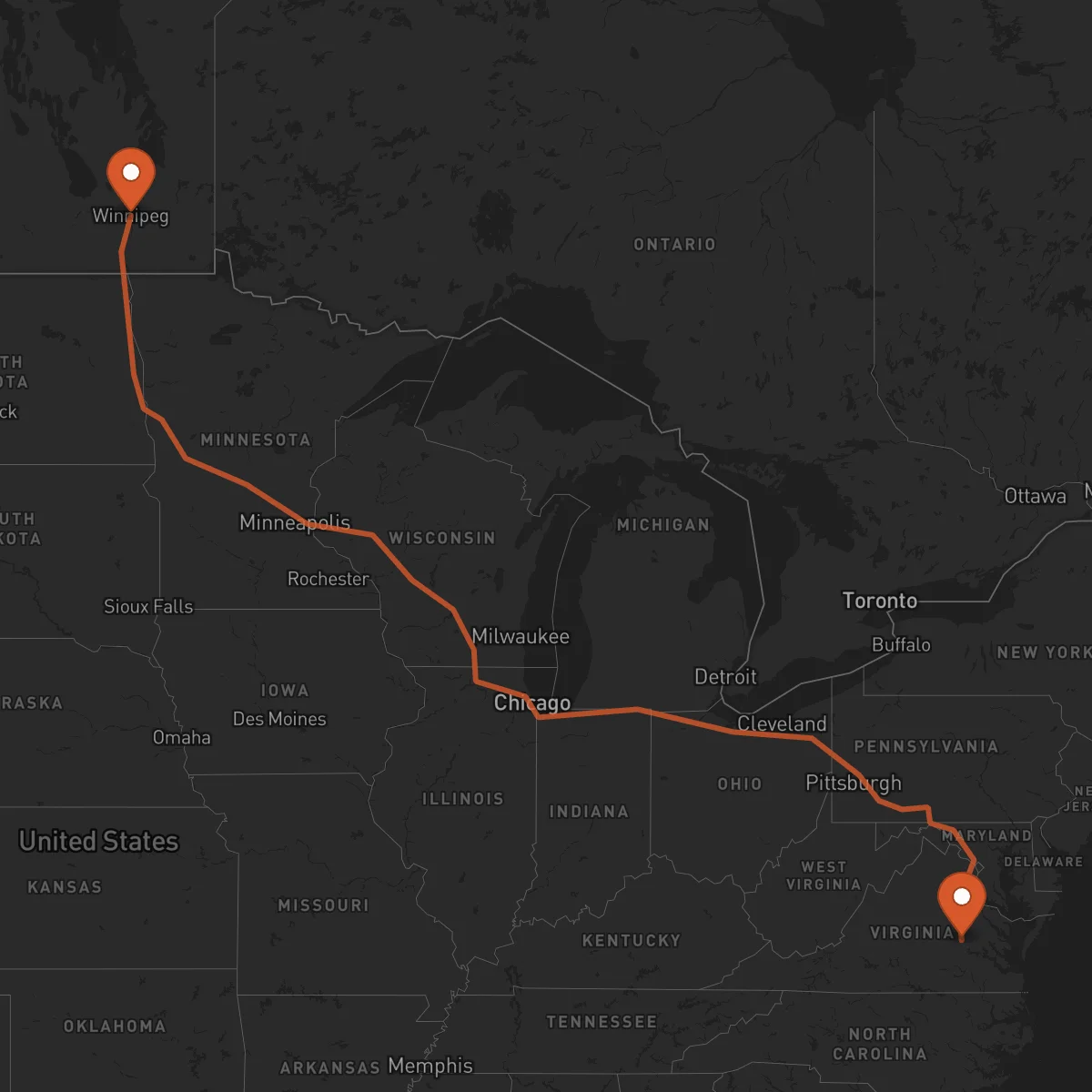
Winnipeg to Richmond
Richmond → WinnipegFTL freight transportation service between Winnipeg and Richmond. Reliable logistics solutions for your business.
Route Description
Everything you need to know about the corridor Winnipeg - Richmond
The Winnipeg to Richmond corridor represents a vital cross-border freight transportation route connecting the Canadian prairies with the eastern United States. This 2,085 km corridor traverses diverse geographic and economic regions, facilitating the movement of goods between Manitoba and Virginia. The route passes through major transportation hubs including Minneapolis and Chicago, providing access to extensive North American distribution networks.
The corridor serves critical industries including agricultural products from the Canadian prairies, manufactured goods, and industrial equipment. Winnipeg's strategic location as a transportation gateway to Western Canada makes it an essential origin point, while Richmond's position in the Mid-Atlantic region provides access to major East Coast markets. The route primarily utilizes Interstate 29 and Interstate 64, offering reliable highway infrastructure for freight transportation.
Key border crossings include the Pembina-Noyes crossing, which provides efficient customs processing for commercial freight. Control Terrestre facilitates seamless operations on this corridor through our network of certified carriers and expertise in cross-border documentation. Our team ensures compliance with customs regulations and provides real-time tracking throughout the journey. We offer dedicated FTL services with specialized equipment options to handle various cargo types, from standard dry freight to temperature-sensitive shipments requiring refrigerated transport.
Services for this Route
Available services for the corridor Winnipeg - Richmond
 Origin
Winnipeg, Manitoba serves as a strategic logistics hub in Western Canada, positioned at the confluence of the Red and Assiniboine Rivers. The city functions as a critical transportation gateway for goods moving between Western Canada and the United States. Winnipeg's economy is anchored by industries including agriculture, manufacturing, and transportation, with major employers in aerospace, food processing, and advanced manufacturing. The city's transportation infrastructure includes Winnipeg James Armstrong Richardson International Airport, extensive rail connections through Canadian National and Canadian Pacific railways, and major highways including the Trans-Canada Highway and Highway 75 connecting to the U.S. border.
 Destination
Richmond
Richmond, Virginia occupies a strategic location in the Mid-Atlantic region, serving as a major logistics and distribution center for the eastern United States. The city benefits from its proximity to the Port of Virginia and major East Coast markets. Richmond's economy encompasses diverse sectors including government, finance, biotechnology, and manufacturing. The region's transportation infrastructure features Richmond International Airport, an extensive rail network through CSX and Norfolk Southern, and major highways including I-64, I-95, and I-295. The city's central East Coast location provides efficient access to markets from New York to Florida.










