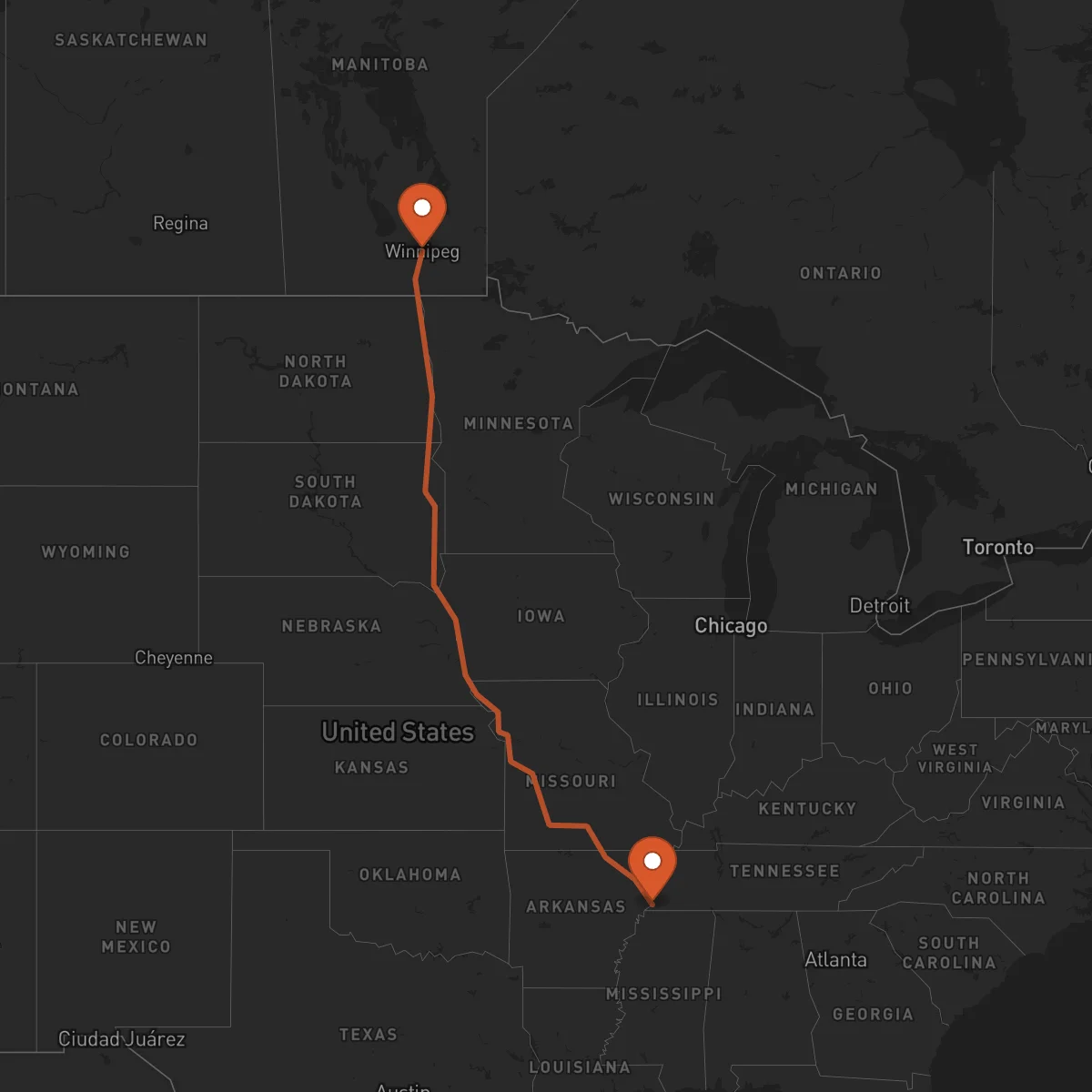
Winnipeg to Memphis
Memphis → WinnipegFTL freight transportation service between Winnipeg and Memphis. Reliable logistics solutions for your business.
Route Description
Everything you need to know about the corridor Winnipeg - Memphis
The Winnipeg-Memphis corridor represents a vital cross-border freight transportation route connecting the Canadian Prairies with the central United States. This 1738 km corridor facilitates the movement of goods between Manitoba's agricultural and manufacturing heartland and Tennessee's logistics hub, supporting critical supply chains across North America. The route traverses diverse economic regions, from Winnipeg's growing industrial sector through the American Midwest's agricultural states to Memphis's position as a major distribution center.
The economic significance of this corridor is substantial, with Winnipeg serving as a gateway to Canadian markets and Memphis functioning as a logistics powerhouse. Key industries utilizing this route include agricultural products, manufactured goods, automotive components, and consumer products. The corridor particularly benefits from Winnipeg's role as a major grain exporter and Memphis's status as a FedEx headquarters and major distribution center, creating complementary trade flows that maximize transportation efficiency.
Transportation infrastructure along this corridor relies primarily on I-29 and I-55, providing reliable highway connections through major cities including Fargo, Kansas City, and Jackson. The Emerson-Pembina border crossing serves as the primary entry point, offering efficient customs processing for commercial vehicles. Control Terrestre facilitates seamless operations on this corridor through our experienced cross-border team, ensuring compliance with customs regulations, providing real-time shipment tracking, and coordinating with trusted carriers who understand the complexities of US-Canada freight movements.
Services for this Route
Available services for the corridor Winnipeg - Memphis
 Origin
Winnipeg, Manitoba serves as a strategic logistics hub in Western Canada, positioned at the geographic center of North America. The city's location at the confluence of the Red and Assiniboine rivers has historically made it a transportation nexus, now enhanced by modern infrastructure including the Winnipeg James Armstrong Richardson International Airport and extensive rail networks. Winnipeg's economy is diverse, with strong agricultural processing, manufacturing, and technology sectors driving freight demand. The city's proximity to major Canadian agricultural regions makes it a critical point for grain, canola, and other commodity exports, while its manufacturing base produces machinery, aerospace components, and food products requiring reliable transportation to US markets.
 Destination
Memphis
Memphis, Tennessee stands as one of America's most important logistics hubs, strategically located at the crossroads of major interstate highways and along the Mississippi River. The city's economy is heavily centered on transportation and logistics, with FedEx's global headquarters driving massive freight volumes through Memphis International Airport, the world's busiest cargo airport. Beyond logistics, Memphis hosts significant manufacturing operations in healthcare technology, automotive parts, and food processing. The city's central location provides excellent access to major US markets within a day's drive, while its robust intermodal facilities connect road, rail, air, and river transportation modes. This infrastructure makes Memphis an ideal destination for cross-border freight, offering efficient distribution capabilities throughout the southeastern United States.










