Tulsa to Fredericton
Fredericton → TulsaFTL freight transportation service between Tulsa and Fredericton. Reliable logistics solutions for your business.
Route Description
Everything you need to know about the corridor Tulsa - Fredericton
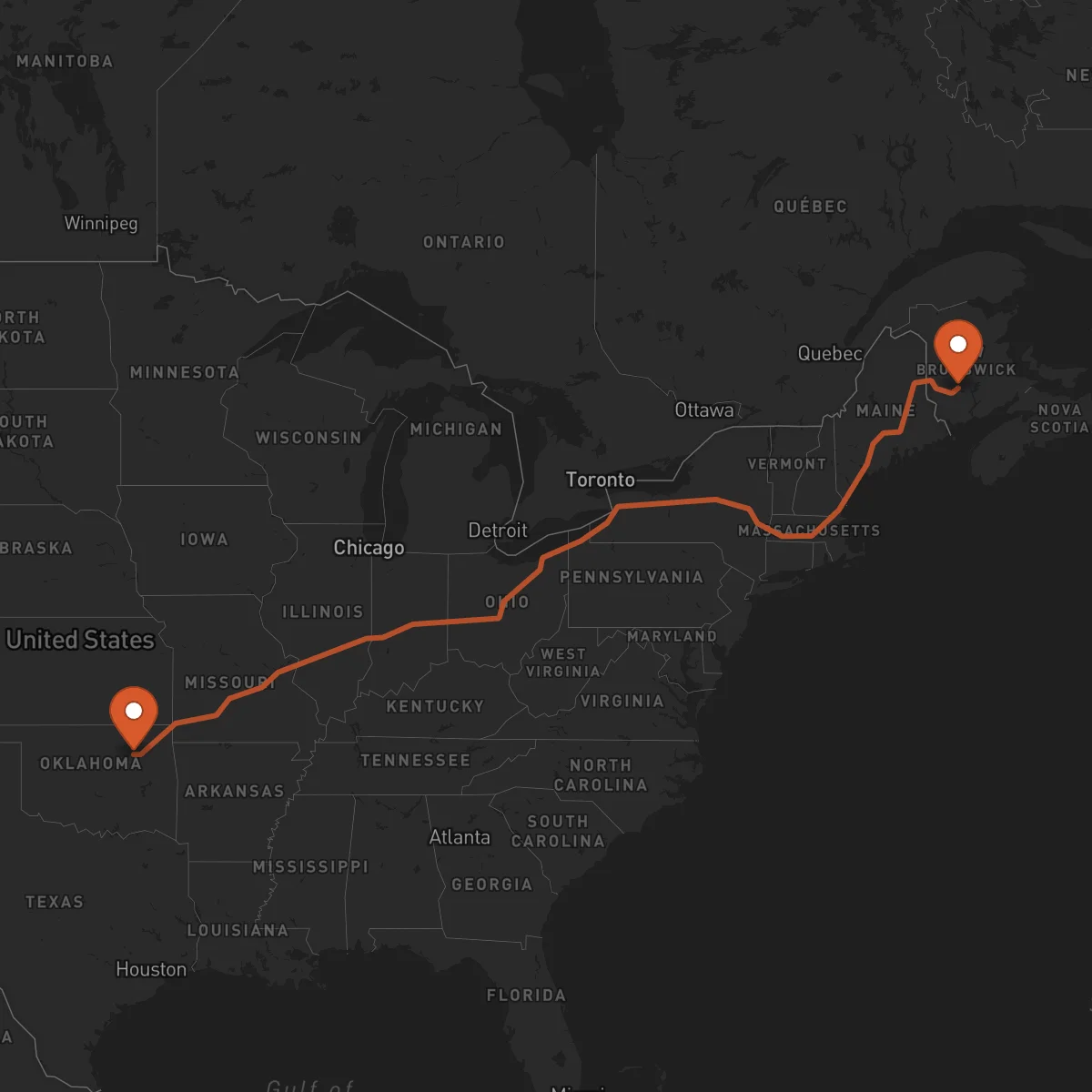
The Tulsa to Fredericton corridor represents a vital cross-border freight transportation route connecting the heart of Oklahoma's industrial base with New Brunswick's capital city. This 2,672 km journey traverses diverse terrain and crosses international borders, requiring expert logistics coordination. The corridor serves as a critical link between the manufacturing powerhouse of Tulsa and the growing distribution hubs in Atlantic Canada, facilitating the movement of goods between the United States and Canada.
The economic significance of this corridor extends beyond its geographical distance. Tulsa, known as the "Oil Capital of the World," serves as a major distribution center for energy-related equipment, automotive parts, and industrial machinery. Fredericton, as New Brunswick's capital, hosts government operations, educational institutions, and emerging technology sectors. The corridor enables seamless trade between these complementary economies, supporting industries such as aerospace, defense, and advanced manufacturing.
Key transportation infrastructure along this route includes Interstate 44, Interstate 70, and Interstate 89, connecting to Canadian Highway 2. The primary border crossing at Calais-St. Stephen facilitates efficient customs clearance for cross-border shipments. Control Terrestre's expertise in navigating cross-border regulations, customs documentation, and international shipping requirements ensures smooth operations along this corridor, minimizing delays and optimizing transit times for our clients.
Services for this Route
Available services for the corridor Tulsa - Fredericton
 Origin
Tulsa
Tulsa, Oklahoma stands as a strategic logistics hub in the central United States, offering exceptional connectivity to major markets across North America. The city's location provides access to three major interstate highways (I-44, I-35, and I-40) and two Class I railroads, creating a multimodal transportation network. Tulsa International Airport and the Tulsa Port of Catoosa on the McClellan-Kerr Arkansas River Navigation System further enhance its logistics capabilities.
The city's economy is anchored by the energy sector, aerospace, and manufacturing industries. Major employers include American Airlines, Williams Companies, and ONEOK, generating substantial freight volumes. The Tulsa Technology Center and proximity to the University of Tulsa ensure a skilled workforce for logistics operations. Tulsa's central location enables efficient distribution to both coasts within 48-72 hours, making it an ideal origin point for cross-border shipments to Canada.
 Destination
Fredericton
Fredericton, New Brunswick serves as a strategic logistics gateway to Atlantic Canada, offering unique advantages for freight distribution. Located along the Saint John River, the city provides access to both road and river transportation networks. The Trans-Canada Highway (Route 2) connects Fredericton to major Canadian markets, while the nearby Saint John port provides international shipping capabilities.
The city's economy is characterized by government services, education, and emerging technology sectors. The presence of the University of New Brunswick and government offices creates consistent freight demand for office supplies, technology equipment, and educational materials. Fredericton's growing tech sector, particularly in cybersecurity and software development, generates specialized freight needs. The city's location in the Atlantic Time Zone and proximity to the U.S. border make it an efficient distribution point for cross-border e-commerce and just-in-time inventory management.










