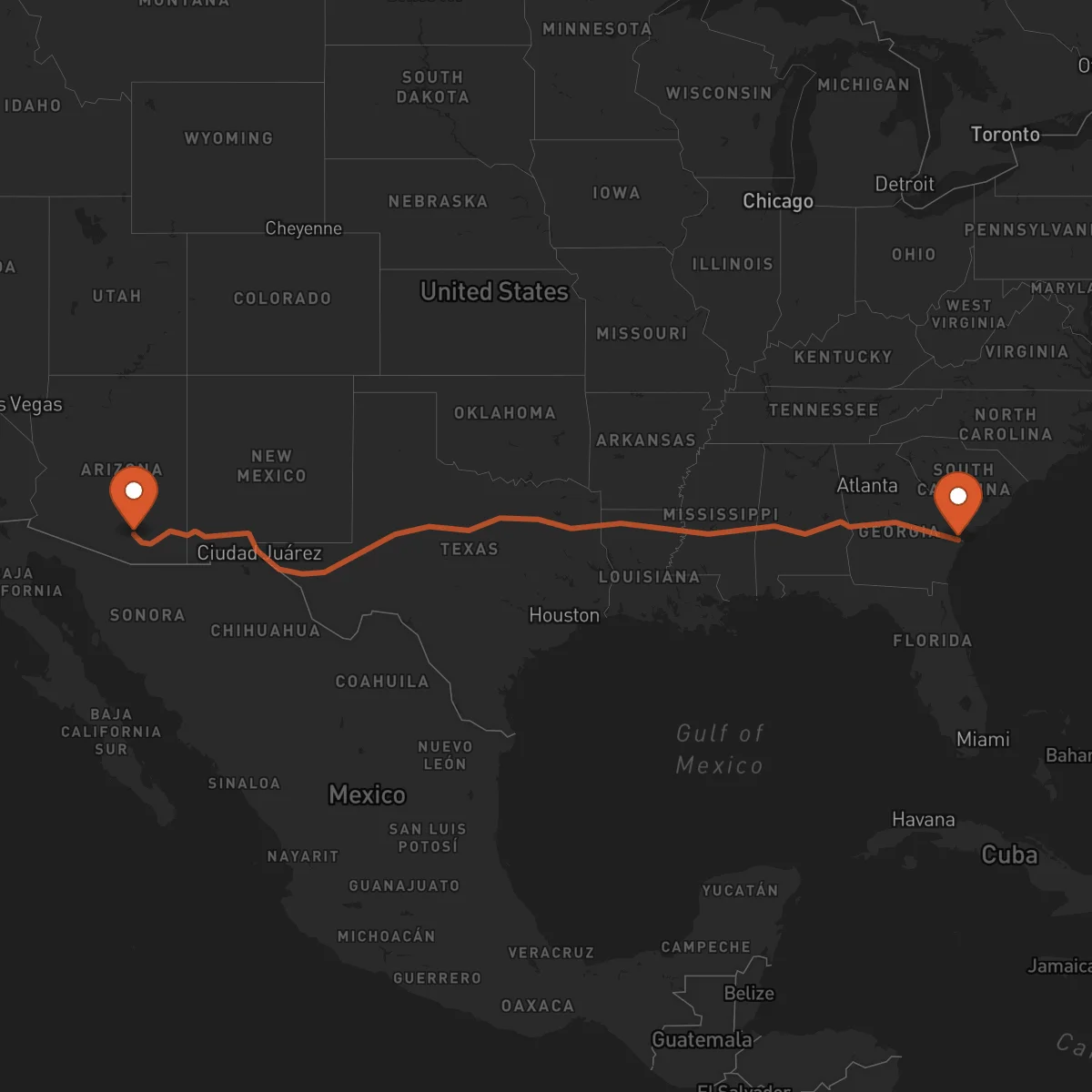
Tucson to Savannah
Savannah → TucsonFTL freight transportation service between Tucson and Savannah. Reliable logistics solutions for your business.
Route Description
Everything you need to know about the corridor Tucson - Savannah
The Tucson-Savannah corridor connects the dynamic Southwest with the strategic Southeast of the United States, spanning approximately 2,804 km across the country. This vital route links Arizona's industrial and commercial hub with Georgia's major port and logistics center, creating a critical artery for domestic freight movement between the Pacific and Atlantic regions.
The corridor serves as a crucial link in America's supply chain, facilitating the movement of goods between major economic zones. Tucson's strategic position near the Mexican border and Savannah's status as home to the fourth-largest container port in the United States make this route essential for both domestic distribution and international trade. The journey traverses diverse landscapes and industrial regions, connecting key manufacturing and distribution centers.
Primary industries utilizing this corridor include automotive, electronics, consumer goods, agricultural products, and industrial equipment. Manufacturing facilities in Arizona and the Southeast rely on this route for just-in-time deliveries, while the agricultural sector uses it for transporting seasonal produce and commodities. The electronics and technology sectors also depend on this corridor for moving components and finished products between production facilities and distribution centers.
Control Terrestre provides comprehensive FTL transportation solutions along this corridor, utilizing major highways including I-10 East and I-16 East. Our extensive network of certified carriers ensures reliable, efficient service with real-time tracking capabilities. We offer specialized equipment options including dry vans, refrigerated units, and flatbeds to accommodate various cargo types, ensuring your freight moves safely and efficiently from origin to destination.
Services for this Route
Available services for the corridor Tucson - Savannah
 Origin
Tucson
Tucson, Arizona serves as a strategic logistics hub in the Southwest, positioned advantageously near the Mexican border and major transportation routes. The city's location at the intersection of I-10 and I-19 provides excellent connectivity to both West Coast ports and inland markets. Tucson's transportation infrastructure includes the Tucson International Airport, extensive rail connections through Union Pacific and BNSF railways, and modern highway systems that facilitate efficient freight movement throughout the region.
The city's economy is diverse, with strong presence in aerospace and defense, optics and photonics, healthcare, and technology sectors. Major employers include Raytheon Missiles & Defense, University of Arizona, and various healthcare systems. The region's manufacturing sector produces electronics, aerospace components, and specialized industrial equipment. Tucson's proximity to the U.S.-Mexico border also makes it a crucial point for cross-border trade, with numerous maquiladoras and international logistics operations in the area.
 Destination
Savannah
Savannah, Georgia stands as one of America's most important logistics and transportation hubs, anchored by the Port of Savannah, which is the fourth-largest container port in the United States and the fastest-growing port in the country. The city's strategic location on the Atlantic coast provides direct access to international shipping routes, while its extensive inland port facilities and intermodal connections create a comprehensive logistics ecosystem.
The region's economy is heavily influenced by logistics, manufacturing, and tourism. Major industries include paper manufacturing, automotive assembly, aerospace, and food processing. The Port of Savannah handles over $100 billion in international trade annually, supported by major companies like Kia Motors, Gulfstream Aerospace, and International Paper. Savannah's logistics infrastructure includes the Garden City Terminal, multiple intermodal facilities, and excellent highway connectivity through I-16, I-95, and I-75, making it a crucial distribution point for the Southeast and beyond.










