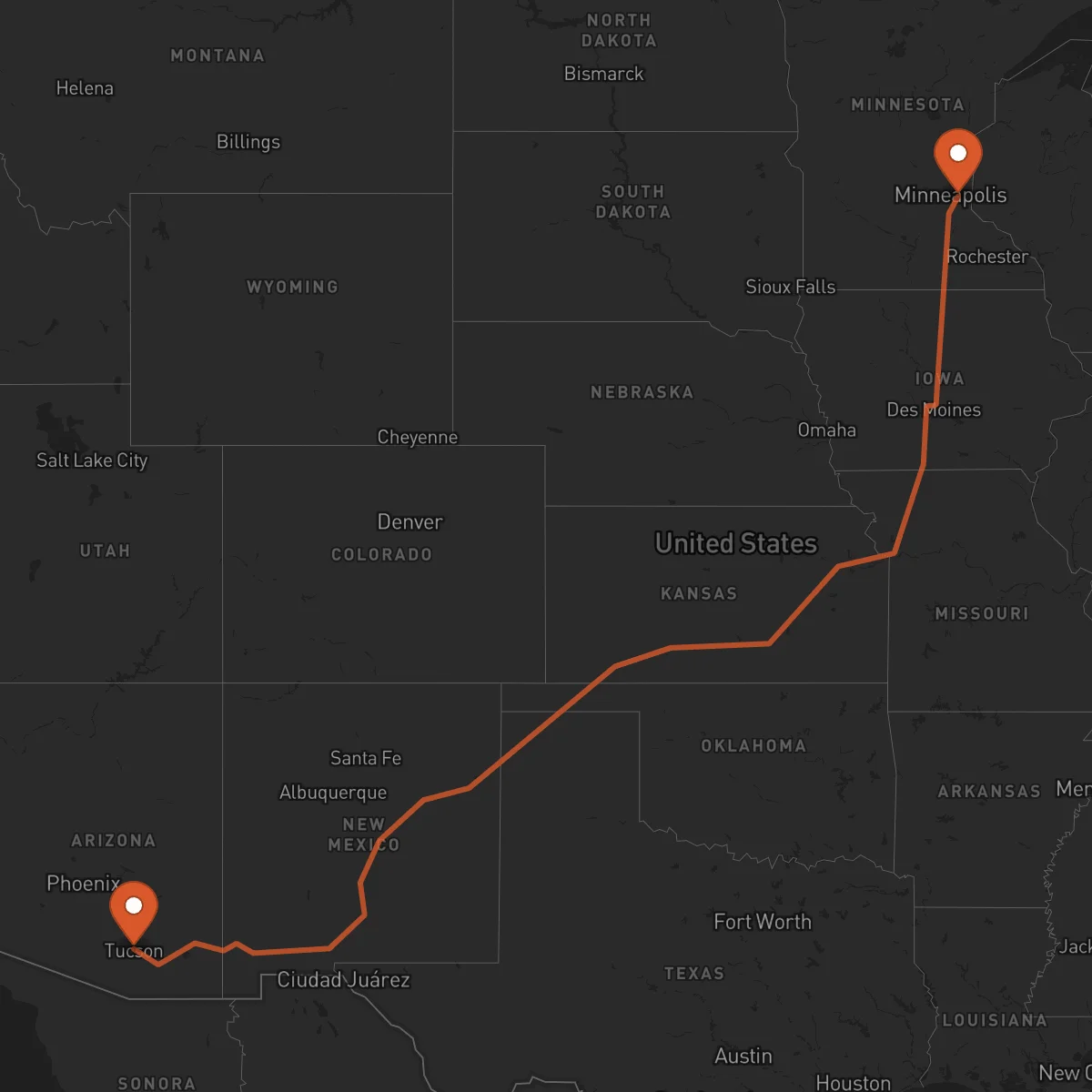
Tucson to Saint Paul
Saint Paul → TucsonFTL freight transportation service between Tucson and Saint Paul. Reliable logistics solutions for your business.
Route Description
Everything you need to know about the corridor Tucson - Saint Paul
The logistics corridor connecting Tucson, Arizona, to Saint Paul, Minnesota, represents a vital transportation link across the United States, spanning approximately 2,091 kilometers. This domestic corridor traverses diverse geographical and economic regions, facilitating the movement of goods between the Southwest and the Upper Midwest. The route's strategic importance lies in connecting the industrial and agricultural centers of the Sun Belt with the manufacturing and distribution hubs of the Midwest, enabling seamless supply chain operations across multiple states and economic zones.
The economic landscape along this corridor is characterized by a rich tapestry of industries. Tucson serves as a gateway to the Arizona-Sonora region, with strong ties to aerospace, defense, and technology sectors. As goods move northward, they pass through agricultural heartlands, manufacturing centers, and emerging tech corridors. Saint Paul, as part of the Minneapolis-Saint Paul metropolitan area, anchors the northern end of this corridor with its diverse economy spanning healthcare, finance, retail, and advanced manufacturing. The corridor facilitates the movement of everything from agricultural products and industrial equipment to high-tech components and consumer goods.
This transportation route primarily utilizes Interstate 35, a major north-south artery that provides reliable and efficient freight movement. The infrastructure supports various freight modes, though truck transportation remains the backbone of this corridor's logistics network. Control Terrestre leverages this established infrastructure to provide comprehensive FTL (Full Truckload) services, ensuring that cargo moves efficiently and securely between these two important economic centers. Our expertise in managing long-haul domestic transportation allows us to optimize routes, coordinate with our network of certified carriers, and provide real-time tracking and support throughout the journey.
Control Terrestre facilitates seamless operations on this corridor by offering dedicated FTL services with a focus on reliability and efficiency. Our strategic partnerships with C-TPAT-certified carriers ensure that shipments move through the supply chain with enhanced security and expedited processing. Whether transporting specialized cargo, temperature-sensitive goods, or standard freight, our team coordinates every aspect of the journey from origin to destination. We understand the unique challenges of this long-haul route and have developed processes to manage everything from route optimization to regulatory compliance, providing our clients with peace of mind and allowing them to focus on their core business operations.
Services for this Route
Available services for the corridor Tucson - Saint Paul
 Origin
Tucson
Tucson, Arizona, serves as a strategic logistics hub in the Southwest, offering unique advantages for freight transportation. Located in southern Arizona, Tucson provides access to major cross-border trade routes with Mexico and serves as a critical distribution point for the broader southwestern region. The city's proximity to the U.S.-Mexico border, combined with its position relative to major transportation arteries, makes it an ideal origin point for shipments heading north to the Midwest. Tucson's infrastructure includes the Tucson International Airport, the Union Pacific Railroad, and ready access to Interstate 10, which connects to I-35 for northbound freight movement.
The economic landscape of Tucson is diverse and growing, with key industries including aerospace and defense, technology, optics and photonics, and healthcare. The presence of major employers such as Raytheon, Honeywell Aerospace, and the University of Arizona creates a demand for specialized logistics services. Additionally, Tucson's role in the regional agricultural economy, particularly in winter produce, generates significant freight volume. The city's developing tech sector and its status as a logistics center for the Arizona-Sonora region further enhance its importance as an origin point for freight moving along the Tucson-Saint Paul corridor.
 Destination
Saint Paul
Saint Paul, Minnesota, stands as a vital logistics and economic center in the Upper Midwest, strategically positioned at the eastern edge of the Minneapolis-Saint Paul metropolitan area. The city's location on the Mississippi River, combined with its extensive transportation infrastructure, makes it an ideal destination for freight arriving from the Southwest. Saint Paul benefits from multiple interstate highways, including I-35, I-94, and I-494, providing excellent connectivity to regional and national markets. The city's logistics infrastructure includes the Saint Paul Downtown Airport, extensive rail connections through BNSF and Union Pacific, and the Port of Saint Paul, which offers barge transportation along the Mississippi River.
The economic profile of Saint Paul is characterized by diversity and strength, with major sectors including healthcare, financial services, retail, education, and manufacturing. The city is home to corporate headquarters and major operations for companies such as 3M, Ecolab, and Securian Financial, creating substantial demand for reliable freight services. Saint Paul's role as a distribution center for the Upper Midwest, combined with its proximity to Canada, enhances its strategic importance in the regional supply chain. The city's robust logistics ecosystem, including warehousing, distribution centers, and freight consolidation facilities, ensures that goods arriving from Tucson can be efficiently processed and distributed to their final destinations throughout the Midwest and beyond.










