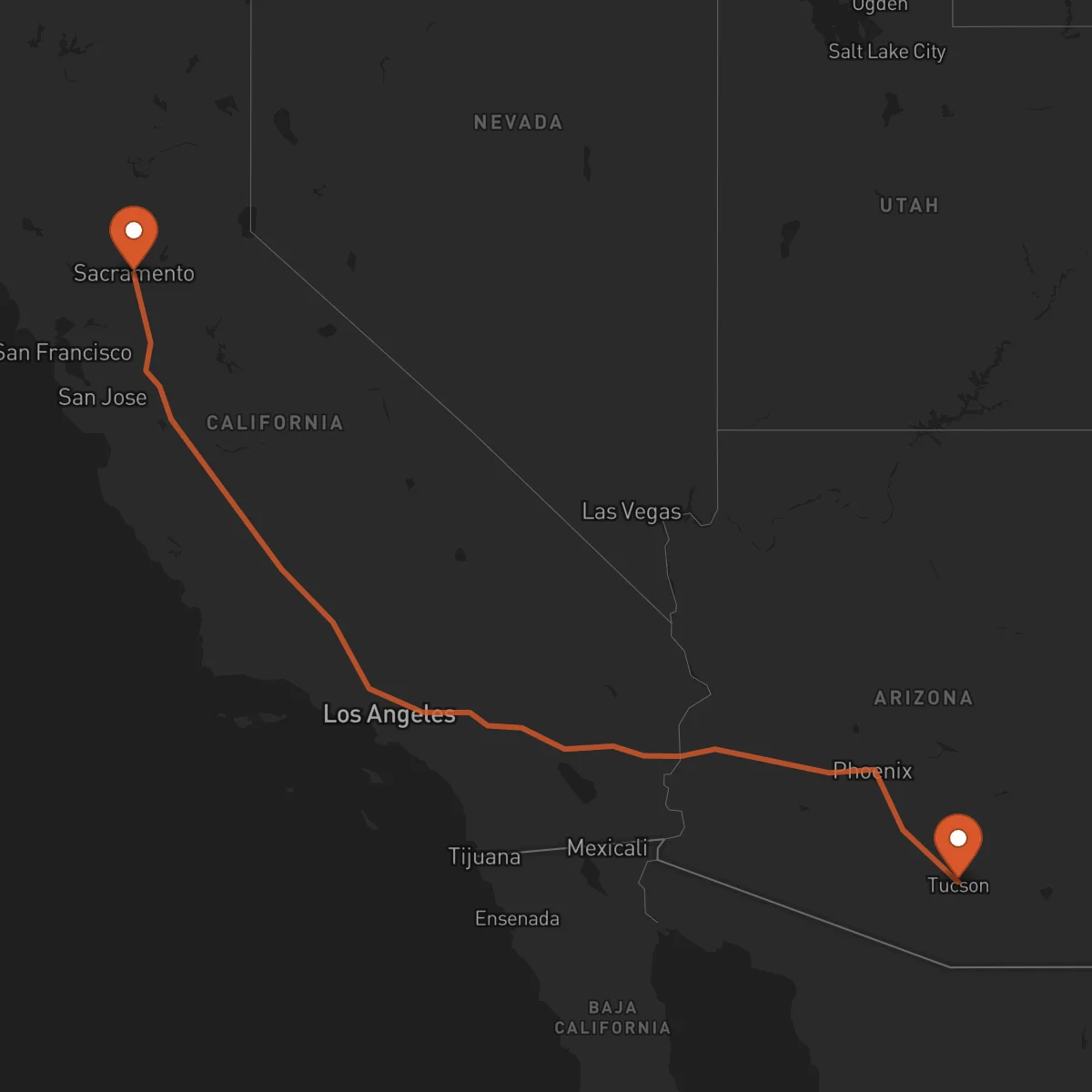
Tucson to Sacramento
Sacramento → TucsonFTL freight transportation service between Tucson and Sacramento. Reliable logistics solutions for your business.
Route Description
Everything you need to know about the corridor Tucson - Sacramento
The Tucson to Sacramento corridor is a vital logistics route connecting the dynamic markets of Arizona and California. Spanning approximately 1,183 kilometers, this domestic corridor serves as a crucial link for businesses seeking to optimize their supply chain operations between these two key economic hubs. The route traverses diverse landscapes, from the Sonoran Desert to the fertile valleys of California, offering unique opportunities for efficient freight transportation. Control Terrestre leverages this strategic corridor to provide seamless full truckload (FTL) services, ensuring timely and reliable delivery of goods across this important trade route.
The region surrounding this corridor is characterized by a robust industrial landscape. Tucson, known for its aerospace and defense industries, as well as its growing technology sector, generates significant freight volume. As goods move westward towards Sacramento, they pass through agricultural heartlands and manufacturing centers, reflecting the diverse economic activities along the route. Sacramento, as the capital of California, serves as a major distribution point for the state's agricultural products, technology goods, and manufactured items. This corridor is particularly crucial for industries such as agriculture, electronics, automotive, and consumer goods, which rely on efficient transportation to maintain their supply chains.
Transportation infrastructure along this route is well-developed, with major highways such as Interstate 10 and Interstate 5 forming the backbone of the corridor. These highways provide direct access to key urban centers and industrial zones, facilitating smooth movement of freight. Control Terrestre's extensive network of certified carriers and state-of-the-art equipment ensures that we can navigate this corridor efficiently, offering our clients flexible and reliable FTL solutions. Our expertise in handling various types of cargo, including specialized and oversized loads, makes us the ideal partner for businesses looking to optimize their logistics operations on this important route.
Services for this Route
Available services for the corridor Tucson - Sacramento
 Origin
Tucson
Tucson, Arizona, serves as a strategic origin point for logistics operations in the southwestern United States. Located in Pima County, Tucson is the second-largest city in Arizona and a major commercial and recreational hub for the region. Its proximity to the U.S.-Mexico border and its position along Interstate 10 make it an ideal gateway for cross-border trade and domestic distribution. Tucson's economy is diverse, with strong sectors in aerospace and defense, technology, healthcare, and education. The city is home to major employers such as Raytheon Missiles & Defense, the University of Arizona, and Davis-Monthan Air Force Base, all of which contribute to a robust industrial base and significant freight generation. Tucson's transportation infrastructure is well-developed, featuring a modern international airport, extensive highway networks, and a major Union Pacific rail yard, providing multiple options for freight movement and logistics operations.
 Destination
Sacramento
Sacramento, California, stands as a strategic destination for logistics operations in the western United States. As the capital city of California, Sacramento is not only a political center but also a major economic hub with a diverse industrial base. Located at the confluence of the Sacramento and American Rivers, the city has historically been a crucial transportation and distribution point. Today, Sacramento's economy is driven by sectors such as government, healthcare, technology, and agriculture. The city's proximity to major agricultural regions in California's Central Valley makes it a key distribution center for food products. Sacramento's transportation infrastructure is extensive, featuring a major international airport, a deep-water port connected via the Sacramento Deep Water Ship Channel, and a network of highways including Interstate 5 and Interstate 80. This multimodal transportation system, combined with the city's strategic location, makes Sacramento an ideal destination for freight distribution throughout Northern California and beyond.










