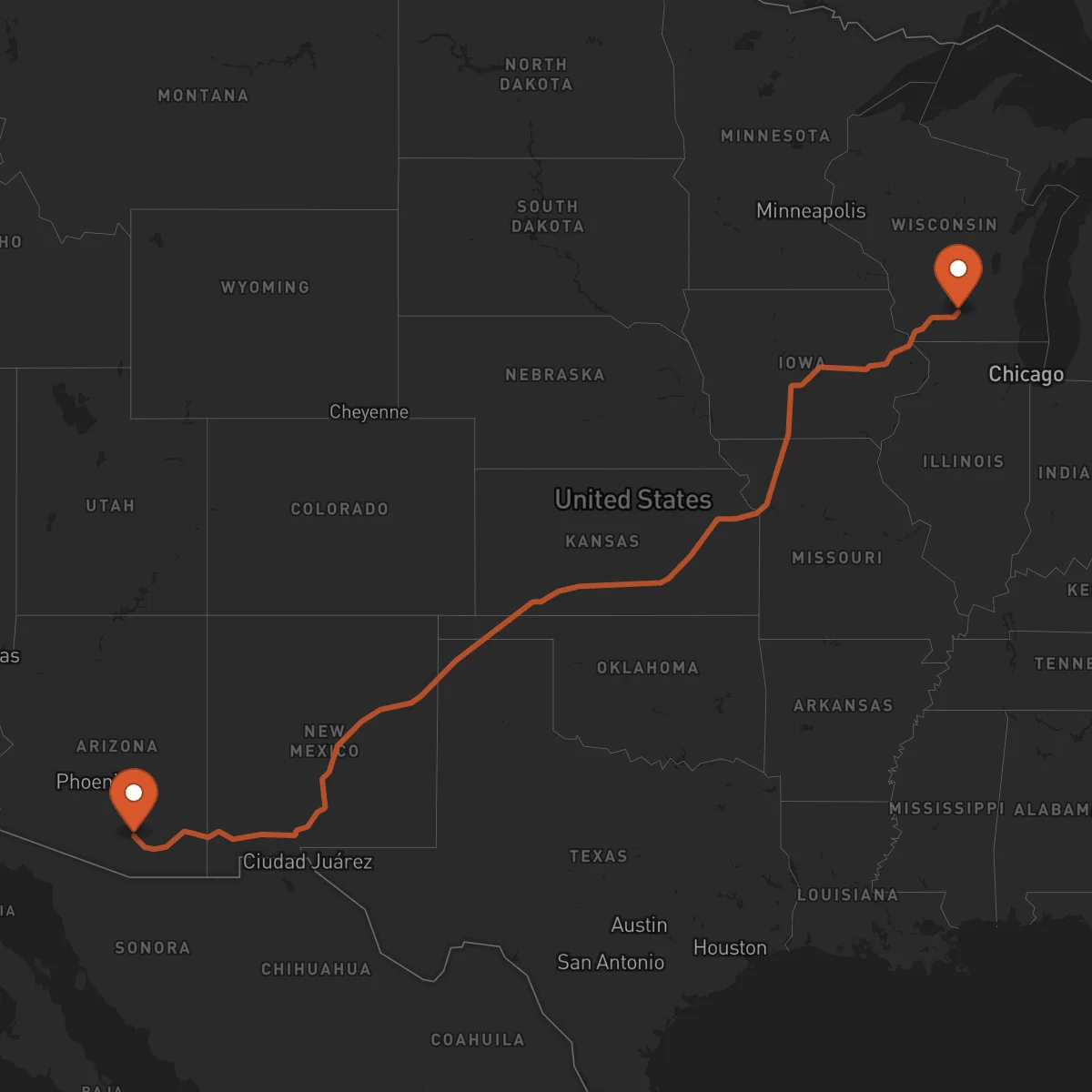
Tucson to Madison
Madison → TucsonFTL freight transportation service between Tucson and Madison. Reliable logistics solutions for your business.
Route Description
Everything you need to know about the corridor Tucson - Madison
The Tucson to Madison corridor represents a vital freight transportation route connecting the Southwest to the Midwest of the United States. This extensive 2,238-kilometer journey traverses diverse landscapes and crosses multiple states, serving as a critical link in the national supply chain network. The route facilitates the movement of goods between the growing industrial centers of Arizona and the established manufacturing hubs of Wisconsin, supporting economic growth and trade across the country.
The economic significance of this corridor is underscored by the complementary industrial strengths of both regions. Tucson's proximity to the Mexican border and its position in the Sun Corridor economic region creates unique cross-border trade opportunities, while Madison's location in the heart of the Midwest positions it as a gateway to the Great Lakes and Northeast markets. This corridor enables businesses to leverage the manufacturing capabilities of the Midwest with the distribution networks and international trade access of the Southwest.
Major industries utilizing this corridor include automotive parts, electronics, agricultural products, and industrial machinery. The route primarily follows Interstate 10 and Interstate 39, providing reliable and efficient transportation infrastructure. Control Terrestre's specialized FTL services ensure that your cargo moves seamlessly from origin to destination, with dedicated equipment and experienced carriers who understand the unique requirements of this important trade route.
Services for this Route
Available services for the corridor Tucson - Madison
 Origin
Tucson
Tucson, Arizona serves as a strategic logistics hub in the Southwest, offering exceptional connectivity for freight transportation. Located just 100 kilometers from the Mexican border, Tucson provides direct access to cross-border trade opportunities and serves as a critical node in the Sun Corridor economic region. The city's transportation infrastructure includes major highways such as I-10, which connects to Los Angeles to the west and Phoenix to the north, as well as direct rail connections through Union Pacific and BNSF railways. Tucson's international airport and proximity to the Port of Guaymas in Mexico further enhance its position as a multimodal logistics center.
The region's economy is diverse, with strong sectors in aerospace and defense, optics and photonics, healthcare, and technology. Tucson is home to major employers such as Raytheon Missiles & Defense, the University of Arizona, and numerous manufacturing facilities. The area's growing industrial base creates consistent demand for reliable freight transportation services, particularly for time-sensitive and high-value cargo moving to markets across the United States.
 Destination
Madison
Madison, Wisconsin stands as a premier logistics destination in the Midwest, strategically positioned at the intersection of major transportation networks. Located approximately 130 kilometers west of Milwaukee and 230 kilometers northwest of Chicago, Madison provides excellent access to the Great Lakes region and the broader Midwest market. The city benefits from proximity to major highways including I-39, I-90, and I-94, creating efficient north-south and east-west freight corridors. Additionally, Madison is served by the Wisconsin and Southern Railroad, offering intermodal connectivity for seamless cargo movement.
The Madison metropolitan area boasts a robust and diverse economy, with particular strengths in manufacturing, healthcare, education, and technology. Major industries include precision manufacturing, biotechnology, information technology, and agricultural processing. The presence of the University of Wisconsin-Madison drives innovation and research, while companies such as Epic Systems, American Family Insurance, and numerous manufacturing firms create substantial freight movement requirements. This economic diversity ensures consistent demand for reliable FTL transportation services connecting Madison to markets throughout the United States.










