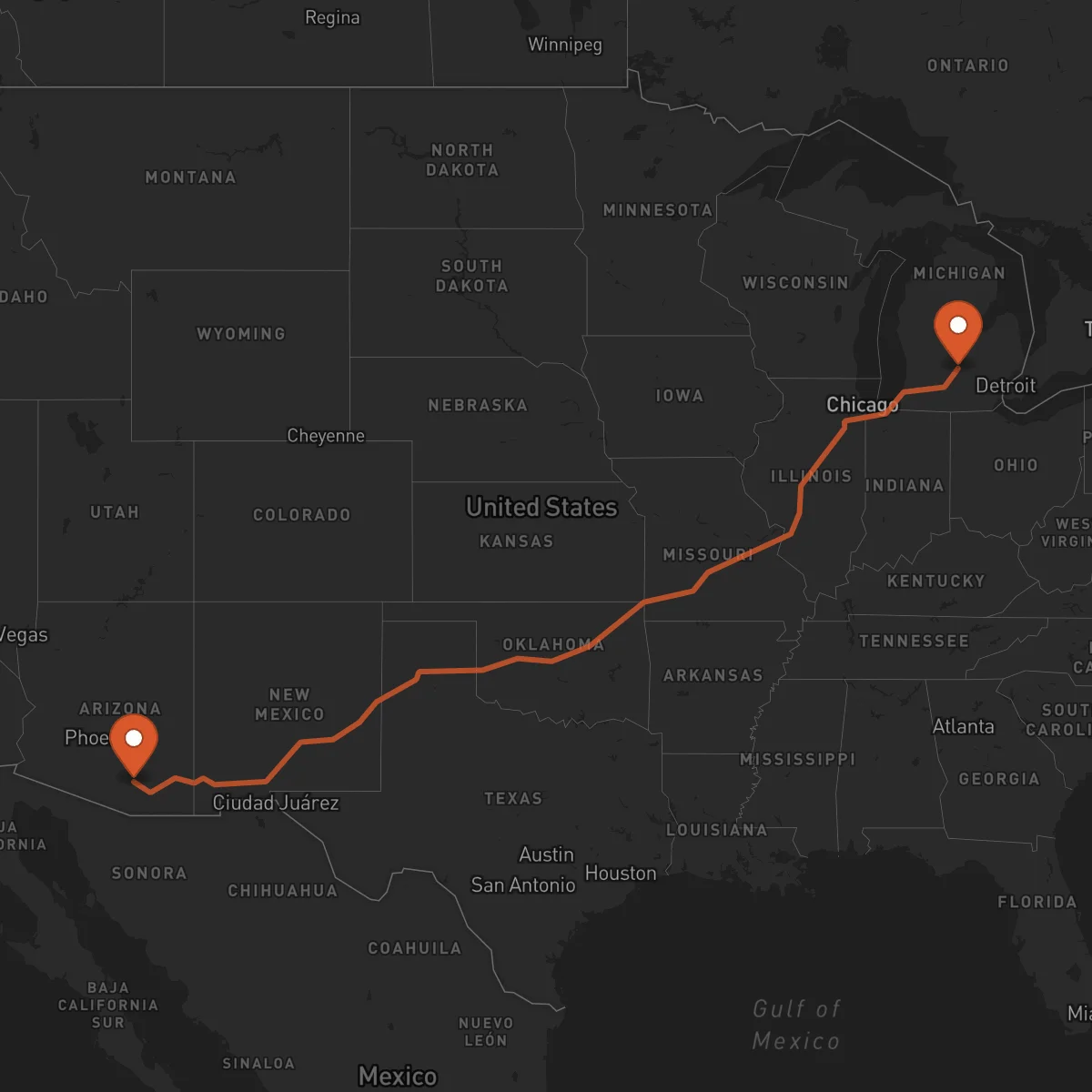
Tucson to Lansing
Lansing → TucsonFTL freight transportation service between Tucson and Lansing. Reliable logistics solutions for your business.
Route Description
Everything you need to know about the corridor Tucson - Lansing
The Tucson to Lansing corridor represents a vital transportation link connecting the southwestern United States with the industrial heartland of Michigan. This domestic route spans approximately 2,591 kilometers, traversing diverse terrain and crossing multiple states including Arizona, New Mexico, Colorado, Nebraska, Iowa, Illinois, and Michigan. The corridor serves as a critical artery for freight movement between the growing logistics hub of Tucson and the manufacturing powerhouse of Lansing, facilitating the flow of goods that power both regional and national economies.
The economic significance of this corridor is underscored by the complementary industrial strengths of its origin and destination points. Tucson has emerged as a major logistics and distribution center, leveraging its strategic border proximity and extensive transportation infrastructure. Meanwhile, Lansing stands as a cornerstone of American manufacturing, particularly renowned for its automotive industry presence with major facilities operated by General Motors and its suppliers. This creates a dynamic trade relationship where raw materials, components, and finished goods flow in both directions along this crucial route.
Key industries utilizing this corridor include automotive manufacturing and parts distribution, electronics, aerospace components, agricultural products, and general manufacturing supplies. The route primarily follows major interstate highways including I-10, I-25, I-76, I-80, I-39, and I-96, providing reliable and efficient transportation infrastructure. Control Terrestre enhances this corridor's effectiveness through our specialized full truckload services, offering dedicated equipment options ranging from standard dry vans to specialized trailers for oversized or temperature-sensitive cargo. Our extensive network of certified carriers and real-time tracking capabilities ensure seamless freight movement across this important domestic trade route.
Services for this Route
Available services for the corridor Tucson - Lansing
 Origin
Tucson
Tucson, Arizona serves as a strategic logistics gateway in the southwestern United States, offering exceptional connectivity for freight transportation. Located just 96 kilometers from the U.S.-Mexico border, Tucson provides seamless access to international trade routes while maintaining robust domestic distribution capabilities. The city's economy is anchored by aerospace and defense industries, with major employers including Raytheon Missiles & Defense and Bombardier Aerospace, alongside a growing technology sector and significant agricultural exports including winter vegetables and livestock products. Tucson's transportation infrastructure is notably comprehensive, featuring the Tucson International Airport with dedicated cargo facilities, the Union Pacific Railroad intermodal yard, and direct access to Interstate 10, which provides east-west connectivity across the southern United States. The city's multimodal capabilities, combined with its proximity to major border crossings, make it an ideal origin point for freight shipments requiring both domestic and cross-border logistics solutions.
 Destination
Lansing
Lansing, Michigan stands as a critical logistics hub in the American Midwest, strategically positioned to serve the nation's manufacturing heartland. As the state capital and a major center for automotive production, Lansing offers unparalleled access to one of the most concentrated industrial regions in North America. The city's economy is dominated by the automotive sector, with General Motors operating multiple facilities in the area and supporting a vast network of automotive suppliers and related industries. Lansing's transportation infrastructure is exceptionally well-developed, featuring direct access to Interstate 96 for east-west movement, proximity to major rail corridors operated by CSX and Norfolk Southern, and the Capital Region International Airport with cargo handling capabilities. The convergence of major highways including I-69, I-496, and US-127 creates a robust network for efficient freight distribution throughout the Midwest and beyond. This strategic positioning, combined with the region's manufacturing density, makes Lansing an essential destination for full truckload freight movements requiring reliable access to America's industrial core.










