Tucson to Chicago
Chicago → TucsonFTL freight transportation service between Tucson and Chicago. Reliable logistics solutions for your business.
Route Description
Everything you need to know about the corridor Tucson - Chicago
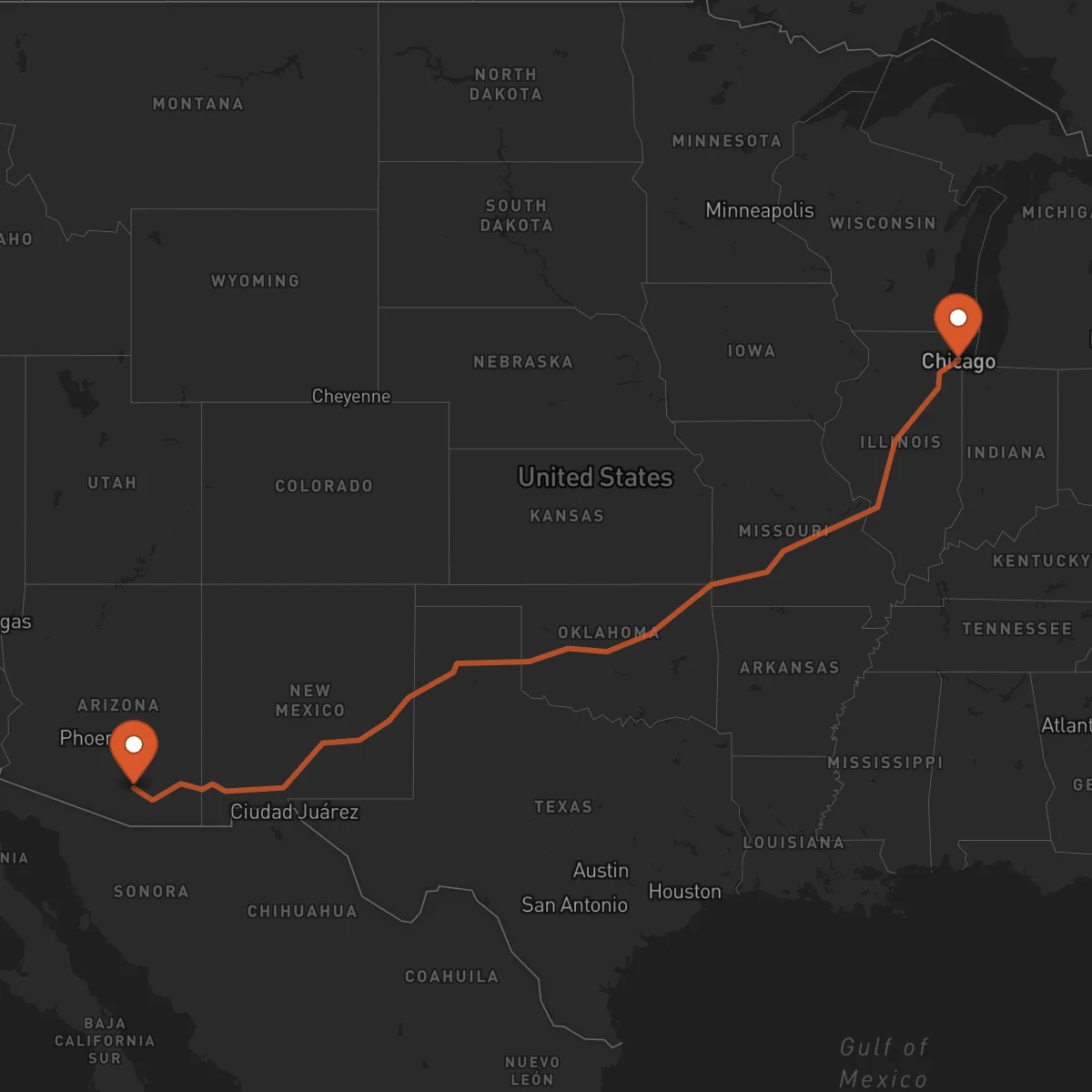
The logistics corridor between Tucson, Arizona, and Chicago, Illinois, represents one of the most critical transportation routes in the United States, connecting the southwestern region with the industrial heartland of the Midwest. This 2,321-kilometer route traverses diverse landscapes and crosses multiple states, serving as a vital link for commerce between the Sun Belt and the Great Lakes region.
The corridor follows major interstate highways, primarily I-10 and I-55, creating a direct north-south connection that facilitates the movement of goods from the growing markets of the Southwest to the manufacturing and distribution centers of the Midwest. This strategic route enables efficient transportation of goods between two economically dynamic regions, supporting the supply chain needs of businesses across multiple industries.
This corridor is particularly important for industries such as automotive, manufacturing, electronics, and consumer goods. Tucson's proximity to the Mexican border and its role as a logistics hub for the Southwest makes it a key origin point for cross-border trade, while Chicago's position as a major transportation and distribution center in the Midwest makes it a crucial destination for goods destined to the broader North American market.
Control Terrestre leverages this corridor through our extensive network of strategic transportation providers, offering full truckload (FTL) services that ensure your cargo moves efficiently and securely from Tucson to Chicago. Our specialized equipment and experienced carriers are positioned along this route to provide reliable, on-time delivery for your freight transportation needs.
Services for this Route
Available services for the corridor Tucson - Chicago
 Origin
Tucson
Tucson, Arizona, serves as a strategic logistics hub in the southwestern United States, benefiting from its proximity to the Mexican border and its location along major transportation corridors. The city's position as a gateway to cross-border trade makes it an ideal origin point for freight moving north to the Midwest. Tucson's economy is diverse, with strong sectors in aerospace and defense, optics and photonics, technology, and healthcare. The city's transportation infrastructure includes major highways such as I-10, which runs east-west across the southern United States, and connections to rail networks that facilitate multimodal transportation solutions.
 Destination
Chicago
Chicago, Illinois, stands as one of the most important logistics and transportation hubs in North America, often referred to as the 'transportation capital of the United States.' The city's strategic location in the Midwest, at the intersection of major rail lines and highways, makes it a critical distribution center for goods moving throughout the country. Chicago's economy is anchored by manufacturing, finance, technology, and professional services. The city boasts an extensive transportation infrastructure, including O'Hare International Airport (one of the busiest in the world), multiple interstate highways (I-55, I-90, I-94), and one of the largest rail freight networks in the nation, making it an ideal destination for freight consolidation and distribution.










