Toronto to San Diego
San Diego → TorontoFTL freight transportation service between Toronto and San Diego. Reliable logistics solutions for your business.
Route Description
Everything you need to know about the corridor Toronto - San Diego
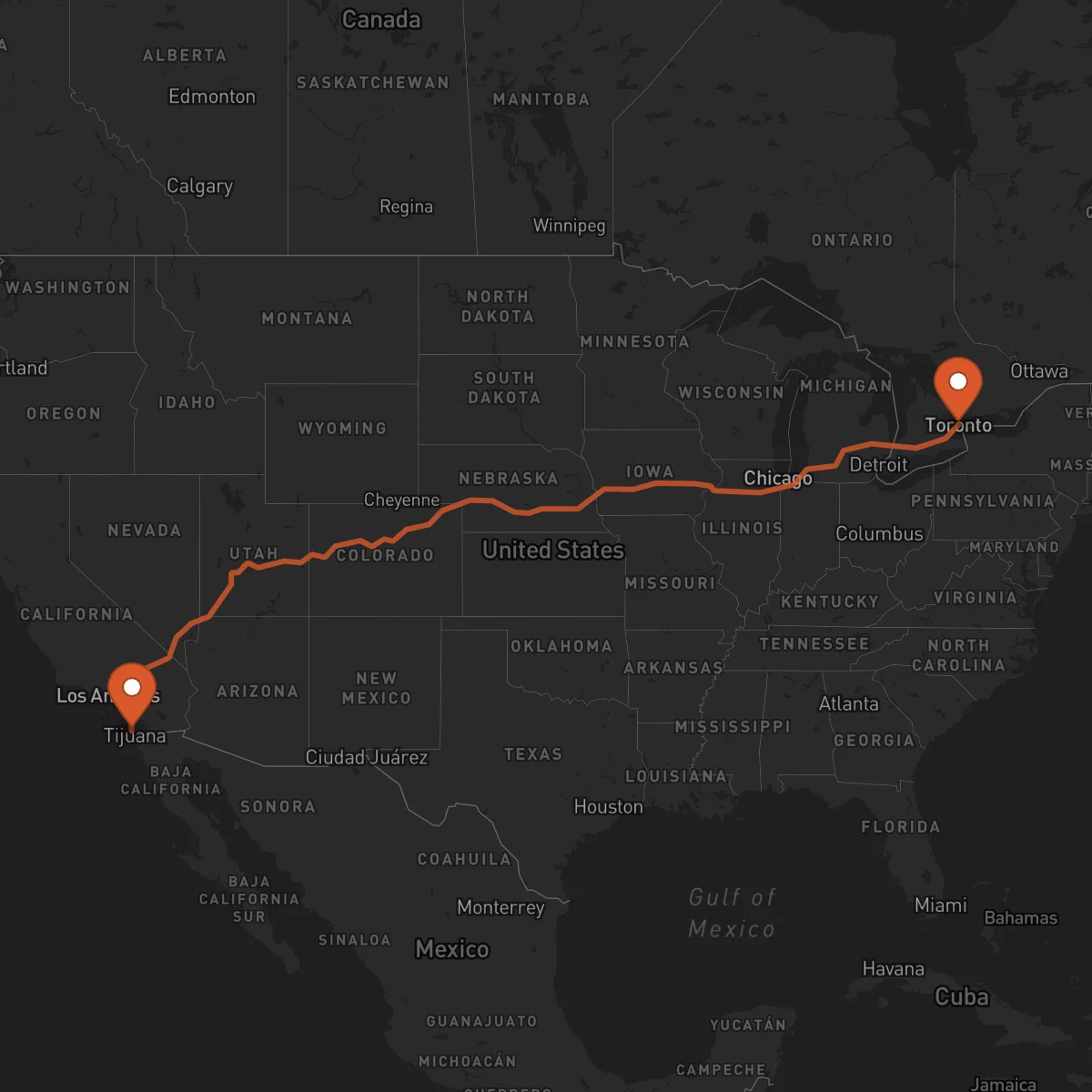
The Toronto-San Diego corridor represents a vital cross-border freight transportation route connecting Canada's economic powerhouse with one of California's most dynamic ports. This 3,483 km route traverses the North American heartland, linking the Great Lakes industrial region with the Pacific Southwest's thriving logistics hub. The corridor serves as a critical supply chain artery for companies operating between Canada, the United States, and international markets.
This route passes through major industrial centers including Detroit, Chicago, and Los Angeles, connecting diverse economic regions. The corridor's strategic importance is amplified by San Diego's proximity to the US-Mexico border and its role as a gateway for trans-Pacific trade. Companies utilizing this corridor benefit from access to Toronto's manufacturing base, Chicago's distribution networks, and San Diego's international trade facilities.
Key industries served include automotive, electronics, pharmaceuticals, and consumer goods. The route primarily utilizes Interstate 90 and Interstate 15, with major border crossings at Detroit-Windsor and other strategic points. Control Terrestre's expertise in cross-border operations ensures seamless customs clearance and efficient transit through all jurisdictions. Our C-TPAT-certified partners and dedicated teams handle all documentation requirements, minimizing delays and ensuring compliance with both US and Canadian regulations.
Services for this Route
Available services for the corridor Toronto - San Diego
 Origin
Toronto serves as a strategic logistics hub in Canada's most populous province, Ontario. The city's location on Lake Ontario provides access to both road and water transportation networks, while its proximity to the US border facilitates efficient cross-border operations. Toronto's extensive transportation infrastructure includes major highways (401, 400, 407), Pearson International Airport, and the Port of Toronto, creating multiple options for freight movement.
The Greater Toronto Area (GTA) is Canada's financial and manufacturing center, hosting diverse industries including automotive, aerospace, technology, and food processing. The region's robust industrial base generates consistent freight volumes, particularly in automotive parts, consumer electronics, and industrial equipment. Toronto's economic diversity and manufacturing capabilities make it an ideal origin point for full truckload shipments requiring reliable, time-sensitive delivery.
 Destination
San Diego
San Diego's strategic location on the US-Mexico border and Pacific coast establishes it as a critical logistics gateway. The city's proximity to the US-Mexico border crossing at Otay Mesa provides immediate access to major transportation corridors connecting to Mexico and the southwestern United States. San Diego International Airport and the Port of San Diego complement the region's extensive highway network, including I-5 and I-805.
The region's economy centers on international trade, military operations, biotechnology, and tourism. San Diego's border location makes it a key entry point for cross-border freight, particularly for industries requiring specialized handling such as medical devices, electronics, and perishable goods. The city's infrastructure supports efficient distribution throughout Southern California and connects seamlessly with major markets in Los Angeles, Phoenix, and Las Vegas.










